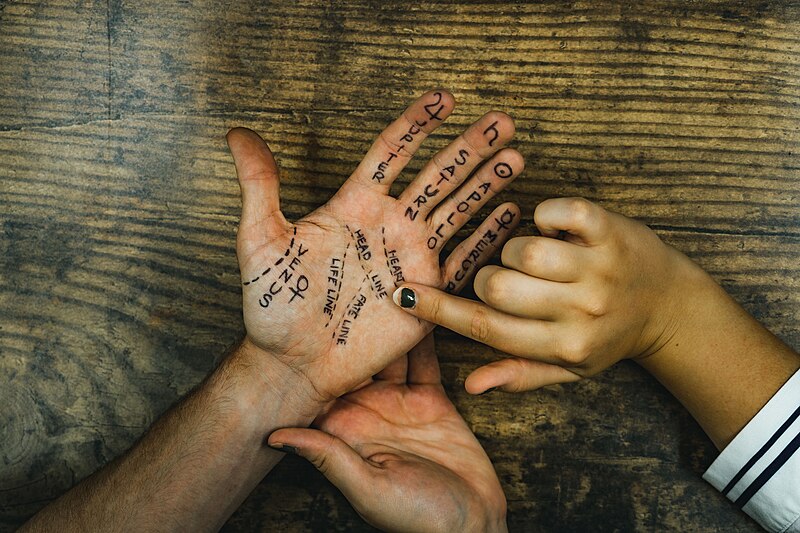
File:Palm_Readings.jpg · Wikimedia Commons · See Wikimedia Commons
palmistry
Sign in to saveAlso known as chiromancy, palm reading, cheiromancy, chirology, hand analysis, chironomy, chirognomy, line reading
thumb|upright=1.25|A fortune-telling|fortune-teller conducting a palm reading, with lines and mounts marked out on the person's left palm thumb|Gold stamped front cover of The Psychonomy of the Hand
Palmistry is the practice of interpreting the lines and mounts on a person's hand to tell fortunes or reveal information about their character and future. While some people consult palmists for entertainment or insight, it lacks scientific evidence supporting its predictive claims.
AI-generated from the Wikipedia summary — may contain errors.
Wikidata facts
- Instance of
- occupation
- Subclass of
- divination
- Image
- Pietro della Vecchia - A Fortune Teller Reading a Soldier's Palm.jpg
Show 4 more facts
- P8168
- Impact
- Commons category
- Chiromancy
- topic's main category
- Category:Chiromancy
- uses
- palm
Sources (2)
via Wikidata · CC0
~8 min read
Encyclopedic overview
9 sectionsContents
- History
- Ancient palmistry
- Modern palmistry
- Relationship between Palmistry and Dermatoglyphics
- Criticism
- See also
- References
- Further reading
- External links
thumb|upright=1.25|A fortune-telling|fortune-teller conducting a palm reading, with lines and mounts marked out on the person's left palm thumb|Gold stamped front cover of The Psychonomy of the Hand
Palmistry is the pseudoscientific practice of fortune-telling through the study of the palm. Also known as palm reading, chiromancy, chirology or cheirology, the practice is found all over the world, with numerous cultural variations. Those who practice palmistry are generally called palmists, palm readers, hand readers, hand analysts, or chirologists.
Excerpted from Wikipedia’s “palmistry” article, available under the CC BY-SA 4.0 licence.
Gallery (20)
Available in 67 languages
- Español
- Français
- Deutsch
- 中文
- 日本語
- Русский
- Português
- Italiano
- العربية
- हिन्दी
- Afrikaans
- Albanian
- Armenian
- Azerbaijani
- Bahasa Indonesia
- Basque
- Belarusian
- Breton
Show 48 more
- Bulgarian
- Burmese
- Catalan
- Croatian
- Czech
- Danish
- Esperanto
- Estonian
- Finnish
- Georgian
- Greek
- Haitian Creole
- Hebrew
- Hungarian
- Icelandic
- Irish
- Kannada
- Kazakh
- Latvian
- Lithuanian
- Macedonian
- Malayalam
- Mongolian
- Nederlands
- Norwegian
- Polski
- Romanian
- Scottish Gaelic
- Serbian
- Serbian (Latin)
- simple
- Sinhala
- Slovak
- Slovenian
- Svenska
- Tamil
- Tatar
- Tiếng Việt
- Türkçe
- Ukrainian
- Urdu
- Western Panjabi
- Wu Chinese
- Yakut
- Yiddish
- zh_yue
- فارسی
- 한국어
via Wikidata sitelinks · CC0