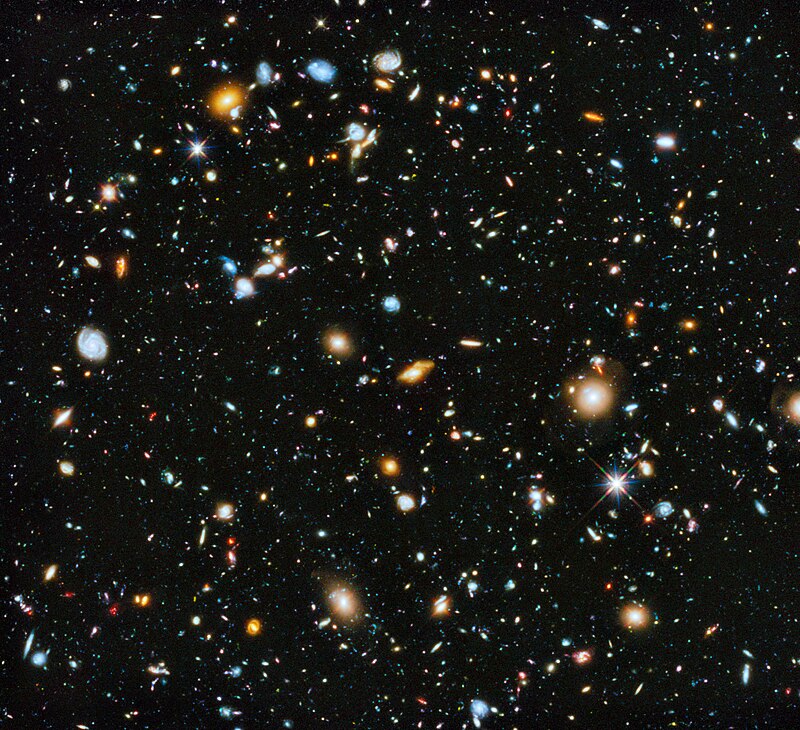
File:NASA-HS201427a-HubbleUltraDeepField2014-20140603.jpg · Wikimedia Commons · See Wikimedia Commons
pantheism
Sign in to savePantheism refers to a diverse family of philosophical and religious beliefs, that equate reality with divinity. Pantheistic concepts date back thousands of years, and pantheistic elements have been identified in diverse religious traditions, such as Christianity. Most notably, pantheism refers to the belief that the totality of being—called by various names Nature, universe, cosmos—is a self-organizing unity that needs no distinct creator, and can be met with the same sense of reveration and awe as theists attribute to their gods.
Pantheism is a diverse set of beliefs that identify reality itself—the universe or nature as a whole—with divinity, rather than seeing God as separate from creation. This perspective, which appears in various religious traditions throughout history, offers an alternative to traditional theism by suggesting that the cosmos is a self-organizing unity worthy of the reverence and awe that believers typically direct toward a distinct god.
AI-generated from the Wikipedia summary — may contain errors.
Wikidata facts
- Subclass of
- theism
Show 4 more facts
- Commons category
- Pantheism
- topic's main category
- Category:Pantheism
- on focus list of Wikimedia project
- Wikipedia:Vital articles/Level/4
- has list
- list of pantheists
Sources (2)
via Wikidata · CC0
~25 min read
Encyclopedic overview
29 sectionsContents
- Etymology
- Definitions
- History
- Pre-modern times
- Baruch Spinoza
- 18th century
- 19th century
- Growing influence
- Comparison with non-Christian religions
- 20th century
- 21st century
- Categorizations
- Degree of determinism
- Degree of belief
- Form of monism
- Other
- Demographics
- Prevalence
- Age, ethnicity, and gender
- Related concepts
- Pantheism in religion
- Traditional religions
- Spirituality and new religious movements
- See also
- Notes
- References
- Sources
- Further reading
- External links
Pantheism refers to a diverse family of philosophical and religious beliefs, that equate reality with divinity. Pantheistic concepts date back thousands of years, and pantheistic elements have been identified in diverse religious traditions, such as Christianity. Most notably, pantheism refers to the belief that the totality of being—called by various names Nature, universe, cosmos—is a self-organizing unity that needs no distinct creator, and can be met with the same sense of reveration and awe as theists attribute to their gods.
Pantheism is not to be confused with the panentheism, which maintains divinity as an entity greater than the universe out of which the universe arises.
Excerpted from Wikipedia’s “pantheism” article, available under the CC BY-SA 4.0 licence.
Gallery (18)
Available in 85 languages
- Español
- Français
- Deutsch
- 中文
- 日本語
- Русский
- Português
- Italiano
- العربية
- हिन्दी
- Afrikaans
- Albanian
- Armenian
- Asturian
- azb
- Azerbaijani
- Bahasa Indonesia
- Balinese
Show 66 more
- Bangla
- Basque
- bat_smg
- Belarusian
- Bulgarian
- Catalan
- Central Kurdish
- Croatian
- Czech
- Danish
- Esperanto
- Estonian
- Filipino
- Finnish
- Galician
- gcr
- Georgian
- Greek
- Hebrew
- Hungarian
- Icelandic
- Ido
- Interlingua
- Jamaican Creole English
- Kazakh
- Kyrgyz
- Latin
- Latvian
- Lingua Franca Nova
- Lithuanian
- Luxembourgish
- Macedonian
- Malagasy
- Malay
- Mirandese
- Neapolitan
- Nederlands
- Newari
- Norwegian
- Norwegian Nynorsk
- Polski
- Romanian
- Rusyn
- Serbian
- Serbian (Latin)
- Silesian
- simple
- Slovak
- Slovenian
- Svenska
- Tamil
- Tiếng Việt
- Toki Pona
- Türkçe
- Tuvinian
- Ukrainian
- Urdu
- Uzbek
- Welsh
- Western Frisian
- Wu Chinese
- Yiddish
- zh_yue
- فارسی
- ไทย
- 한국어
via Wikidata sitelinks · CC0