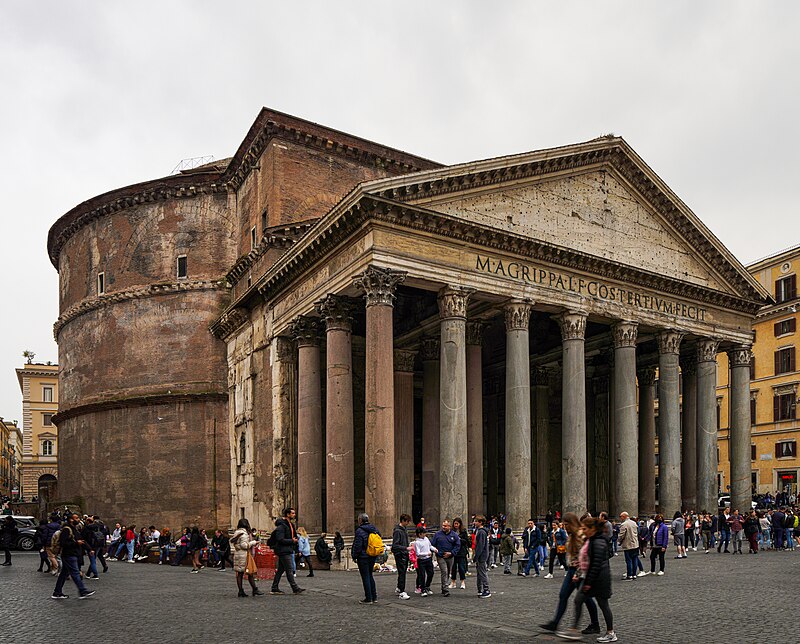
File:Pantheon_(Rome)_-_Right_side_and_front.jpg · Wikimedia Commons · See Wikimedia Commons
Pantheon
Sign in to saveAlso known as Pantheon (Rome, Italy), Santa Maria ad Martyres, Basilica of Our Lady of the Martyrs, Basilica of Santa Maria ad Martyres, Basilica of Santa Maria, church of Santa Maria ad Martyres
ancient Roman temple in Rome, Italy
The Pantheon is an ancient Roman temple in Rome that was built over 1,900 years ago and remains one of the best-preserved buildings from that era. It matters because it demonstrates remarkable Roman engineering and architectural achievement, particularly in its innovative design and massive concrete dome, and it continues to influence how architects and historians understand classical construction techniques.
AI-generated from the Wikipedia summary — may contain errors.
Described at

Chiesa di Santa Maria ad Martyres — LodView
dati.beniculturali.it →Link to a page describing this subject · 980 chars · not written by Vinony
Wikidata facts
- Area
- 1500
- Employees
- 3
- Official website
- www.pmlaz.beniculturali.it
- Image
- Pantheon (Rome) - Right side and front.jpg
- Height
- 43.3
- Width
- 54.5
- Length
- 35
Show 16 more facts
- Commons category
- Pantheon (Rome)
- Commons gallery
- Pantheon
- inception
- 0128-00-00
- visitors per year
- 4926809
- street address
- Piazza Della Rotonda, Roma
- Commons Institution page
- Pantheon, Rome
- postal code
- 00186
- phone number
- +39-06-6830-0230
- email address
- mailto:[email protected]
- fee
- 0
- number of volunteers
- 16
- collection or exhibition size
- 50
- name
- Ritonda de Rome
- native label
- Pantheon
- IIIF manifest URL
- gn.biblhertz.it/fotothek/api/iiif/3/werk/obj08045879/manifest
via Wikidata · CC0
~40 min read
Article
The Pantheon ( UK: /ˈpænθiən/, US: /-ɒn/; Latin: Pantheum, from Ancient Greek Πάνθειον (Pantheion) '[temple] of all the gods') is an ancient 2nd century Roman temple and, since AD 609, a Catholic church called the Basilica of St. Mary and the Martyrs (Italian: Basilica Santa Maria ad Martyres) in Rome, Italy. It is perhaps the most famous, and architecturally most influential, rotunda.
The current Pantheon was built on the site of an earlier temple, which had been commissioned by Marcus Vipsanius Agrippa during the reign of Augustus (27 BC–AD 14). After the original burnt down, the present building was ordered by the emperor Hadrian and probably dedicated c. AD 126. Its date of construction is uncertain, because Hadrian chose to re-inscribe the new temple with Agrippa's original date inscription from the older temple.
Gallery (12)
On the map
Available in 76 languages
- Español
- Français
- Deutsch
- 中文
- 日本語
- Русский
- Português
- Italiano
- العربية
- हिन्दी
- Afrikaans
- Albanian
- Armenian
- Asturian
- Azerbaijani
- Bahasa Indonesia
- Bashkir
- Basque
Show 57 more
- be_x_old
- Belarusian
- Bosnian
- Bulgarian
- Catalan
- Croatian
- Czech
- Danish
- Egyptian Arabic
- eml
- Esperanto
- Estonian
- Finnish
- Galician
- Georgian
- Greek
- Hebrew
- Hungarian
- Irish
- Javanese
- Latin
- Latvian
- Lingua Franca Nova
- Lithuanian
- Macedonian
- Malay
- Malayalam
- Mazanderani
- Mongolian
- Nederlands
- Norwegian
- Norwegian Nynorsk
- Occitan
- Polski
- Romanian
- Serbian
- Serbian (Latin)
- simple
- Slovak
- Slovenian
- Svenska
- Tamil
- Tiếng Việt
- Türkçe
- Ukrainian
- Urdu
- Uzbek
- Waray
- Welsh
- West Flemish
- Western Panjabi
- Wu Chinese
- zh_min_nan
- zh_yue
- فارسی
- ไทย
- 한국어
via Wikidata sitelinks · CC0