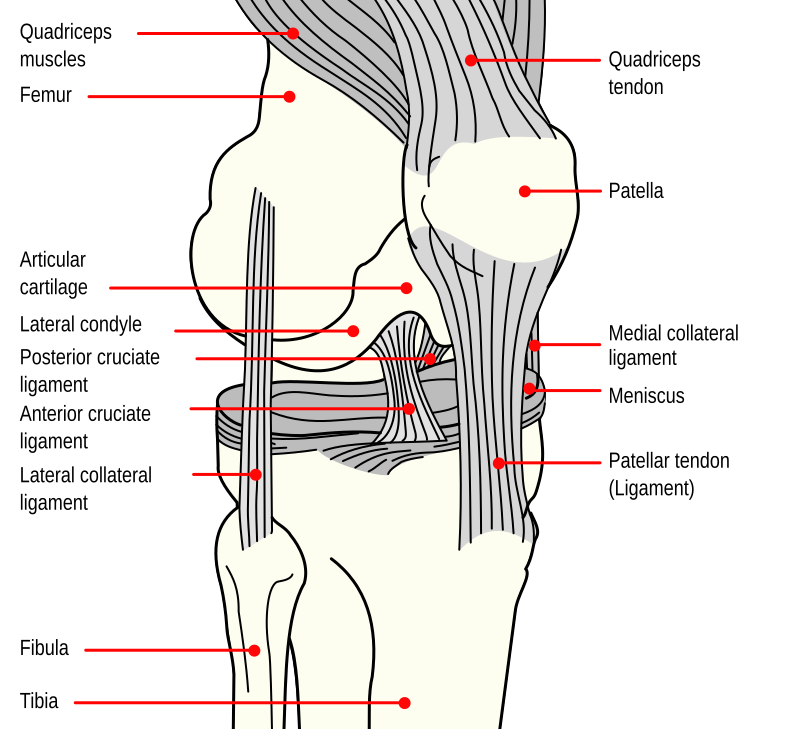
File:Knee_diagram.svg · Wikimedia Commons · See Wikimedia Commons
patella
Sign in to saveAlso known as knee cap, kneepan, kneecap, Knee-cap
The patella (: patellae or patellas), also known as the kneecap, is a flat, rounded triangular bone which articulates with the femur (thigh bone) and covers and protects the anterior articular surface of the knee joint. The patella is found in many tetrapods, such as mice, cats, birds, and dogs, but not in whales, or most reptiles.
The patella, commonly known as the kneecap, is a flat, triangular bone that sits in front of the knee joint where it connects with your thighbone and protects the knee. This bone is found in many four-legged animals like mice, cats, and dogs, but interestingly, whales and most reptiles don't have one.
AI-generated from the Wikipedia summary — may contain errors.
Key facts
- Bone.Name
- Patella
- Bone.Latin
- patella
- Bone.Image
- Knee diagram.svg
- Bone.Caption
- Right knee
- Bone.Origins
- Present at the joint of femur and tibia fibula
via Wikipedia infobox
Research
20,553 papers- Patella Fractures: Approach to Treatment.The Journal of the American Academy of Orthopaedic Surgeons · 2021Hargett DI, Sanderson BR, Little MTMDOI: 10.5435/JAAOS-D-20-00591
- Anterior Hook Plating of Patella Fractures: A Biomechanical Analysis and Clinical Series.ReviewJournal of orthopaedic trauma · 2023Alley MC, Kain M, Mitchell S et al.DOI: 10.1097/BOT.0000000000002565
- Patella Apex Influences Patellar Ligament Forces and Ratio.Journal of biomechanical engineering · 2021Wheatley MGA, Clouthier AL, Thelen DG et al.DOI: 10.1115/1.4051213
- "Anatomic patella design versus medialized dome design in the modern posterior stabilized (ATTUNE) total knee arthroplasty: a systematic review and meta-analysis".Journal of orthopaedic surgery and research · 2025Hajiaghajani S, Bahrami O, Hefzosseheh M et al.DOI: 10.1186/s13018-025-05858-1
- Applied biomechanics of the patella.ReviewClinical orthopaedics and related research · 2001Grelsamer RP, Weinstein CHDOI: 10.1097/00003086-200108000-00003
- [Nail-patella syndrome].Der Hautarzt; Zeitschrift fur Dermatologie, Venerologie, und verwandte Gebiete · 1996Wildfeuer T, Albrecht GDOI: 10.1007/s001050050522
- Management of the Patella During Total Knee Arthroplasty.JBJS reviews · 2021Held MB, Gazgalis A, Sarpong NO et al.DOI: 10.2106/JBJS.RVW.21.00054
- The Double-Patella Sign: A Patellar Implant Loosening Case Report.JBJS case connector · 2023Ganz MP, Mannino A, Scuderi GRDOI: 10.2106/JBJS.CC.23.00292
via PubMed
Wikidata facts
- Image
- Patella post.jpg
Show 3 more facts
- Commons category
- Patella
- topic's main category
- Category:Patella
- described at URL
- neal.fun/earth-reviews/kneecaps
via Wikidata · CC0
~8 min read
Encyclopedic overview
15 sectionsContents
- Structure
- Variation
- Development
- Function
- Clinical significance
- Dislocation
- Treatment
- Vertical alignment
- Fracture
- Exostosis
- Other animals
- Etymology
- See also
- References
- External links
The patella (: patellae or patellas), also known as the kneecap, is a flat, rounded triangular bone which articulates with the femur (thigh bone) and covers and protects the anterior articular surface of the knee joint. The patella is found in many tetrapods, such as mice, cats, birds, and dogs, but not in whales, or most reptiles.
In humans, the patella is the largest sesamoid bone (i.e., embedded within a tendon or a muscle) in the body. Babies are born with a patella of soft cartilage which begins to ossify into bone at about four years of age.
Excerpted from Wikipedia’s “patella” article, available under the CC BY-SA 4.0 licence.
Gallery (15)
Available in 60 languages
- Español
- Français
- Deutsch
- 中文
- 日本語
- Русский
- Português
- Italiano
- العربية
- Azerbaijani
- Bahasa Indonesia
- Bangla
- Bashkir
- Basque
- Belarusian
- Betawi
- Bosnian
- Bulgarian
Show 41 more
- Catalan
- Central Kurdish
- Chuvash
- Croatian
- Czech
- Divehi
- Esperanto
- Estonian
- Filipino
- Finnish
- Galician
- Greek
- Guarani
- Hebrew
- Icelandic
- Ido
- Latin
- Latvian
- Lithuanian
- Luxembourgish
- Nederlands
- Newari
- Norwegian
- Polski
- Romanian
- Serbian
- Serbian (Latin)
- Slovak
- Slovenian
- Svenska
- Tamil
- Tibetan
- Türkçe
- Ukrainian
- Walloon
- Waray
- Western Panjabi
- zh_yue
- فارسی
- ไทย
- 한국어
via Wikidata sitelinks · CC0