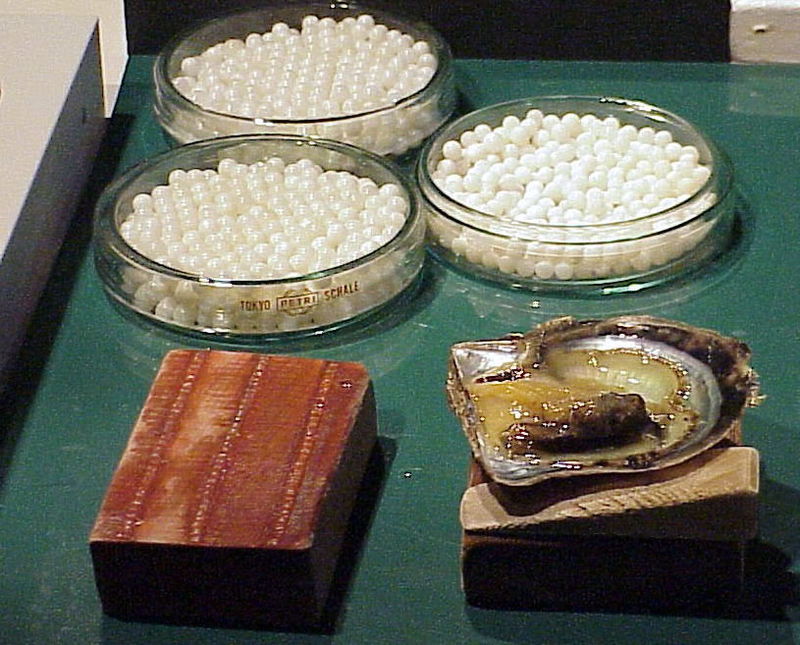
File:Pearls.jpg · Wikimedia Commons · See Wikimedia Commons
pearl
Sign in to savethumb|Georgian seed pearl gold ring
A pearl is a lustrous gem formed inside an oyster or other shellfish when an irritant becomes coated with layers of a shiny substance called nacre. Pearls have been valued throughout history for jewelry and decoration, making them culturally and economically significant gems.
AI-generated from the Wikipedia summary — may contain errors.
Key facts
- Mineral.name
- Pearl
- Mineral.image
- Various pearls.jpg
- Mineral.imagesize
- 210px
- Mineral.alt
- Various pearls
- Mineral.caption
- Various pearls
- Mineral.category
- Carbonate mineral, protein
- Mineral.formula
- Calcium carbonate, CaCO3 Conchiolin
- Mineral.strunz
- 05.8
- Mineral.color
- White, pink, silver, cream, brown, green, blue, black, yellow, orange, red, gold, purple, iridescent
- Mineral.system
- Orthorhombic
- Mineral.cleavage
- None
- Mineral.fracture
- Uneven, various
- Mineral.mohs
- 2.5–4.5
- Mineral.streak
- White
- Mineral.gravity
- 2.60–2.85
- Mineral.refractive
- Common pearl: 1.52-1.66 Black pearl: 1.53-1.69
- Mineral.birefringence
- 0.156
- Mineral.pleochroism
- Absent
via Wikipedia infobox
Wikidata facts
- Material used
- nacre
- Image
- Various pearls.jpg
- Has use
- fashion accessory
Show 6 more facts
- Commons category
- Pearls
- topic's main category
- Category:Pearls
- Commons gallery
- Pearl
- MCN code
- 7101.10.00
- different from
- bead
- on focus list of Wikimedia project
- Wikipedia:Vital articles/Level/4
via Wikidata · CC0
~44 min read
Encyclopedic overview
34 sectionsContents
- Etymology
- Definition
- Physical properties
- Freshwater and saltwater pearls
- Formation
- Natural pearls
- Cultured pearls
- Imitation pearls
- Gemological identification
- Value of a natural pearl
- Origin of a natural pearl
- Types of cultured pearls
- From other species
- History
- Pearl hunting
- British Isles
- Pearl farming
- Timeline of pearl production
- Freshwater pearl farming
- Momme weight
- In jewelry
- Gallery
- Shapes
- Lengths of pearl necklaces
- Colors
- Religious references
- Hindu scriptures
- Hebrew scriptures
- New Testament scriptures
- Islamic scriptures
- Additional references
- See also
- References
- External links
thumb|Georgian seed pearl gold ring
A pearl is a hard, glistening object produced within the soft tissue (specifically the mantle) of a living shelled mollusk or another animal, such as fossil conulariids. Just like the shell of a mollusk, a pearl is composed of calcium carbonate (mainly aragonite or a mixture of aragonite and calcite) in minute crystalline form, which is deposited in concentric layers. More commercially valuable pearls are perfectly round and smooth, but many other shapes, known as baroque pearls, can occur. The finest quality of natural pearls have been highly valued as gemstones and objects of beauty for many centuries. Because of this, pearls have become a metaphor for something rare, fine, admirable, and valuable.
Excerpted from Wikipedia’s “pearl” article, available under the CC BY-SA 4.0 licence.
Gallery (52)
Available in 107 languages
- Español
- Français
- Deutsch
- 中文
- 日本語
- Русский
- Português
- Italiano
- العربية
- हिन्दी
- Afrikaans
- Albanian
- Albanian
- Armenian
- Assamese
- Asturian
- Azerbaijani
- Bahasa Indonesia
Show 88 more
- Bangla
- Basque
- bat_smg
- be_x_old
- Belarusian
- Bikol
- Bulgarian
- Burmese
- Catalan
- Central Kurdish
- Chuvash
- Croatian
- Czech
- dag
- Danish
- Egyptian Arabic
- Esperanto
- Estonian
- Fijian
- Filipino
- Finnish
- Galician
- Georgian
- Greek
- Guarani
- Hakka Chinese
- Hebrew
- Hungarian
- hyw
- Ido
- Javanese
- Kannada
- Kazakh
- kge
- Komi
- Kyrgyz
- Latin
- Latvian
- Limburgish
- Lithuanian
- Macedonian
- Maithili
- Malagasy
- Malay
- Malayalam
- Marathi
- Mazanderani
- Mongolian
- Nederlands
- Nepali
- Northern Frisian
- Norwegian
- Norwegian Nynorsk
- Occitan
- Pashto
- Polski
- Punjabi
- Romanian
- Sanskrit
- Serbian
- Serbian (Latin)
- Sicilian
- simple
- Sindhi
- Sinhala
- Slovak
- Slovenian
- Svenska
- Tajik
- Tamil
- Tatar
- Telugu
- Tiếng Việt
- Türkçe
- Ukrainian
- Urdu
- Uzbek
- Venetian
- Welsh
- Western Panjabi
- Wu Chinese
- Yakut
- Yiddish
- zh_classical
- zh_yue
- فارسی
- ไทย
- 한국어
via Wikidata sitelinks · CC0