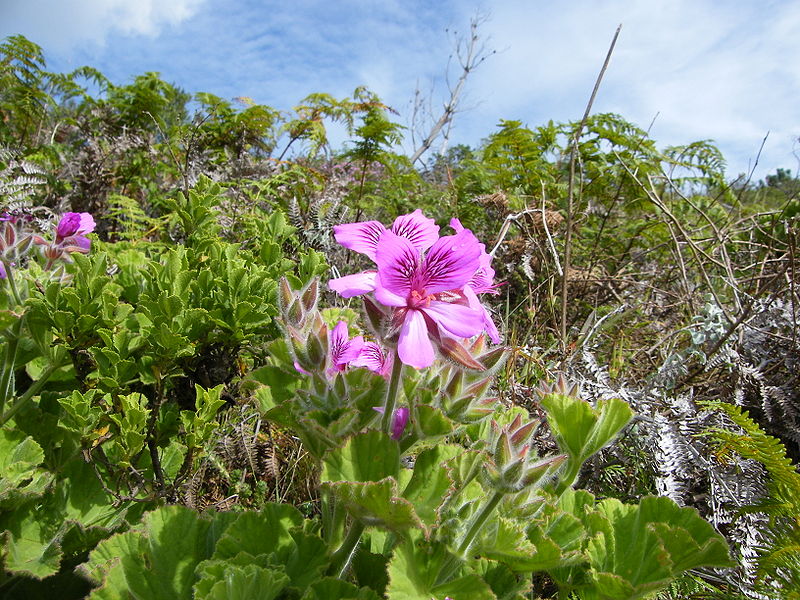
File:Pelargonium_cucullatum_Contour_Path_Rhodes_Mem.JPG · Wikimedia Commons · See Wikimedia Commons
Pelargonium
Sign in to saveAlso known as angel eyes
Pelargonium () is a genus of flowering plants commonly called geraniums, pelargoniums, or storksbills. It includes about 280 species of perennials, succulents, and shrubs. Taxonomist Carl Linnaeus originally included all the species of Pelargonium and Geranium under the latter name. In 1789, Charles Louis L'Héritier de Brutelle separated them into two genera.
OverviewAI-generated
Pelargonium is a genus within the family Geraniaceae. It belongs to the order Geraniales, class Magnoliopsida, and phylum Tracheophyta in the kingdom Plantae. The scientific name is listed as Pelargonium L'Hér.
Records for this taxon are held by various institutions, including UACH, CIBYC-UAEM, SEMAHN, ENCB-IPN, and IIB-UV. These records are associated with the country of Mexico. The genus has been the subject of 903 entries in PubMed and has 107,221 occurrences recorded in GBIF. Additionally, iDigBio holds 2,330 records and 1,295 media items for the family Geraniaceae.
Synthesized by Vinony from 27 facts across 7 sources: Wikidata, GBIF, iNaturalist, PubMed, Gbif Occ, iDigBio, Vinony graph. Generated from structured data (not the Wikipedia text) and checked against those facts — may still contain errors.
Species
Common Geranium-bronze
Pelargonium
GENUS
- KingdomPlantae
- PhylumTracheophyta
- ClassMagnoliopsida
- OrderGeraniales
- FamilyGeraniaceae
Die Pelargonien (Pelargonium) sind eine Pflanzengattung innerhalb der Familie der Storchschnabelgewächse (Geraniaceae). Die 220 bis 280 Arten sind im südlichen Afrika verbreitet. Als Trivialname für bestimmte, als Beet- oder Balkonpflanzen verwendete Pelargonium-Arten und -Hybriden wird oft der Name „Geranien“ verwendet (vom griechischen Wort géranos, γέρανος, was „Kranich“ bedeutet).
via GBIF
Museum specimens
- Specimen records
- 2,330
- With media
- 1,295
- Family
- Geraniaceae
- Collections
- UACH, CIBYC-UAEM, SEMAHN, ENCB-IPN, IIB-UV, FESI-UNAM
- Recorded in
- Mexico
Research
903 papers- Immunomodulatory Effects of Pelargonium sidoides Extract (EPs7630) in the Treatment of Acute Rhinosinusitis.ReviewExpert reviews in molecular medicine · 2025Perić A, Vezmar Kovačević S, Barać A et al.DOI: 10.1017/erm.2025.10013
- Unlocking the therapeutic potential of Pelargonium sidoides natural extract: A scoping review.Heliyon · 2024Reina BD, Malheiros SS, Vieira SM et al.DOI: 10.1016/j.heliyon.2024.e40554
- Pelargonium sidoides extract EPs 7630: a review of its clinical efficacy and safety for treating acute respiratory tract infections in children.ReviewInternational journal of general medicine · 2018Careddu D, Pettenazzo ADOI: 10.2147/IJGM.S154198
- Pelargonium sidoides extract for treating acute respiratory tract infections.The Cochrane database of systematic reviews · 2013Timmer A, Günther J, Motschall E et al.DOI: 10.1002/14651858.CD006323.pub3
- Pelargonium sidoides for acute bronchitis: a systematic review and meta-analysis.Phytomedicine : international journal of phytotherapy and phytopharmacology · 2008Agbabiaka TB, Guo R, Ernst EDOI: 10.1016/j.phymed.2007.11.023
- Pelargonium sidoides extract for acute respiratory tract infections.The Cochrane database of systematic reviews · 2008Timmer A, Günther J, Rücker G et al.DOI: 10.1002/14651858.CD006323.pub2
- [Pelargonium sidoides-extract (EPs 7630): registration confirms efficacy and safety].ReviewWiener medizinische Wochenschrift (1946) · 2007Conrad A, Kolodziej H, Schulz VDOI: 10.1007/s10354-007-0434-6
- Medicinal properties and conservation of Pelargonium sidoides DC.ReviewJournal of ethnopharmacology · 2014Moyo M, Van Staden JDOI: 10.1016/j.jep.2014.01.009
via PubMed
Wikidata facts
- Instance of
- taxon
- Parent taxon
- Geraniaceae
- Image
- Pelargonium 'Copthorne' in Jardin des 5 sens (1).jpg
Show 8 more facts
- has fruit type
- capsule
- taxon rank
- genus
- Commons category
- Pelargonium
- taxon name
- Pelargonium
- topic's main category
- Category:Pelargonium
- Commons gallery
- Pelargonium
- taxon common name
- pelargonija
via Wikidata · CC0
~39 min read
Encyclopedic overview
39 sectionsContents
- Description
- Taxonomy
- Genus history
- Circumscription
- Subdivision
- Phylogenetic analyses
- Subgenera
- Species
- Etymology
- Distribution and habitat
- Ecology
- Pests and diseases
- Cultivation
- Cultivation history
- Cultivars
- A. Zonal pelargoniums (''Pelargonium'' × ''hortorum'' <small>Bailey</small>)
- B. Ivy-leaved pelargoniums (derived from ''Pelargonium peltatum'')
- C. Regal pelargoniums (''Pelargonium'' × ''domesticum'' <small>Bailey</small>)
- D. Angel pelargoniums (derived from ''Pelargonium crispum'')
- E. Unique pelargoniums (derived from ''Pelargonium fulgidum'')
- F. Scented-leaved pelargoniums
- G. Species pelargoniums
- H. Primary hybrids
- List of AGM pelargoniums
- Uses
- Ornamental plants
- Scented leaf pelargoniums
- Herbal medicine
- Pets
- Chemistry
- In culture
- Notes
- References
- Bibliography
- Books
- Historical
- Articles and theses
- Societies
- External links
Pelargonium () is a genus of flowering plants commonly called geraniums, pelargoniums, or storksbills. It includes about 280 species of perennials, succulents, and shrubs. Taxonomist Carl Linnaeus originally included all the species of Pelargonium and Geranium under the latter name. In 1789, Charles Louis L'Héritier de Brutelle separated them into two genera.
While Geranium species are mostly temperate herbaceous plants, dying down in winter, Pelargonium species are evergreen perennials indigenous to warm temperate and tropical regions of the world, with many species in southern Africa. They are drought and heat tolerant but can tolerate only minor frosts. Some species are extremely popular garden plants, grown as houseplants and bedding plants in temperate regions. They have a long flowering period, with flowers mostly in red, orange, or white, but intensive breeding has produced a huge array of cultivars with great variety in size, flower colour, leaf form and aromatic foliage.
Excerpted from Wikipedia’s “Pelargonium” article, available under the CC BY-SA 4.0 licence.
Gallery (55)
Available in 60 languages
- Español
- Français
- Deutsch
- 中文
- 日本語
- Русский
- Português
- Italiano
- العربية
- Afrikaans
- Armenian
- Azerbaijani
- Bahasa Indonesia
- Basque
- bat_smg
- Bavarian
- Belarusian
- Bikol
Show 41 more
- Bulgarian
- Catalan
- Cebuano
- Croatian
- Czech
- Danish
- Egyptian Arabic
- Esperanto
- Estonian
- Finnish
- Galician
- Greek
- Hebrew
- Hungarian
- Ido
- Iloko
- Kashubian
- Kazakh
- Kyrgyz
- Lithuanian
- Lower Sorbian
- Macedonian
- Malayalam
- Nederlands
- Norwegian
- Norwegian Nynorsk
- Polski
- Romanian
- Sardinian
- Serbian
- Serbian (Latin)
- Sindhi
- Slovak
- Slovenian
- Svenska
- Türkçe
- Ukrainian
- Upper Sorbian
- Waray
- فارسی
- 한국어
via Wikidata sitelinks · CC0