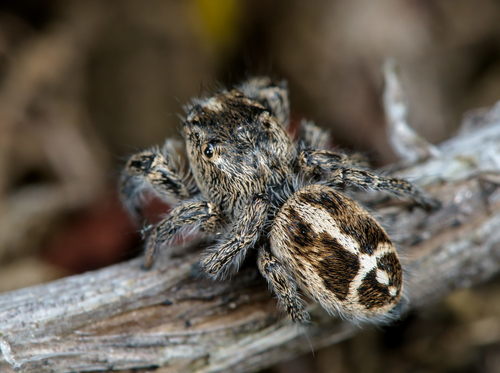
(c) Gilles San Martin, some rights reserved (CC BY-SA), uploaded by Gilles San Martin · cc-by-sa
Pellenes
Sign in to savePellenes is a genus of jumping spiders that was first circumscribed by Eugène Louis Simon in 1876. It is considered a senior synonym of Hyllothyene. In 2000, Dmitri Logunov, Yuri Marusik and Sergei Rakov divided the genus Pellenes into four subgenera, based on the shape of the male palpal bulb. The subgenera are Pelmirus, Pelmultus, and Pelpaucus. Wayne Maddison placed the genus in the subtribe Harmochirina in the tribe Plexippini in 2015. This had previously been known as Harmochireae, as circumscribed by Simon in 1903. It is allocated to the subclade Saltafresia in the clade Salticoida. The
Species
GENUS
- KingdomAnimalia
- PhylumArthropoda
- ClassArachnida
- OrderAraneae
- FamilySalticidae
via GBIF
Wikidata facts
Show 3 more facts
- taxon author citation
- Simon, 1876
- Commons category
- Pellenes
- taxon name
- Pellenes
Sources (2)
via Wikidata · CC0
~7 min read
Article
6 sectionsContents
- Distribution
- Species
- References
- Citations
- Bibliography
- External links
Pellenes is a genus of jumping spiders that was first circumscribed by Eugène Louis Simon in 1876. It is considered a senior synonym of Hyllothyene. In 2000, Dmitri Logunov, Yuri Marusik and Sergei Rakov divided the genus Pellenes into four subgenera, based on the shape of the male palpal bulb. The subgenera are Pelmirus, Pelmultus, and Pelpaucus. Wayne Maddison placed the genus in the subtribe Harmochirina in the tribe Plexippini in 2015. This had previously been known as Harmochireae, as circumscribed by Simon in 1903. It is allocated to the subclade Saltafresia in the clade Salticoida. The spiders are a member of Plexippoida. Phylogenetic analysis of molecular data demonstrates that the genus is most closely related to Habronattus and Havaika. In 2016, Jerzy Prószyński grouped the genus with Dexippus under the name Pelenines, named after the genus. It is allocated to the supergroup Hylloida.
They are dark to black with white stripes on the back, and often have bright red markings. Most species have a special propensity for snail shells. Pellenes seriatus and P. lapponicus males look very similar to Hasarius adansoni when viewed from the front.
Available in 13 languages
- Español
- Français
- Italiano
- Cebuano
- Egyptian Arabic
- Nederlands
- Norwegian
- Romanian
- Svenska
- Tiếng Việt
- Türkçe
- Waray
via Wikidata sitelinks · CC0