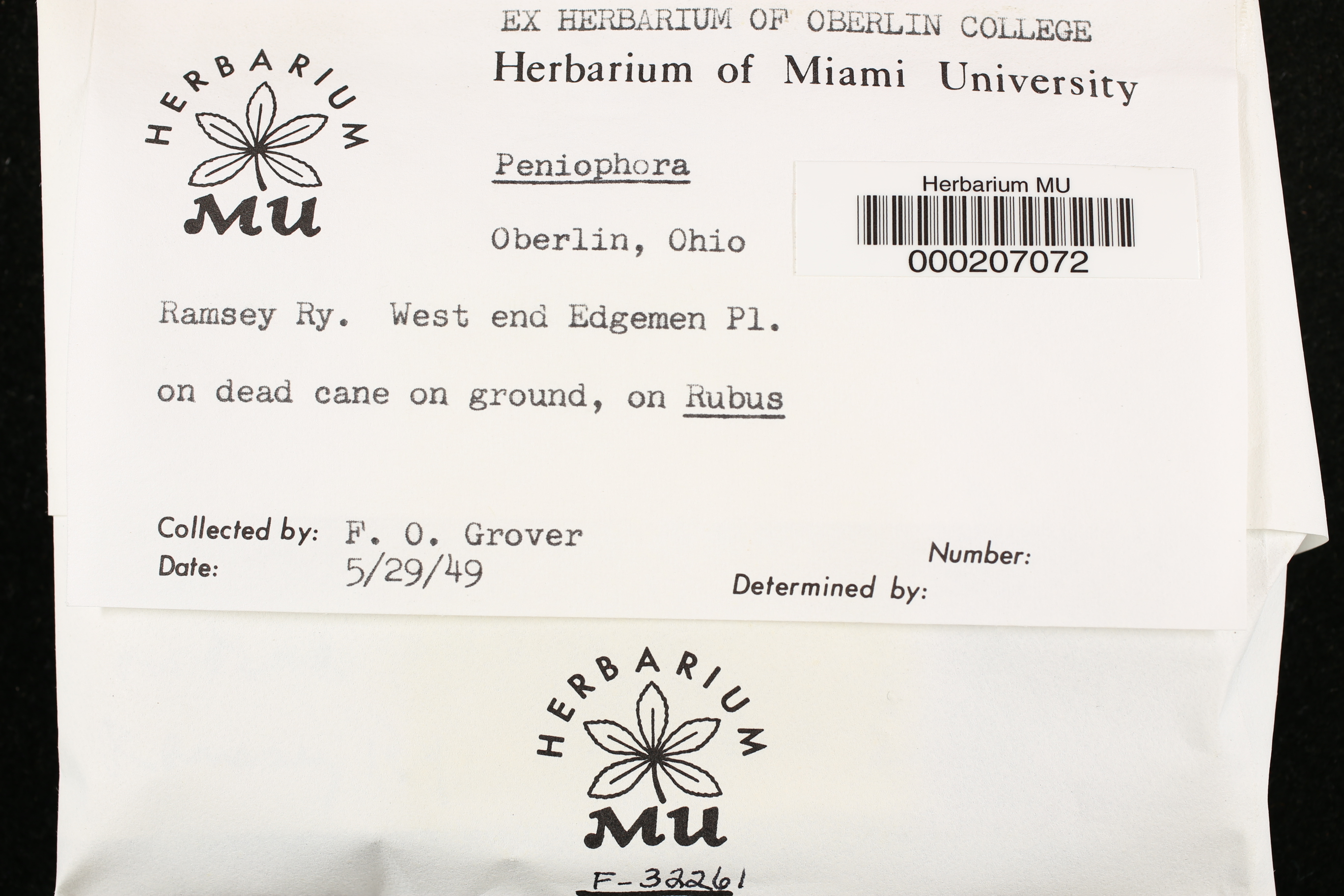
Specimen image via iDigBio · CC0
Peniophora
Sign in to savePeniophora is a genus of fungi which are plant pathogens. Members of the genus belong to the class Agaricomycetes, order Russulales, and family Peniophoraceae. The genus is widespread, and contains 62 species. The species of Peniophora are resupinate, or crust-like, and are described as corticioid. A number of its members are parasitised by other fungi. For example, Tremella mesenterica is a parasite to several species of Peniophora.
Species
GENUS
- KingdomFungi
- PhylumBasidiomycota
- ClassAgaricomycetes
- OrderRussulales
- FamilyPeniophoraceae
via GBIF
Museum specimens
- Specimen records
- 2,793
- With media
- 2,571
- Family
- Peniophoraceae
- Collections
- NY, NEB, ILLS, OSC
- Recorded in
- United States, Canada
Wikidata facts
- Instance of
- taxon
- Parent taxon
- Peniophoraceae
- Image
- Peniophora incarnata (36443147085).jpg
Show 5 more facts
- topic's main category
- Category:Peniophora
- taxon rank
- genus
- taxon name
- Peniophora
- Commons category
- Peniophora
- taxon author citation
- Cooke
Sources (2)
via Wikidata · CC0
~3 min read
Encyclopedic overview
3 sectionsContents
- Taxonomy and classification
- Partial list of species
- References
Peniophora is a genus of fungi which are plant pathogens. Members of the genus belong to the class Agaricomycetes, order Russulales, and family Peniophoraceae. The genus is widespread, and contains 62 species. The species of Peniophora are resupinate, or crust-like, and are described as corticioid. A number of its members are parasitised by other fungi. For example, Tremella mesenterica is a parasite to several species of Peniophora.
== Taxonomy and classification == The genus was first described by Mordecai Cubitt Cooke in 1879. The type species is Peniophora quercina, initially named Thelephora quercina by Christian Hendrik Persoon in 1801 before being transferred to Peniophora by Cooke in 1879. However, this species was also chosen as the type species for the genus Corticium as defined by Persoon in 1794. Until 1981 the starting point for the nomenclature of the corticioid fungi was the publication of Fries' first volume of the Systema mycologicum, which was set at January 1, 1821. Corticium Persoon (1794) was therefore a devalidated name because it was published before the starting point. Mycologists of the later 19th and 20th centuries, including Patouillard (1900), Burt (1914–26), and Bourdot and Galzin (1928) distinguished species of Peniophora Cooke by their hymenial cystidia from species of Corticium Persoon, which lacked them. Despite being synonyms under the International Code of Botanical Nomenclature (ICBN), Corticium and Peniophore were used in this encompassing sense well into the 20th century. Changes made to the ICBN in 1981 included moving the starting point date for fungi back to May 1, 1753, the publication date of Linnaeus' Species plantarum. Names published between 1753 and 1821 (including Corticium) are now considered valid.
Excerpted from Wikipedia’s “Peniophora” article, available under the CC BY-SA 4.0 licence.