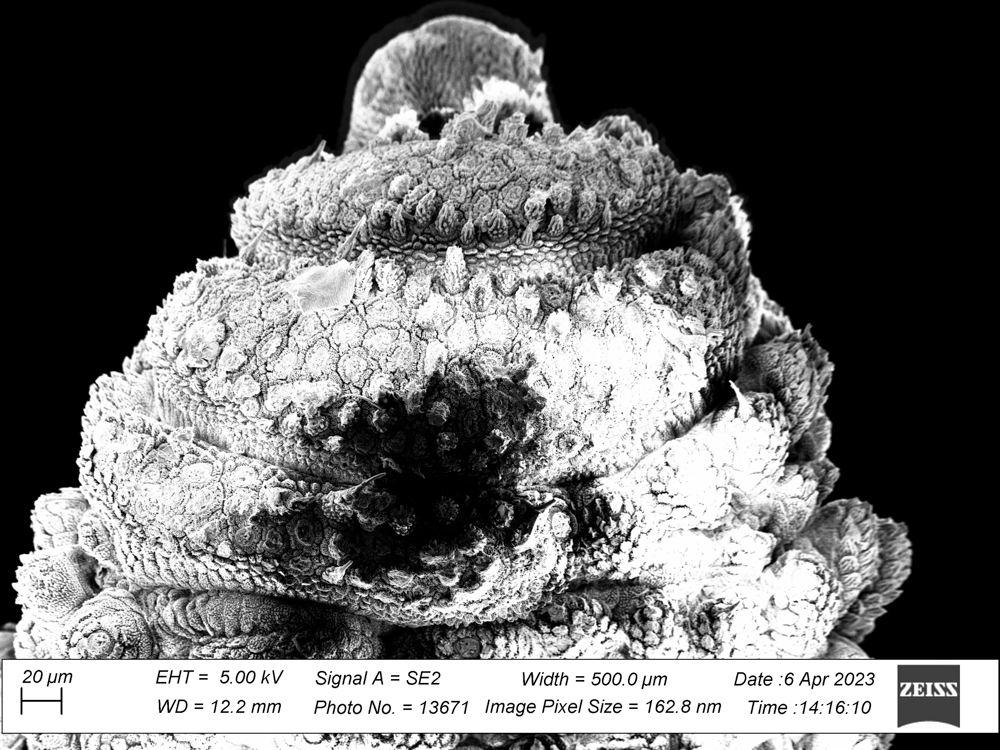
Specimen image via iDigBio
Peripatidae
Sign in to savePeripatidae or Equatorial Velvet Worms is a family of velvet worms. This family includes more than 90 described species distributed among 13 genera, but some authorities deem only 80 of these species to be valid. The oldest putative representatives of the family herald from Burmese amber dated to the mid-Cretaceous, around 100 million years ago, with representatives from Dominican and Baltic amber attesting to a broader distribution in the Palaeogene / Neogene; molecular variability suggests that the family's crown group may have arisen in the early Mesozoic.
Museum specimens
- Specimen records
- 25
- With media
- 53
- Family
- Peripatidae
- Collections
- MCZ, AUM, YPM, MNHN
- Recorded in
- Guyana, Colombia, Costa Rica, Brazil, Dominican Republic, Panama, Nicaragua, Guyane FrançAise
Wikidata facts
- Instance of
- taxon
- Parent taxon
- Onychophora
- Image
- Velvet worm (2002).jpg
Show 6 more facts
- Commons category
- Peripatidae
- taxon rank
- family
- taxon name
- Peripatidae
- topic's main category
- Category:Peripatidae
- taxonomic type
- Peripatus
- start time
- 99000000-0
Sources (2)
via Wikidata · CC0
~3 min read
Encyclopedic overview
7 sectionsContents
- Description
- Distribution
- Taxonomy
- Neopatida
- Genera
- References
- External links
Peripatidae or Equatorial Velvet Worms is a family of velvet worms. This family includes more than 90 described species distributed among 13 genera, but some authorities deem only 80 of these species to be valid. The oldest putative representatives of the family herald from Burmese amber dated to the mid-Cretaceous, around 100 million years ago, with representatives from Dominican and Baltic amber attesting to a broader distribution in the Palaeogene / Neogene; molecular variability suggests that the family's crown group may have arisen in the early Mesozoic.
==Description== The Peripatidae exhibit a range of derivative features. They are longer, on average, than the Peripatopsidae and also have more leg pairs. The number of legs in the Peripatidae varies within species as well as among species and ranges from 19 pairs (in Typhloperipatus williamsoni and Speleoperipatus spelaeus) to 43 pairs (in Plicatoperipatus jamaicensis). The gonopore is always between the penultimate leg pair. There are no known oviparous species—the overwhelming majority, including all the Neotropical Peripatidae, are viviparous with females that develop a placenta to provide the growing embryo with nutrients. The Asian genera Typhloperipatus and Eoperipatus, however, exhibit lecithotrophic ovoviviparity; that is, their females do not develop any placenta and instead retain yolky eggs in their uteri to supply nourishment.
Excerpted from Wikipedia’s “Peripatidae” article, available under the CC BY-SA 4.0 licence.