Estrada-González, Mariae C.;Agüero, José;Mendoza-Becerril, María A.
Phacellophora
Sign in to savePhacellophora, commonly known as the fried egg jellyfish or egg-yolk jellyfish, is a very large jellyfish in the monotypic family Phacellophoridae containing a single species Phacellophora camtschatica. This genus can be easily identified by the yellow coloration in the center of its body which closely resembles an egg yolk, hence its common name. Some individuals can have a bell close to 60 cm (2 ft) in diameter, and most individuals have 16 clusters of up to a few dozen tentacles, each up to 6 m (20 ft) long. A smaller jellyfish, Cotylorhiza tuberculata, typically found i
Species
サムクラゲ属
GENUS
- KingdomAnimalia
- PhylumCnidaria
- ClassScyphozoa
- OrderSemaeostomeae
- FamilyPhacellophoridae
via GBIF
Museum specimens
- Specimen records
- 2
- With media
- 1
- Family
- Ulmaridae
- Collections
- CAS, NHMUK
- Recorded in
- United States, Spain
~11 min read
Encyclopedic overview
9 sectionsContents
- Taxonomy and systematics
- Ecology
- Feeding
- Symbiotic relationships
- Body systems
- Life cycle
- Distribution
- References
- External links
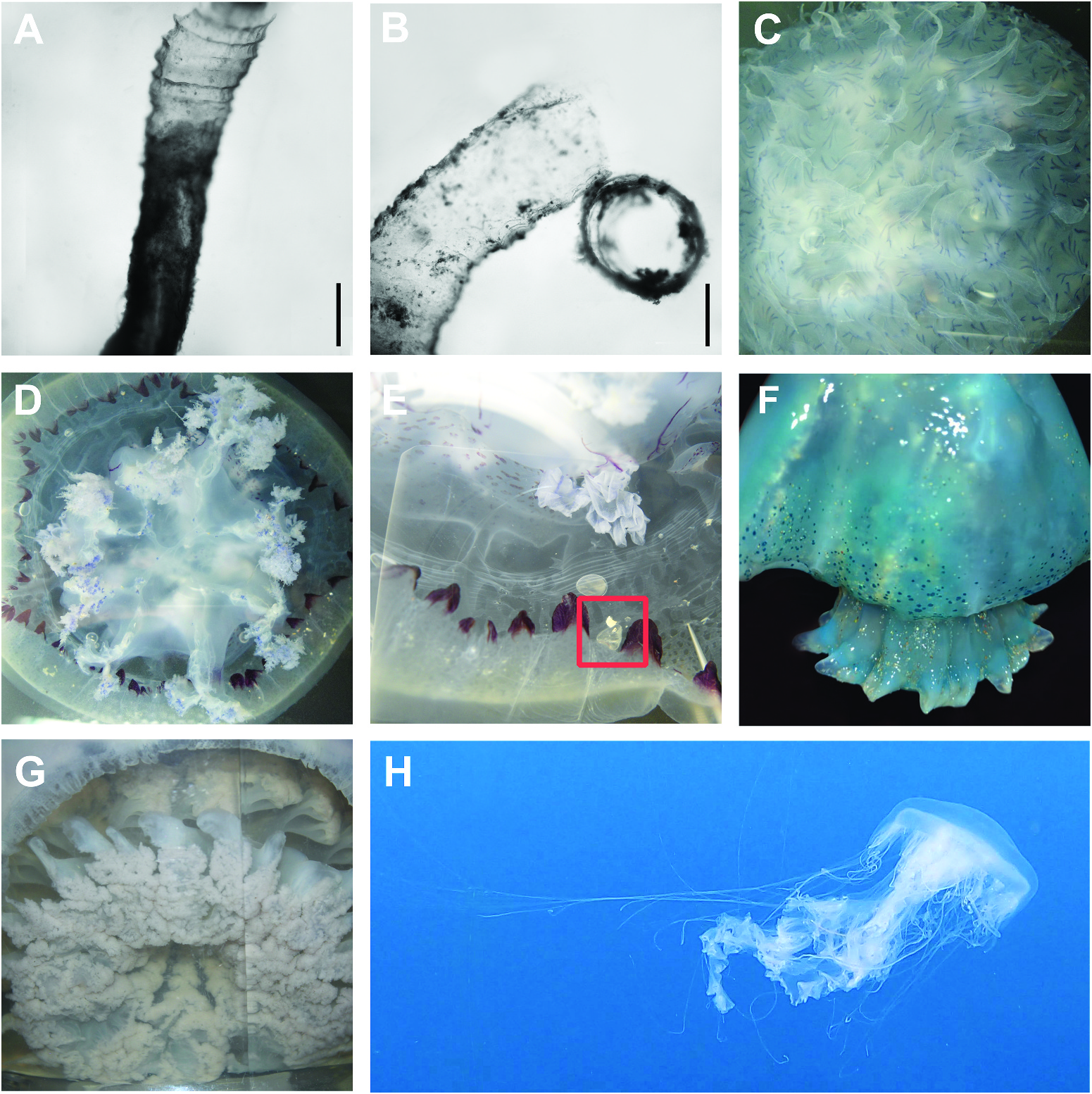
Phacellophora, commonly known as the fried egg jellyfish or egg-yolk jellyfish, is a very large jellyfish in the monotypic family Phacellophoridae containing a single species Phacellophora camtschatica. This genus can be easily identified by the yellow coloration in the center of its body which closely resembles an egg yolk, hence its common name. Some individuals can have a bell close to 60 cm (2 ft) in diameter, and most individuals have 16 clusters of up to a few dozen tentacles, each up to 6 m (20 ft) long. A smaller jellyfish, Cotylorhiza tuberculata, typically found in warmer water, particularly in the Mediterranean Sea, is also popularly called a fried egg jellyfish. Also, P. camtschatica is sometimes confused with the Lion's mane jellyfish (Cyanea capillata).
It feeds primarily by collecting medusae and plankton with its tentacles, and bringing them into its mouth for digestion. It is capable of only limited motion, and mostly drifts with the current, even when swimming. This species and most of its relatives in the Cnidaria phylum often use suspension feeding as their main food gathering strategy.
Excerpted from Wikipedia’s “Phacellophora” article, available under the CC BY-SA 4.0 licence.