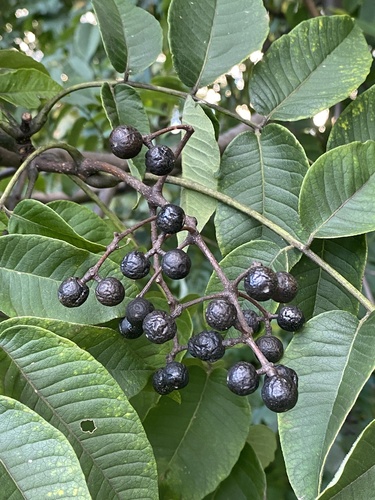
(c) Misha Zitser, all rights reserved, uploaded by Misha Zitser
Phellodendron
Sign in to savePhellodendron, or cork-tree, is a genus of deciduous, dioecious trees in the family Rutaceae, native to east and northeast Asia. It has leathery, pinnate leaves and yellow, clumped flowers. The name refers to the thick and corky bark of some (but not all) species in the genus.
Species
Amur Corktree
GENUS
- KingdomPlantae
- PhylumTracheophyta
- ClassMagnoliopsida
- OrderSapindales
- FamilyRutaceae
Die Korkbäume (Phellodendron) sind eine Pflanzengattung innerhalb der Familie der Rautengewächse (Rutaceae). Die nur noch zwei Arten sind in Südost- und Ostasien verbreitet. Der Kork wird von der Korkeiche gewonnen, die nicht zu den Korkbäumen zählt. Inhaltsverzeichnis 1 Beschreibung 1.1 Vegetative Merkmale 1.2 Generative Merkmale 2 Verwendung 3 Systematik 4 Literatur 4.1 Einzelnachweise 5 Weblinks Beschreibung Laubblätter und Blütenstände des Amur-Korkbaum (Phellodendron amurense) Vegetative Merkmale Korkbaum-Arten wachsen als sommergrüne Bäume. Der Name der Korkbaum stammt von ihrer meist sehr korkigen Rinde. Der Bast ist intensiv gelb gefärbt. Die Winterknospen verbergen sich in der Basis der Blattstiele. Die gegenständig angeordneten Laubblätter sind in Blattstiel und -spreite gegliedert. Die Blattspreite ist unpaarig gefiedert und bestehen aus 5 bis 13 kurz gestielten Fiederblättchen. Diese fast ganzrandigen bis schwach gesägten Blättchen sind am Rand durchscheinend drüsig punktiert und duften aromatisch. Die Nebenblätter fehlen. Generative Merkmale Korkbaum-Arten sind zweihäusig getrenntgeschlechtig (diözisch). Die Blüten stehen in endständigen, rispigen Blütenständen zusamme
via GBIF · Kew POWO
Research
526 papers- Protective Effects of Phellodendron Species on Bone Health: A Novel Perspective on Their Potentials in Treating Osteoporosis and Osteoarthritis.Chinese journal of integrative medicine · 2024
- Berberine and Its Role in Chronic Disease.Advances in experimental medicine and biology · 2016
- Phellodendron bark extract and berberine chloride suppress microbiome dysbiosis in a saliva-derived in vitro microcosm biofilm model.Archives of oral biology · 2025
- Phellodendron chinense C.K.Schneid: An in vitro study on its anti-Helicobacter pylori effect.Journal of ethnopharmacology · 2024
- Palmatine, an isoquinoline alkaloid from Phellodendron amurense Rupr., ameliorated gouty inflammation by inhibiting pyroptosis via NLRP3 inflammasome.Journal of ethnopharmacology · 2025
via PubMed
Wikidata facts
- Image
- Phellodendron amurense0.jpg
Show 4 more facts
- taxon name
- Phellodendron
- Commons category
- Phellodendron
- taxon common name
- 黄檗属
Sources (1)
via Wikidata · CC0
~3 min read
Article
3 sectionsContents
- Fossil record
- Cultivation and uses
- References
Phellodendron, or cork-tree, is a genus of deciduous, dioecious trees in the family Rutaceae, native to east and northeast Asia. It has leathery, pinnate leaves and yellow, clumped flowers. The name refers to the thick and corky bark of some (but not all) species in the genus.
==Fossil record== Phellodendron seeds are known from the Early Oligocene of eastern North America, from the Mid Oligocene to the Pliocene of Europe and from the Pliocene of Asia and Japan.