File:Nasinov_9024.JPG · Wikimedia Commons · See Wikimedia Commons
pheromone
Sign in to saveAlso known as pheromones, infochemical
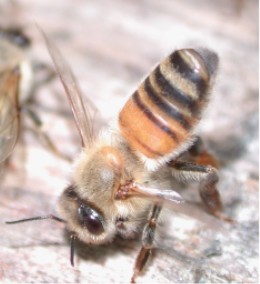
right|thumb|A fanning honeybee exposes [[Nasonov's gland (white – at tip of abdomen) releasing pheromone to entice swarm into an empty hive]]
A pheromone is a chemical substance that an animal releases to communicate with other members of its species, such as when a honeybee exposes a gland to release pheromone that attracts the swarm to a new hive. These chemical signals matter because they allow animals to coordinate important behaviors like finding food, locating mates, or organizing group movements without needing to see or hear each other.
AI-generated from the Wikipedia summary — may contain errors.
Research
20,997 papersvia PubMed
Wikidata facts
- Named after
- hormone
- Image
- Diffuseur pheromones.jpg
Show 2 more facts
- Commons category
- Pheromones
- topic's main category
- Category:Pheromones
via Wikidata · CC0
~24 min read
Encyclopedic overview
30 sectionsContents
- Background
- Categorization by function
- Aggregation
- Alarm
- Epideictic
- Territorial
- Trail
- Sex
- Other
- Categorization by type
- Releaser
- Primer
- Signal
- Pheromone receptors
- In the olfactory epithelium
- In the vomeronasal organ
- Evolution
- Evolution of sex pheromones
- Avoidance of inbreeding
- Applications
- Pheromone trapping
- Animal husbandry
- Human sex pheromone controversies
- Axillary steroids
- Vaginal aliphatic acids
- Stimulators of the vomeronasal organ
- See also
- References
- Further reading
- External links
right|thumb|A fanning honeybee exposes [[Nasonov's gland (white – at tip of abdomen) releasing pheromone to entice swarm into an empty hive]]
A pheromone () is a chemical that is secreted or excreted by an organism, which triggers a social response in members of the same species. There are alarm pheromones, food trail pheromones, sex pheromones, and many others that affect behavior or physiology. Pheromones are used by many organisms, from basic unicellular prokaryotes to complex multicellular eukaryotes. Their use among insects has been particularly well documented. In addition, some vertebrates, plants and ciliates communicate by using pheromones. The ecological functions and evolution of pheromones are a major topic of research in the field of chemical ecology.
Excerpted from Wikipedia’s “pheromone” article, available under the CC BY-SA 4.0 licence.
Gallery (17)
Available in 71 languages
- Español
- Français
- Deutsch
- 中文
- 日本語
- Русский
- Português
- Italiano
- العربية
- Afrikaans
- Armenian
- Asturian
- azb
- Bahasa Indonesia
- Balinese
- Bangla
- Basque
- be_x_old
Show 52 more
- Belarusian
- Bosnian
- Bulgarian
- Catalan
- Central Kurdish
- Croatian
- Czech
- Danish
- Esperanto
- Estonian
- Finnish
- Galician
- Georgian
- Greek
- Haitian Creole
- Hebrew
- Hungarian
- Icelandic
- Irish
- Javanese
- Kazakh
- Kyrgyz
- Latin
- Latvian
- Lithuanian
- Malay
- Malayalam
- Nederlands
- Nepali
- Norwegian
- Norwegian Nynorsk
- Occitan
- Polski
- Romanian
- Serbian
- Serbian (Latin)
- simple
- Slovak
- Slovenian
- Sundanese
- Svenska
- Tamil
- Tiếng Việt
- Türkçe
- Ukrainian
- Uzbek
- Waray
- Wu Chinese
- zh_yue
- فارسی
- ไทย
- 한국어
via Wikidata sitelinks · CC0