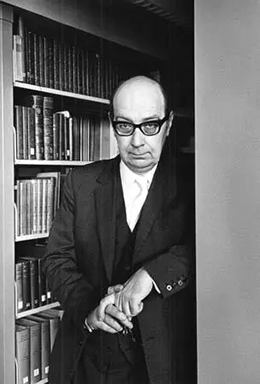
File:Philip_Larkin_in_a_library.gif · Wikimedia Commons · See Wikimedia Commons
Philip Larkin
Sign in to saveAlso known as Philip Arthur Larkin
English writer, jazz critic and librarian (1922-1985)
OverviewAI-generated
Philip Larkin (1922–1985) was a British journalist, poet, librarian, and novelist. Born in Coventry, he was educated at St John's College and worked for the University of Leicester and the University of Hull. His work focused on lyric poetry and the field of jazz. Larkin was a member of the Royal Society of Literature and the American Academy of Arts and Sciences. He received the Commander of the Order of the British Empire, the Cholmondeley Award, and the King’s / Queen’s Gold Medal for Poetry.
Larkin died of esophageal cancer in Kingston upon Hull and was buried in Cottingham. His archives are held by the National Library of Wales and the British Library. Among his listed works are *Korablʹ severa*, *Prentice Hall Literature--The British Tradition*, and *La vida amb forat a dins. Poesia escollida*.
Synthesized by Vinony from 38 facts across 8 sources: Wikidata, Crossref, Open Library, MusicBrainz, Last.fm, Wikiquote, Vinony collections, Vinony graph. Generated from structured data (not the Wikipedia text) and checked against those facts — may still contain errors.
Person · Open Library
- Born
- 1922
- Died
- 1985
- Works
- 50
Top works
- Korablʹ severa
- Prentice Hall Literature--The British Tradition
- Prentice Hall Literature--The British Edition--Volume II
- Prentice Hall Literature - Timeless Voices, Timeless Themes - The British Tradition
- La vida amb forat a dins. Poesia escollida
via Open Library + Wikidata
Music · MusicBrainz
- Type
- Person
- Gender
- Male
- Origin
- United Kingdom
- Active from
- 1922
- Active to
- 1985
via MusicBrainz · CC0
Listeners · Last.fm
- Listeners
- 2,017
- Total plays
- 19,082
Philip Arthur Larkin, CH, CBE, FRSL, (9 August 1922 – 2 December 1985) was an English poet, novelist and jazz critic. He spent his working life as a university librarian and was offered the Poet Laureateship following the death of John Betjeman, but declined the post. Larkin is commonly regarded as one of the greatest English poets of the latter half of the twentieth century. In 2003 Larkin was chosen as the "nation's best-loved poet" in a survey by the Poetry Book Society and in 2008 The Times
Key facts
- Born
- Philip Arthur Larkin , ( 1922-08-09 ) 9 August 1922, Coventry , England
- Died
- 2 December 1985 (1985-12-02) (aged 63), Kingston upon Hull , England
- Resting place
- Cottingham municipal cemetery, 53°47′00.98″N 0°25′50.19″W / 53.7836056°N 0.4306083°W / 53.7836056; -0.4306083 ( Cottingham cemetery location of Philip Larkin's grave )
- Monuments
- Bronze statue, Martin Jennings (2010, Hull Paragon Interchange station )
- Occupation
- Poet librarian novelist jazz critic
- Alma mater
- University of Oxford
- Employer
- University of Hull (from 1955)
- Notable works
- The Whitsun Weddings (1964) High Windows (1974)
via Wikipedia infobox
Wikidata facts
- Instance of
- human
- Given name
- Philip
- Gender
- male
- Citizenship
- United Kingdom
- Place of birth
- Coventry
- Place of death
- Kingston upon Hull
- Occupation
- critic
- Employer
- University of Leicester
- Languages spoken
- English language
- Field of work
- jazz
- Genre
- lyric poetry
- Image
- Philip Larkin by Humphrey Ocean.jpg
Show 11 more facts
- Commons category
- Philip Larkin
- date of birth
- 1922-08-09
- date of death
- 1985-12-02
- cause of death
- esophageal cancer
- place of burial
- Cottingham
- manner of death
- natural causes
- archives at
- British Library
- name in native language
- Philip Larkin
- start of work period
- 1945-00-00
- writing language
- English language
Sources (8)
via Wikidata · CC0
~40 min read
Encyclopedic overview
Philip Arthur Larkin (9 August 1922 – 2 December 1985) was an English poet, novelist, and librarian. His first book of poetry, The North Ship, was published in 1945, followed by two novels, Jill (1946) and A Girl in Winter (1947). He came to prominence in 1955 with the publication of his second collection of poems, The Less Deceived, followed by The Whitsun Weddings (1964) and High Windows (1974). He contributed to The Daily Telegraph as its jazz critic from 1961 to 1971, with his articles gathered in All What Jazz: A Record Diary 1961–71 (1985), and edited The Oxford Book of Twentieth Century English Verse (1973). His many honours include the Queen's Gold Medal for Poetry. He was offered, but declined, the position of Poet Laureate in 1984, following the death of Sir John Betjeman.
After graduating from Oxford University in 1943 with a first in English Language and Literature, Larkin became a librarian. It was during the thirty years he worked with distinction as university librarian at the Brynmor Jones Library at the University of Hull that he produced the greater part of his published work. His poems are marked by what Andrew Motion calls "a very English, glum accuracy" about emotions, places, and relationships, and what Donald Davie described as "lowered sights and diminished expectations". Eric Homberger (echoing Randall Jarrell) called him "the saddest heart in the post-war supermarket"—Larkin himself said that deprivation for him was "what daffodils were for Wordsworth". Influenced by W. H. Auden, W. B. Yeats, and Thomas Hardy, his poems are highly structured but flexible verse forms. They were described by Jean Hartley, the ex-wife of Larkin's publisher George Hartley (the Marvell Press), as a "piquant mixture of lyricism and discontent". Anthologist Keith Tuma writes that there is more to Larkin's work than its reputation for dour pessimism suggests.
Excerpted from Wikipedia’s “Philip Larkin” article, available under the CC BY-SA 4.0 licence.