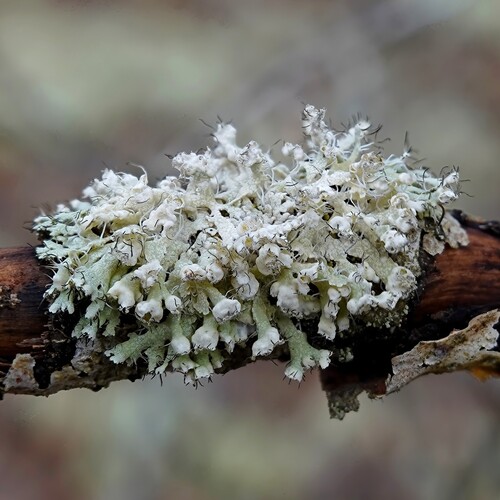
(c) Hans Ritter, some rights reserved (CC BY-NC), uploaded by Hans Ritter · cc-by-nc
Physcia
Sign in to savePhyscia is a genus of lichen-forming fungi in the family Physciaceae. The widely distributed genus contains about 80 species. The genus is cosmopolitan, and has been extensively studied in various regions in the past several decades, with significant biodiversity in South America identified as a central diversity hotspot. Physcia species are foliose, lichens that grow with a loose to close appressed habit. Their upper surface is typically whitish, pale greenish, green-grey, or dark grey in colour. The thallus colour remains relatively unchanged when moistened. Physcia lichens typically grow on
Species
Hooded Rosette Lichen
GENUS
- KingdomFungi
- PhylumAscomycota
- ClassLecanoromycetes
- OrderCaliciales
- FamilyPhysciaceae
Schimmels Physcia is een geslacht van korstmossen behorend tot de familie Physciaceae van de ascomyceten.[1] Het geslacht telt 73 soorten.[2] De korstmossen van het geslacht Physcia komen voor op stenen, de bast van bomen en struiken en op dood hout. De 2 - 8 cm grote thallus is bladachtig, gelobd, onregelmatig gevormd, rozetvormig of uit een geheel bestaand. Soms vloeien de kolonies samen. De bovenkant is groenachtig grijs of lichtgrijs tot donkergrijs, gewoonlijk bedekt met een witte laag (pruina). Het vruchtlichaam van de schimmel is een bruin tot zwart, hol tot vlak of iets bol apothecium. Het epihymenium, de laag boven het hymenium, is lichtbruin. Het hymenium en hypothecium zijn kleurloos. De parafysen zijn onvertakt of aan de toppen spaarzaam vertakt. De lichtbruine top van de parafyse is knuppelvormig met een dunne donkerbruine kap. De goed ontwikkelde medulla (merg) is wit of deels geel. De sporenzakjes zijn cilindrisch tot knuppelvormig en hebben acht ascosporen. De grijsbruine tot bruine of donkerbruine, spoelvormige, dikwandige ascosporen hebben een tussenwand. Dwarsdoorsnde van het apothecium van Physcia pulverulenta. (Volgens Nienburg, 1913.) t = hymenium, sp=asci, p=
via GBIF
Museum specimens
- Specimen records
- 5,423
- With media
- 2,884
- Family
- Physciaceae
- Collections
- US, F
- Recorded in
- United States, Guatemala
Wikidata facts
- Instance of
- taxon
- Parent taxon
- Physciaceae
- Image
- Physcia millegrana 140676.jpg
Show 6 more facts
- Commons category
- Physcia
- taxon name
- Physcia
- taxon rank
- genus
- taxonomic type
- Physcia tenella
- taxon common name
- Vingermos
- taxon author citation
- (Schreb.) Michx.
via Wikidata · CC0
~25 min read
Encyclopedic overview
15 sectionsContents
- Systematics
- Historical taxonomy
- Infrageneric classification
- Naming
- Species pairs
- Description
- Chemistry
- Comparison with similar genera
- Habitat and distribution
- Species interactions
- Species
- Biomonitoring
- References
- Citations
- Cited literature
Physcia is a genus of lichen-forming fungi in the family Physciaceae. The widely distributed genus contains about 80 species. The genus is cosmopolitan, and has been extensively studied in various regions in the past several decades, with significant biodiversity in South America identified as a central diversity hotspot. Physcia species are foliose, lichens that grow with a loose to close appressed habit. Their upper surface is typically whitish, pale greenish, green-grey, or dark grey in colour. The thallus colour remains relatively unchanged when moistened. Physcia lichens typically grow on bark, on wood, or rock, although they have occasionally been recorded dwelling on man-made structures. They thrive in nutrient-rich environments and are expanding rapidly in urban areas of the United Kingdom previously affected by SO2 pollution.
The main characteristics that separate Physcia from similar genera in the same order, including Dirinaria, Heterodermia, Hyperphyscia, Kashiwadia, Phaeophyscia, and Pyxine, are the distinct morphology of its (brown and two-celled), its somewhat cylindrical (asexual reproductive structures), and the presence of the chemical atranorin in the upper . Physcia has been divided into sections based on morphological and chemical , such as the presence or absence of on the thallus margins and K+ (yellow) spot test reaction in the cortex.
Excerpted from Wikipedia’s “Physcia” article, available under the CC BY-SA 4.0 licence.
Gallery (11)
Available in 14 languages
via Wikidata sitelinks · CC0