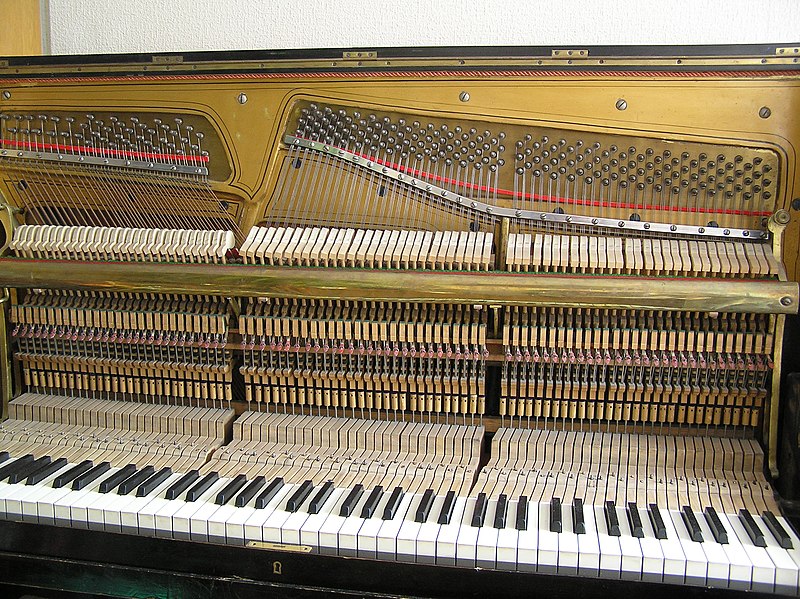
File:Upright_piano_inside.jpg · Wikimedia Commons · See Wikimedia Commons
piano
Sign in to saveAlso known as pianoforte, concert grand piano, fortepiano, spinet, spinnet
A piano is a keyboard instrument that produces sound when its keys are depressed, activating an action mechanism where hammers strike strings. Modern pianos have a row of 88 black and white keys—with the exception of the Bosendörfer and Stuart & Sons pianos—and tuned to a chromatic scale in equal temperament. A musician who specializes in piano is called a pianist.
A piano is a keyboard instrument where pressing keys causes hammers to strike strings, producing sound, and it typically has 88 black and white keys tuned to a chromatic scale. Pianos are important instruments used by musicians called pianists and have been central to both classical and popular music traditions.
AI-generated from the Wikipedia summary — may contain errors.
Key facts
- Instrument.name
- Piano
- Instrument.background
- keyboard
- Instrument.hornbostel_sachs
- 314.122-4-8
- Instrument.hornbostel_sachs_desc
- Simple chordophone with keyboard sounded by hammers
- Instrument.inventors
- Bartolomeo Cristofori
- Instrument.developed
- Early 18th century
- Instrument.range
- frameless|upright|center
via Wikipedia infobox
Wikidata facts
- Official name
- gravicembalo col piano e forte
- Image
- Steinway & Sons upright piano, model K-52 (mahogany finish), manufactured at Steinway's factory in New York City.jpg
Show 13 more facts
- location of creation
- Florence
- Commons gallery
- Piano
- Commons category
- Pianos
- topic's main category
- Category:Piano
- Hornbostel-Sachs classification
- 314.122-4-8
- inception
- 1720-00-00
- discoverer or inventor
- Bartolomeo Cristofori
- used by
- pianist
- on focus list of Wikimedia project
- Wikipedia:Vital articles/Level/4
- time of discovery or invention
- 1700-00-00
- described by source
- Encyclopædia Britannica 11th edition
- lowest note
- A
- different from
- piano
Sources (8)
via Wikidata · CC0
~63 min read
Encyclopedic overview
26 sectionsContents
- History
- Invention
- Early fortepiano
- Further developments
- Variations in shape and design
- Types
- <span class="anchor" id="grand piano"></span><span class="anchor" id="concert grand piano"></span><span class="anchor" id="parlor grand piano"></span><span class="anchor" id="boudoir grand piano"></span><span class="anchor" id="baby grand piano"></span> Grand
- Upright
- Specialized
- Electric, electronic, and digital
- Hybrid instruments
- Construction and components
- Keyboard
- Pedals
- Mechanics
- Maintenance
- Tuning
- Playing and technique
- Performance styles
- Traditional Burmese style
- Role
- See also
- References
- Bibliography
- Further reading
- External links
A piano is a keyboard instrument that produces sound when its keys are depressed, activating an action mechanism where hammers strike strings. Modern pianos have a row of 88 black and white keys—with the exception of the Bosendörfer and Stuart & Sons pianos—and tuned to a chromatic scale in equal temperament. A musician who specializes in piano is called a pianist.
There are two main types of piano: the grand piano and the upright piano. The grand piano offers better sound and more precise key control, making it the preferred choice when space and budget allow. The grand piano is also considered a necessity in venues hosting skilled pianists. The upright piano is more commonly used because of its smaller size and lower cost.
Excerpted from Wikipedia’s “piano” article, available under the CC BY-SA 4.0 licence.
Gallery (52)
Available in 150 languages
- Español
- Français
- Deutsch
- 中文
- 日本語
- Русский
- Português
- Italiano
- العربية
- हिन्दी
- abstract
- Afrikaans
- Albanian
- Albanian
- Amharic
- Aragonese
- Armenian
- Assamese
Show 131 more
- Asturian
- azb
- Azerbaijani
- Bahasa Indonesia
- Bangla
- Bashkir
- Basque
- bat_smg
- be_x_old
- Belarusian
- Bosnian
- Breton
- Bulgarian
- Burmese
- Catalan
- cdo
- Cebuano
- Central Kurdish
- Cherokee
- Cornish
- Crimean Tatar
- Croatian
- Czech
- Danish
- Egyptian Arabic
- Esperanto
- Estonian
- Fiji Hindi
- Filipino
- Finnish
- fiu_vro
- Galician
- Georgian
- Greek
- Guarani
- Gujarati
- Hakka Chinese
- Hebrew
- Hungarian
- hyw
- Iban
- Icelandic
- Ido
- Iloko
- Interlingua
- Irish
- Javanese
- Kannada
- Kazakh
- kbp
- Kikuyu
- Komi
- Kurdish
- Kyrgyz
- Latin
- Latvian
- Limburgish
- Lingala
- Lingua Franca Nova
- Lithuanian
- Lojban
- Lombard
- Low German
- Luxembourgish
- Macedonian
- Madurese
- Malagasy
- Malay
- Malayalam
- Manx
- Marathi
- Mazanderani
- Mongolian
- Moroccan Arabic
- nah
- nds_nl
- Nederlands
- Newari
- Norwegian
- Norwegian Nynorsk
- Occitan
- Old English
- Picard
- Piedmontese
- Polski
- Punjabi
- Quechua
- roa_rup
- Romanian
- Romansh
- Rusyn
- Saterland Frisian
- Scots
- Serbian
- Serbian (Latin)
- Sicilian
- simple
- Sindhi
- Slovak
- Slovenian
- Somali
- Sundanese
- Svenska
- Swahili
- Tajik
- Tamil
- Telugu
- Tibetan
- Tiếng Việt
- Tok Pisin
- Toki Pona
- Türkçe
- Ukrainian
- Urdu
- Uyghur
- Uzbek
- Venetian
- Waray
- Welsh
- West Flemish
- Western Frisian
- Western Panjabi
- Wu Chinese
- Yiddish
- Zaza
- zh_min_nan
- zh_yue
- Zulu
- فارسی
- ไทย
- 한국어
via Wikidata sitelinks · CC0