
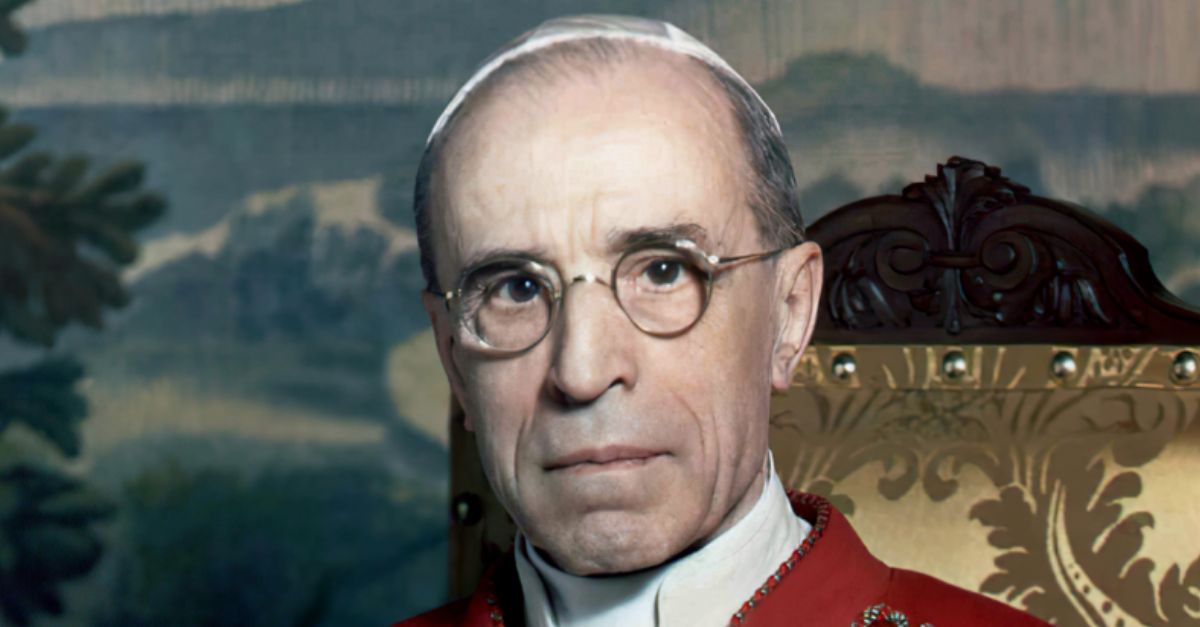
File:Pius_XII_with_tabard,_by_Michael_Pitcairn,_1951_(retouched).jpg · Wikimedia Commons · See Wikimedia Commons
Pius XII
Sign in to saveAlso known as Eugenio Pacelli, Pius PP. XII, Eugenio Marìa Giuseppe Giovanni Pacelli, Pope Pius XII, Pope Pio XII, Venerable Pius XII
pope of the Catholic Church from 1939 to 1958
OverviewAI-generated
Pius XII, born Eugenio Maria Giuseppe Giovanni Pacelli on 2 March 1876 in Rome, Italy, was a Latin Catholic priest and bishop who served as Pope. He also held the positions of Cardinal Secretary of State, cardinal, and Camerlengo of the Sacred College of Cardinals. His occupation included serving as a Catholic bishop, and he was a member of the Pontifical Academy of Sciences. He spoke Italian, German, Latin, and English.
He died of heart failure from natural causes on 9 October 1958 at Castel Gandolfo. His body was buried in the Vatican Grotto, St. Peter's Basilica. He received the Order of St. Gregory the Great, Order of Pius IX, Order of the Golden Spur, and the Equestrian Order of the Holy Sepulchre. He was nominated for the Nobel Peace Prize and holds the canonization status of Venerable. His motto was "Opus Justitiae Pax."
His notable works include *Discorso di sua santità Pio XII alla Pontificia Accademia delle scienze 22 novembre 1951*, *Discorsi e panegirici*, *Pius XII and Poland*, and *Über recht und staat*. He is recognized in the Popes collection. His quotes include, "All men are brothered in Jesus Christ," and "Perhaps the greatest sin in the world today is that men have begun to lose the sense of sin."
Synthesized by Vinony from 46 facts across 10 sources: Wikidata, Open Library, MusicBrainz, Last.fm, TMDb, Firecrawl, Crossref, Wikiquote, Vinony collections, Vinony graph. Generated from structured data (not the Wikipedia text) and checked against those facts — may still contain errors.
Film & TV
Rome, Italy
Known for
- The Pope and the Führer - The Secret Vatican Files of World War II2025
- Pope Pius XII and the Holocaust — Self (archive footage)2024
- Cinecittà, de Mussolini à la Dolce Vita — Self (archive footage)2021
- Hesburgh — Self (archive footage)2019
- The Mystery of Padre Pio — Himself (archive footage)2018
- The Man Nobody Knew: In Search of My Father, CIA Spymaster William Colby — Self (archive footage)2011
- The Pink Wall — Self2011
- Grace Kelly: The American Princess — Self (archive footage)1987
- Genocide — Self (archive footage) (as The Pope)1982
- La Rabbia — Self (archive footage)1963
via TMDB
Described at
Historical Figures Who Kept Their True Evil Hidden From The World
History often cloaked its villains in garments of greatness, only for time to strip away the illusion and reveal what truly lay beneath. Many figures celebrated as heroes or visionaries left behind a far darker imprint than their admirers ever suspected.
factinate.com →History often cloaked its villains in garments of greatness, only for time to strip away the illusion and reveal what truly lay beneath. Many figures celebrated as heroes or visionaries left behind a far darker imprint than their admirers ever suspected. King Leopold II of Belgium cloaked exploitation beneath a philanthropic banner, presenting his Congo venture as a civilizing mission through the International African Society. Behind this moral disguise, his regime orchestrated one of the deadliest colonial systems in recorded history. Ten to fifteen million Congolese perished through forced labor, starvation, and violent terror. Soldiers mutilated those who missed rubber quotas, and this enforced a reign of fear so absolute that Leopold never needed to visit the Congo himself to orchestrate its horror. At Auschwitz, Josef Mengele wore the white coat of a healer but wielded it as a weapon. Known grimly as the “Angel of Death,” he selected prisoners for experiments that blurred medicine into torture and curiosity into cruelty. His obsession with twins and genetics produced countless fatalities under the guise of science. After the war, Mengele escaped to South America to vanish into anonymity until his passing in 1979—his crimes continuing to haunt global memory long after his disappearance. Jimmy Savile stood before the British public as a beloved entertainer and philanthropist. Launching Top of the Pops and raising millions for charity, he cultivated an image of benevolence that got him a knighthood from Queen Elizabeth II in 1990. But only after his 2011 passing did the truth surface: he was a prolific predatory offender who preyed on the vulnerable, including hospital patients and children. His decades of abuse thrived in plain sight as institutions ignored countless warning signs. As WWII engulfed Europe, Pope Pius XII commanded immense spiritual authority over millions of Catholics. Yet historical evidence revealed he had early, detailed knowledge of what was happening in Germany as far back as 1942—and still chose public silence. His calculated neutrality shielded the Church but stained his moral legacy. By prioritizing institutional caution over moral outcry, he left historians divided and believers shaken about faith’s responsibility during humanity’s darkest chapter. History's most fascinating stories and darkest secrets, delivered to your inbox daily. Mao Zedong’s “Little Red Book” became both a political manifesto and a tool of devotion, fueling his transformation into a living god during China’s Cultural Revolution. This cult of personality justified purges, persecution, and ideological violence on an unprecedented scale. Under his Great Leap Forward, collectivization and reckless agricultural policies led to famine and people passing on a staggering level, and estimates range from fifteen to forty-five million lives lost. His legacy stands as a warning of ideology unrestrained by humanity. For generations, Christopher Columbus was revered as a courageous visionary who bridged continents. Schoolbooks and statues enshrined him as the discoverer of the New World, his voyages celebrated as triumphs of exploration and faith in human progress. But records later revealed his rule in the Caribbean was marked by enslavement and execution. He helped establish the transatlantic slave trade, even reducing Indigenous communities to forced labor. The heroic myth of discovery crumbled beneath the weight of documented atrocity. Edward VIII’s abdication once symbolized romantic devotion—renouncing the British crown for love of Wallis Simpson. His dramatic gesture charmed the world and seemed to demonstrate individual freedom over duty, a modern fairy tale steeped in sacrifice. Only later did revelations of Nazi sympathies taint that image. His 1937 meeting with Hitler, hidden for decades, exposed troubling alliances that reframed his story from selfless love to moral failure, casting doubt on his loyalty to both cou
Excerpt from a page describing this subject · 40,000 chars · not written by Vinony
Wikidata facts
- Instance of
- human
- Given name
- Giovanni
- Gender
- male
- Citizenship
- Italy
- Place of birth
- Rome
- Place of death
- Castel Gandolfo
- Sibling
- Francesco Pacelli
- Occupation
- Catholic bishop
- Educated at
- Almo Collegio Capranica
- Languages spoken
- Spanish
- Religion
- Catholic Church
- Participant in
- 1939 conclave
- Academic degree
- laurea
- Image
- Pius XII with tabard, by Michael Pitcairn, 1951 (retouched).jpg
- Motto
- Opus Justitiae Pax
- Work location
- Vatican City
Show 18 more facts
- place of burial
- St. Peter's Basilica
- Commons category
- Pius XII
- date of birth
- 1876-03-02
- date of death
- 1958-10-09
- topic's main category
- Category:Pope Pius XII
- cause of death
- heart failure
- birth name
- Eugenio Maria Giuseppe Giovanni Pacelli
- manner of death
- natural causes
- nominated for
- Nobel Peace Prize
- canonization status
- Venerable
- consecrator
- Agostino Zampini
- feast day
- October 9
- significant person
- Ludwig Kaas
- depicted by
- Hitler's Pope
- date of burial or cremation
- 1958-10-13
- maintained by WikiProject
- WikiProject Catholicism
- described at URL
- www.wikitolica.com/p/papa-pio-xii
- described by source
- Wikitólica
Sources (12)
via Wikidata · CC0
~40 min read
Encyclopedic overview
Orders Ordination2 April 1899 by Francesco di Paola Cassetta Consecration13 May 1917 by Benedict XV Created cardinal16 December 1929 by Pius XI RankCardinal priest Personal details BornEugenio Maria Giuseppe Giovanni Pacelli (1876-03-02)2 March 1876 Rome, Italy
Died9 October 1958(1958-10-09) (aged 82) Castel Gandolfo, Italy
Excerpted from Wikipedia’s “Pius XII” article, available under the CC BY-SA 4.0 licence.
Gallery (13)
Available in 105 languages
- Español
- Français
- Deutsch
- 中文
- 日本語
- Русский
- Português
- Italiano
- العربية
- Achinese
- Afrikaans
- Albanian
- Albanian
- Aragonese
- Armenian
- Aymara
- Azerbaijani
- Bahasa Indonesia
Show 86 more
- Balinese
- Basque
- Bavarian
- be_x_old
- Belarusian
- Bikol
- Bishnupriya
- Breton
- Bulgarian
- Catalan
- cdo
- Croatian
- Czech
- Danish
- Egyptian Arabic
- Esperanto
- Estonian
- Filipino
- Finnish
- Friulian
- Galician
- Georgian
- Greek
- Haitian Creole
- Hakka Chinese
- Hebrew
- Hungarian
- Icelandic
- Ido
- Iloko
- Irish
- Javanese
- Latin
- Latvian
- Lingala
- Lithuanian
- Lombard
- Low German
- Lower Sorbian
- Luxembourgish
- Macedonian
- Madurese
- Malagasy
- Malay
- Maltese
- Marathi
- Mazanderani
- Mongolian
- Nederlands
- Norwegian
- Norwegian Nynorsk
- Occitan
- Pampanga
- Pashto
- Piedmontese
- Polski
- Quechua
- Romanian
- Scots
- Scottish Gaelic
- Serbian
- Serbian (Latin)
- Sicilian
- simple
- Slovak
- Slovenian
- Svenska
- Swahili
- Tamil
- Tiếng Việt
- Türkçe
- Ukrainian
- Upper Sorbian
- Urdu
- Venetian
- Waray
- Welsh
- Western Frisian
- Wu Chinese
- Yoruba
- Zaza
- zh_min_nan
- zh_yue
- فارسی
- ไทย
- 한국어
via Wikidata sitelinks · CC0