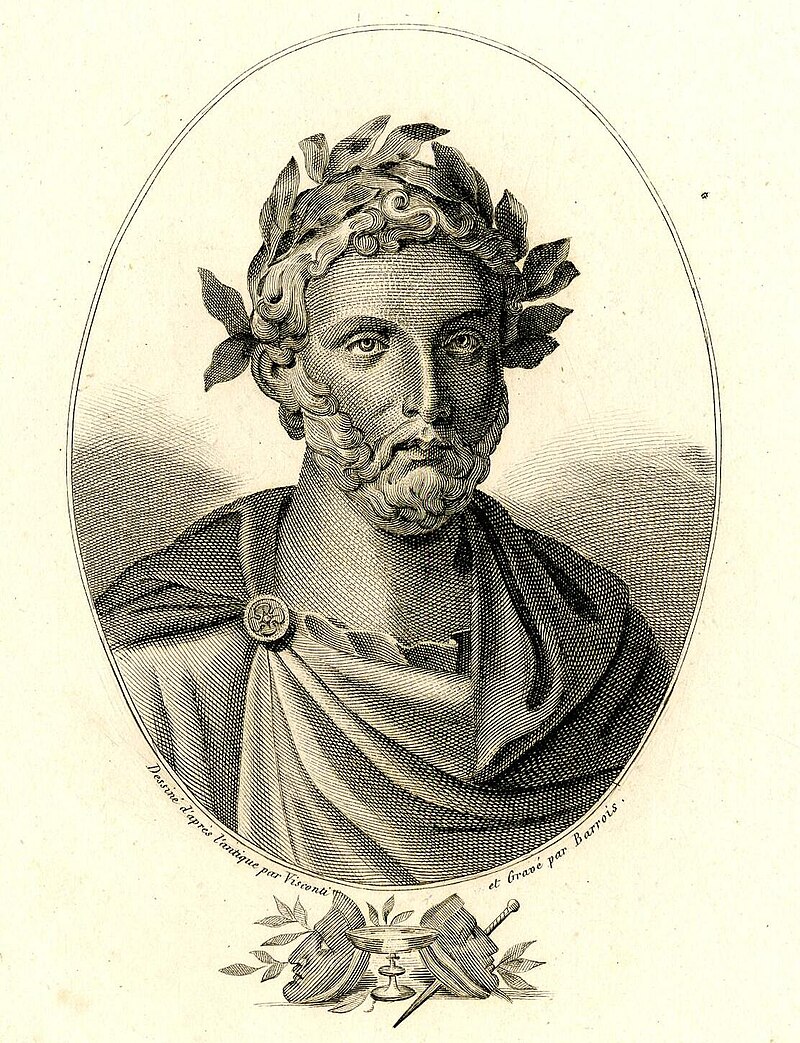
File:Plautus_18th_century_engraving_(cropped).jpg · Wikimedia Commons · See Wikimedia Commons
Plautus
Sign in to saveAlso known as Titus Maccius Plautus
Titus Maccius Plautus ( ; 254 – 184 BC) was a Roman playwright of the Old Latin period. His comedies are the earliest Latin literary works to have survived in their entirety. He wrote Palliata comoedia, the genre devised by Livius Andronicus, the innovator of Latin literature. The word Plautine () refers to both Plautus's own works and works similar to or influenced by his. He influenced some of the greatest figures in literature, including Shakespeare and Molière (The Miser is partly modeled after Plautus's Aulularia).
OverviewAI-generated
Plautus, known in his native language as T. Maccius Plautus, was a male playwright and writer from Ancient Rome. Born in Sarsina in 250 BCE, he died in Rome in 184 BCE. He wrote in Latin and spoke or wrote in Latin and Italian.
His notable works include Pseudolus, Menaechmi, Cistellaria, and Rudens. Additional titles associated with him are Greek Originals of the Plays, Captivi and the Mostellaria, Captiva and the Mostellaria, Captivi and Mostellaria of Plautus, and Casina. He is described by sources including the Brockhaus and Efron Encyclopedic Dictionary, Encyclopædia Britannica 11th edition, Pauly–Wissowa, and The Nuttall Encyclopædia.
Synthesized by Vinony from 18 facts across 4 sources: Wikidata, Open Library, TMDb, Europeana Sparql. Generated from structured data (not the Wikipedia text) and checked against those facts — may still contain errors.
Person · Open Library
- Works
- 28
Top works
- Greek Originals of the Plays
- Captivi and the Mostellaria
- Captiva and the Mostellaria
- Captivi and Mostellaria of Plautus
- Casina
via Open Library + Wikidata
Key facts
- Writer.name
- Plautus
- Writer.image
- Plautus 18th century engraving (cropped).jpg
- Writer.caption
- Imaginary 18th-century portrait
- Writer.birth_date
- 254 BC
- Writer.birth_place
- Sarsina, Umbria, Roman Republic
- Writer.death_date
- 184 BC
- Writer.death_place
- Rome, Roman Republic
- Writer.period
- Roman Republic
- Writer.genre
- Roman comedy
- Writer.language
- Latin
- Writer.occupation
- Playwright
via Wikipedia infobox
Wikidata facts
- Instance of
- human
- Gender
- male
- Citizenship
- Ancient Rome
- Place of birth
- Sarsina
- Place of death
- Rome
- Occupation
- writer
- Languages spoken
- Italian
- Notable work
- Asinaria
- Image
- Plautus 18th century engraving (cropped).jpg
Show 10 more facts
- topic's main category
- Category:Plautus
- Commons category
- Plautus
- date of birth
- 0250-00-00
- date of death
- 0184-00-00
- Commons Creator page
- Plautus
- writing language
- Latin
- name in native language
- T. Maccius Plautus
- Stack Exchange tag
- latin.stackexchange.com/tags/plautus
- P8168
- Ali Akbar Khan
- P13311
- Sarah Guppy
via Wikidata · CC0
Works in European collections
32 objects attributed to Plautus, held across European museums, libraries & archives · via Europeana
Comœdiæ

The Plautus of a Grand-speaking Officer

Plautus

Plautus

Plautus

Plautus

Plautus

Plautus

Plautus

Plautus

Plautus

Plautus

Plautus

Plautus

Plautus
Comoediae [Manuscript]

M. Plauti linguae latinae Principis comoediae. XX. recens ex collatione multorum codicum :

[Lector optime scito has comoedias viginti plautinas :
![Ex emendationibus, adque co [m] mentariis /](https://api.europeana.eu/thumbnail/v2/url.json?uri=https%3A%2F%2Fimagines.manuscriptorium.com%2Floris%2FNKCR__-NKCR__6_B_000007__1SERPB8-cs%2FIMG00000001%2Ffull%2F!400%2C400%2F0%2Fdefault.jpg&type=IMAGE)
Ex emendationibus, adque co [m] mentariis /

M. Accii Plavti Comoediae. V. /
Théatre de Plaute - t. 5,: Les menechmes,: Le marchand /
Théatre de Plaute - t. 1,: Amphitryon,: L 'asinaire /
Théatre de Plaute - t. 3,: Les captifs,: Casine,: La cassette /
Théatre de Plaute - t. 10,: La marmite,: Les deux bacchis /
Comœdiæ
Comœdiæ
Comœdiæ
Comœdiæ
M. Acci Plauti Comoediae superstites XX
M. Accius Plautus ex fide atque avctoritate complurium librorum manuscriptorum opera Dionys Lambini ... emendatus ad eodemque commentariis explicatus ... additi quoque sunt duo indices copiosissimi prior verbotum locitionum ..
M. Accii Plauti CapteIvei ad XLVII vett. codicum fidem
M. Accii Plauti Comoediae viginti
~87 min read
Encyclopedic overview
46 sectionsContents
- Biography
- Surviving plays
- Fragmentary plays
- Manuscript tradition
- Historical context
- Roman society deities
- Second Punic War and Macedonian War
- Influences
- Greek New Comedy
- Father–son relationships
- Farce
- Prologues
- Character
- The Clever Slave
- Understanding of Greek by Plautus' audience
- Disputed originality
- ''Contaminatio''
- Stagecraft
- The importance of the ''ludi''
- Geography of the stage
- Relationship with the audience
- Stock characters
- The clever slave
- The lustful old man
- Female characters
- Unnamed characters
- Language and style
- Overview
- Archaic features
- Means of expression
- Poetic devices
- Jokes and wordplay
- Meter
- Vigor and immediacy
- Food
- Influence
- The Middle Ages and early Renaissance
- Shakespeare
- Molière
- Later periods
- See also
- Notes
- References
- Editions
- Further reading
- External links
Titus Maccius Plautus ( ; 254 – 184 BC) was a Roman playwright of the Old Latin period. His comedies are the earliest Latin literary works to have survived in their entirety. He wrote Palliata comoedia, the genre devised by Livius Andronicus, the innovator of Latin literature. The word Plautine () refers to both Plautus's own works and works similar to or influenced by his. He influenced some of the greatest figures in literature, including Shakespeare and Molière (The Miser is partly modeled after Plautus's Aulularia).
==Biography== Not much is known about Plautus's early life. It is believed that he was born in Sarsina, a small town in Emilia Romagna in northern Italy, around 254 BC. According to Morris Marples, Plautus worked as a stage-carpenter or scene-shifter in his early years. It is from this work, perhaps, that his love of the theater originated. His acting talent was eventually discovered; and he adopted the nomen "Maccius" (from Maccus, a clownish stock character in Atellan Farce) and agnomen "Plautus" ("trampled flat", usually in reference to "flat-footed" but sometimes intending "flat-eared" like the ears of a hound). Tradition holds that he made enough money to go into the nautical business, but that the venture collapsed. He is then said to have worked as a manual laborer and to have studied Greek drama—particularly the New Comedy of Menander—in his leisure. His studies allowed him to produce his plays, which were released between and 184 BC. Plautus attained such popularity that his name alone became a hallmark of theatrical success.
Excerpted from Wikipedia’s “Plautus” article, available under the CC BY-SA 4.0 licence.
Available in 69 languages
- Español
- Français
- Deutsch
- 中文
- 日本語
- Русский
- Português
- Italiano
- العربية
- Afrikaans
- Albanian
- Aragonese
- Armenian
- Asturian
- Azerbaijani
- Basque
- be_x_old
- Belarusian
Show 50 more
- Bosnian
- Breton
- Bulgarian
- Catalan
- Cornish
- Croatian
- Czech
- Danish
- Egyptian Arabic
- Esperanto
- Estonian
- Finnish
- Friulian
- Galician
- Georgian
- Greek
- Hebrew
- Hungarian
- Icelandic
- Ido
- Kazakh
- Khmer
- Kyrgyz
- Latin
- Latvian
- Lithuanian
- Macedonian
- Nederlands
- Newari
- Northern Frisian
- Norwegian
- Polski
- Romanian
- Sardinian
- Scots
- Serbian
- Serbian (Latin)
- Sicilian
- simple
- Slovak
- Slovenian
- Svenska
- Tatar
- Türkçe
- Ukrainian
- Welsh
- Wu Chinese
- zh_yue
- فارسی
- 한국어
via Wikidata sitelinks · CC0