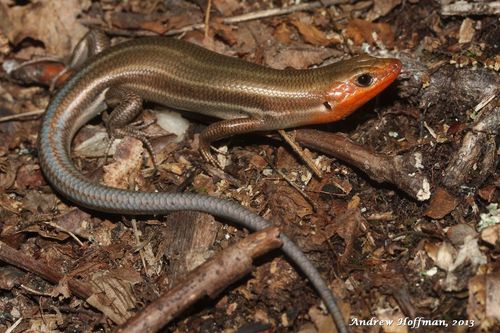
(c) Andrew Hoffman, some rights reserved (CC BY-NC-ND) · cc-by-nc-nd
Plestiodon
Sign in to savePlestiodon is a genus of lizards in the family Scincidae (skinks). The genus contains many species formerly classified under the genus Eumeces, except those now placed in Mesoscincus. They are secretive, agile animals with a cylindrical body covered with smooth, shiny scales. They are distributed from East Asia to throughout North America from southern Canada south to Mexico, including oceanic islands such as Bermuda.
Species
Common Five-lined Skink
GENUS
- KingdomAnimalia
- PhylumChordata
- ClassSquamata
- OrderSquamata
- FamilyScincidae
トカゲ属(-ぞく、蜥蜴属)は爬虫綱有鱗目トカゲ科(スキンク科)の属。スジトカゲ属とも。かつての学名はEumecesだったが、Eumeces属は分子系統の結果に基づき4属に分割された。日本産のものはすべてPlestiodon属に含まれ、トカゲ属という和名は現在この属に用いられている。
via GBIF
Museum specimens
- Specimen records
- 348
- With media
- 2
- Family
- Scincidae
- Collections
- FHSM, UTEP, ASU, UF, MVZ, USNM
- Recorded in
- United States, China
Wikidata facts
Show 4 more facts
- topic's main category
- Category:Plestiodon
- Commons category
- Plestiodon
- taxon name
- Plestiodon
- taxon rank
- genus
Sources (1)
via Wikidata · CC0
~8 min read
Encyclopedic overview
8 sectionsContents
- Defensive mechanism
- Reproduction
- [[Thermoregulation]]
- Systematics
- ''Plestiodon brevirostris'' group
- References
- Further reading
- External links
Plestiodon is a genus of lizards in the family Scincidae (skinks). The genus contains many species formerly classified under the genus Eumeces, except those now placed in Mesoscincus. They are secretive, agile animals with a cylindrical body covered with smooth, shiny scales. They are distributed from East Asia to throughout North America from southern Canada south to Mexico, including oceanic islands such as Bermuda.
==Defensive mechanism== The conspicuous coloring of species of Plestiodon is a survival trait: it attracts a predator's attention to the tail of the animal, which will break off when grabbed. A skink thus often manages to escape and hide under some rock, log, or fallen leaves while the predator still contemplates the wildly thrashing severed tail. (This is an instance of what is called autotomy: voluntarily shedding a body part in order to escape, and later regenerating the body part.) After the tail regenerates, it usually has the same color as the rest of the body and is typically shorter than the original tail. In some species, regrown tails are pinkish. A regrown tail has a cartilaginous rod for support instead of vertebrae.
Excerpted from Wikipedia’s “Plestiodon” article, available under the CC BY-SA 4.0 licence.