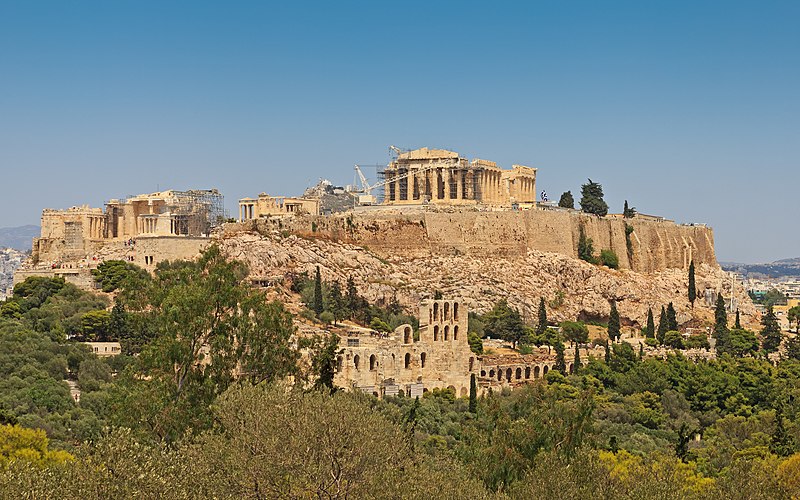
File:Attica_06-13_Athens_50_View_from_Philopappos_-_Acropolis_Hill.jpg · Wikimedia Commons · See Wikimedia Commons
polis
Sign in to savePolis (: poleis) means 'city' in Ancient Greek. The ancient word polis had socio-political connotations not possessed by modern usage. For example, Modern Greek πόλη (póli), "city", is located within a (chóra), "country", which is a πατρίδα (patrída) or "native land" for its citizens. In ancient Greece, the polis was the native land; there was no other. It had a constitution and demanded the supreme loyalty of its citizens. Χώρα was only the countryside, not a country. Ancient Greece was not a sovereign country; rather, it was territory occupied by Hellenes, people who claimed as their native
A polis was an ancient Greek city-state that functioned as its citizens' entire native land, complete with its own constitution and demanding their supreme loyalty—quite different from a modern city, which exists within a larger country. This distinction matters because it shows that ancient Greece was actually a collection of independent city-states rather than a unified nation, fundamentally shaping how Greek society, politics, and identity worked.
AI-generated from the Wikipedia summary — may contain errors.
Key facts
- Settlement.image_caption
- Acropolis of Athens, a noted polis of Classical Greece. The polis was the whole city, which had its own walls. Shown is a part of the polis, the akropolis, "city heights", which was never alone regarded as its own city. The origins of the settlement are lost in prehistoric times. Also included in the classical Athenian polis were suburban locations in the region of Attica, such as the port, Piraeus.
- Settlement.etymology
- "walls"
- Settlement.government_type
- Republic, or commonwealth. The ultimate authority was considered to reside in the citizenry, the demos, despite the broad variation in the form of the administration.
- Settlement.governing_body
- The assembly, or ekklesia, although in the more autocratic forms of administration, it met rarely. Magistrates performed the day-to-day governing, called archons.
- Settlement.unit_pref
- Metric
- Settlement.area_blank1_title
- max area of 60% of poleis
- Settlement.area_blank1_km2
- 100
- Settlement.area_blank2_title
- max area of 80% of poleis
- Settlement.area_blank2_km2
- 200
- Settlement.population_as_of
- 400 BC
- Settlement.population_total
- 7500000+
- Settlement.population_density_km2
- auto
- Settlement.population_demonym
- Dēmos in the Attic-Ionic dialects or dãmos in the Doric. The demonym was formed by producing the name of a people from the name of the polis. For example, the polis of Athens was named Athenai after the goddess Athena; hence the demos was the Athenaioi, "the Athenians".
- Settlement.name
- Polis
- Settlement.native_name_lang
- gr
- Settlement.settlement_type
- Constitutional microstate
- Settlement.image_skyline
- Attica 06-13 Athens 50 View from Philopappos - Acropolis Hill.jpg
via Wikipedia infobox
Wikidata facts
- Has part
- Khôra
Show 3 more facts
- partially coincident with
- city-state
- culture
- Ancient Greece
- different from
- emporium
Sources (2)
via Wikidata · CC0
~42 min read
Encyclopedic overview
15 sectionsContents
- Definition
- Modern usage
- Modern models
- The subjective element of a model
- Problems with Coulanges' ancient city
- Problems with the city-state
- Ancient Greek models
- Aristotle's polis
- The polis as community
- The polis as state
- See also
- Notes
- References
- Sources
- External links
Polis (: poleis) means 'city' in Ancient Greek. The ancient word polis had socio-political connotations not possessed by modern usage. For example, Modern Greek πόλη (póli), "city", is located within a (chóra), "country", which is a πατρίδα (patrída) or "native land" for its citizens. In ancient Greece, the polis was the native land; there was no other. It had a constitution and demanded the supreme loyalty of its citizens. Χώρα was only the countryside, not a country. Ancient Greece was not a sovereign country; rather, it was territory occupied by Hellenes, people who claimed as their native language some dialect of Ancient Greek.
Poleis did not only exist within the area of the modern Republic of Greece. A collaborative study carried by the Copenhagen Polis Centre from 1993 to 2003 classified about 1,500 settlements of the Archaic and Classical ancient-Greek-speaking population as poleis. These ranged from the Caucasus to Southern Spain, and from Southern Russia to Northern Egypt, spread over the shores of the Mediterranean and Black Sea. They have been termed a network of micro-states. Many of the settlements still exist, such as Marseille and Syracuse, but they are no longer Greek or micro-states, belonging to other countries.
Excerpted from Wikipedia’s “polis” article, available under the CC BY-SA 4.0 licence.
Gallery (34)
Available in 72 languages
- Español
- Français
- Deutsch
- 中文
- 日本語
- Русский
- Português
- Italiano
- العربية
- हिन्दी
- Afrikaans
- Albanian
- Albanian
- Armenian
- Asturian
- Azerbaijani
- Bahasa Indonesia
- Basque
Show 53 more
- Bavarian
- Belarusian
- Bosnian
- Breton
- Bulgarian
- Catalan
- Croatian
- Czech
- Danish
- Egyptian Arabic
- Esperanto
- Estonian
- Filipino
- Finnish
- Galician
- Georgian
- Greek
- Hebrew
- Hungarian
- Kazakh
- Kyrgyz
- Latin
- Latvian
- Limburgish
- Lithuanian
- Luxembourgish
- Macedonian
- Malay
- Mongolian
- Nederlands
- Norwegian
- Norwegian Nynorsk
- Occitan
- Polski
- Romanian
- Rusyn
- Serbian
- Serbian (Latin)
- simple
- Slovak
- Slovenian
- Svenska
- Tiếng Việt
- Türkçe
- Ukrainian
- Urdu
- Uzbek
- Venetian
- Wu Chinese
- zh_yue
- فارسی
- ไทย
- 한국어
via Wikidata sitelinks · CC0