File:Assorted_polygons.svg · Wikimedia Commons · See Wikimedia Commons
polygon
Sign in to saveAlso known as 2-polytope
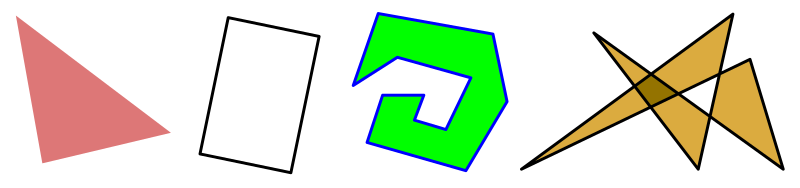
thumb|400px|right|Some polygons of different kinds: open (excluding its boundary), boundary only (excluding interior), closed (including both boundary and interior), and self-intersecting. In geometry, a polygon () is a plane figure made up of line segments connected to form a closed polygonal chain.
A polygon is a flat, closed shape made by connecting straight line segments end-to-end. Polygons are fundamental in geometry and appear everywhere in mathematics, design, and nature, making them essential for understanding how we measure and represent space.
AI-generated from the Wikipedia summary — may contain errors.
Wikidata facts
- Followed by
- polyhedron
- Image
- Areas.jpg
Show 8 more facts
- topic has template
- Template:Infobox polygon
- has facet polytope
- edge
- Commons category
- Polygons
- topic's main category
- Category:Polygons
- Commons gallery
- Polygon
- different from
- Schießstand
- on focus list of Wikimedia project
- Wikipedia:Vital articles/Level/4
- maintained by WikiProject
- WikiProject Mathematics
via Wikidata · CC0
~22 min read
Encyclopedic overview
23 sectionsContents
- Etymology
- Classification
- Number of sides
- Convexity and intersection
- Equality and symmetry
- Miscellaneous
- Properties and formulas
- Angles
- Area
- Simple polygons
- Regular polygons
- Self-intersecting
- Centroid
- Generalizations
- Naming
- History
- In nature
- Computer graphics
- See also
- References
- Bibliography
- Notes
- External links
thumb|400px|right|Some polygons of different kinds: open (excluding its boundary), boundary only (excluding interior), closed (including both boundary and interior), and self-intersecting. In geometry, a polygon () is a plane figure made up of line segments connected to form a closed polygonal chain.
The segments of a closed polygonal chain are called its edges or sides. The points where two edges meet are the polygon's vertices or corners. An '''n-gon' is a polygon with n sides; for example, a triangle is a 3-gon.
Excerpted from Wikipedia’s “polygon” article, available under the CC BY-SA 4.0 licence.
Gallery (18)
Available in 114 languages
- Español
- Français
- Deutsch
- 中文
- 日本語
- Русский
- Português
- Italiano
- العربية
- हिन्दी
- Afrikaans
- Albanian
- Aragonese
- Armenian
- Assamese
- Asturian
- Azerbaijani
- Bahasa Indonesia
Show 95 more
- Bangla
- Bashkir
- Basque
- be_x_old
- Belarusian
- Bikol
- Bosnian
- Bulgarian
- Burmese
- Catalan
- Central Kurdish
- Chuvash
- Croatian
- Czech
- Danish
- Esperanto
- Estonian
- Filipino
- Finnish
- Galician
- gcr
- Georgian
- Greek
- Gujarati
- Haitian Creole
- Hakka Chinese
- Hebrew
- Hungarian
- Icelandic
- Ido
- Irish
- Kabardian
- Kazakh
- Khmer
- Kurdish
- Kyrgyz
- Latin
- Latvian
- Lingua Franca Nova
- Lithuanian
- Lombard
- Low German
- Macedonian
- Madurese
- Malagasy
- Malay
- Malayalam
- Manx
- Mari
- Moksha
- Nederlands
- Nepali
- Norwegian
- Norwegian Nynorsk
- Occitan
- Oromo
- Pashto
- Polski
- Punjabi
- Quechua
- Romanian
- Scottish Gaelic
- Serbian
- Serbian (Latin)
- Shona
- Sicilian
- Silesian
- simple
- Sinhala
- Slovak
- Slovenian
- Somali
- Standard Moroccan Tamazight
- Svenska
- Swahili
- Tajik
- Tamil
- Tiếng Việt
- Toki Pona
- Türkçe
- Ukrainian
- Urdu
- Uzbek
- Venetian
- Waray
- Welsh
- West Flemish
- Wu Chinese
- Yiddish
- Yoruba
- zh_classical
- zh_yue
- فارسی
- ไทย
- 한국어
via Wikidata sitelinks · CC0