Portrait of a Youth
Also known as Portrait of a Young Man (The Broccardo Portrait), Man's portrait
painting by Giorgione, 1500, Szépművészeti Múzeum
Described at
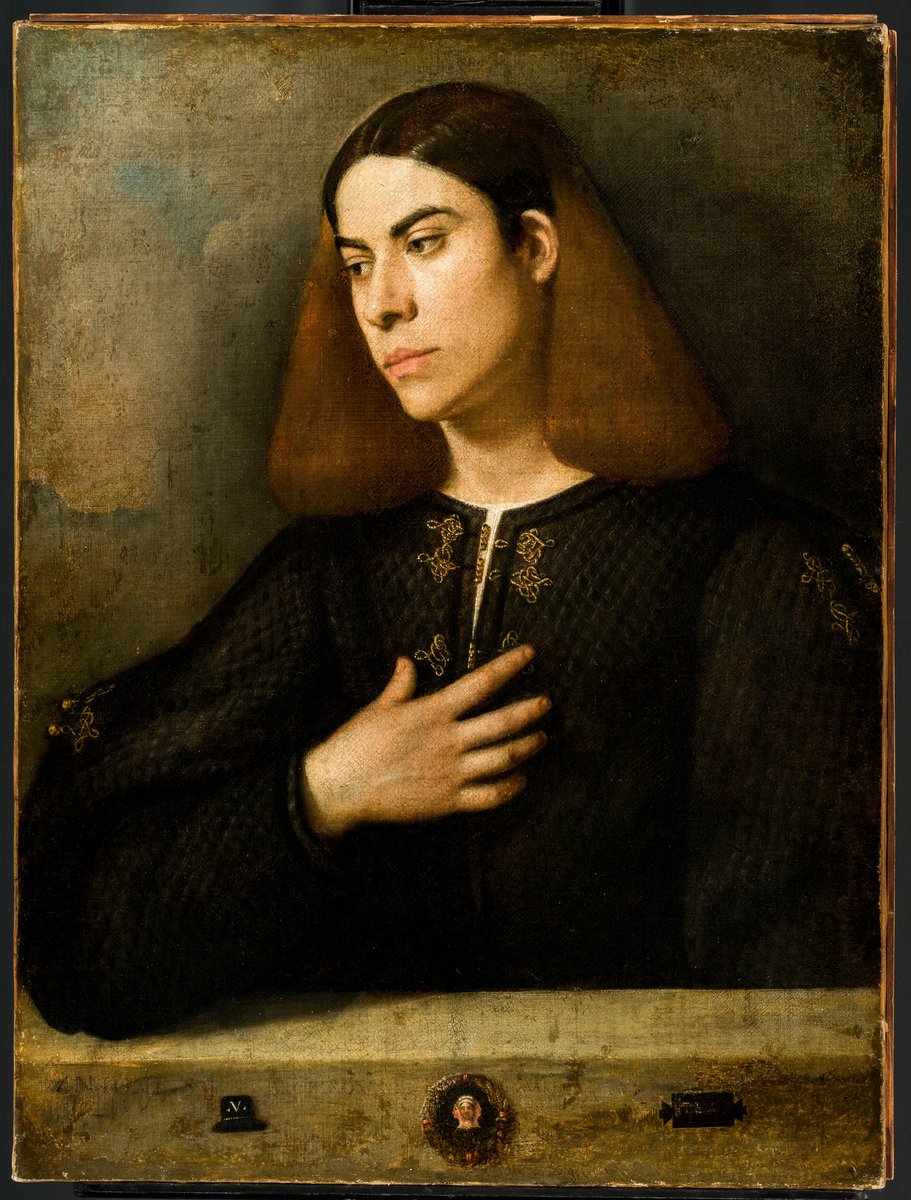
Portrait of a Young Man (The ʺBroccardo” Portrait) – Museum of Fine Arts, Budapest
mfab.hu →Artist Giorgione Castelfranco Veneto, ca. 1473/1474 – Venice, 1510 Culture Italian Date ca. 1503 Object type painting Medium, technique oil on canvas Dimensions 72.5 × 54 cm Inventory number 94 Collection Old Master Paintings On view Museum of Fine Arts, First Floor, European Art 1250–1600, Gallery XVII ‘Even today it is difficult to define what the advent of Giorgione means for the history of taste. Like Proust, he taught that the world could be looked at in a more pleasurable, more subjective way. His recipe for doing so was to infuse painting with the lyricism and romance that were already current in the prose and poetry of his time.’ It would be hard to find a better summary of Giorgione’s significance than the words of the great art historian John Pope-Hennessy. Though he died young, Giorgione utterly overturned the world of Venetian painting, and enshrouded not only narrative scenes in a magical, poetical atmosphere, but also transferred this approach to portraiture. So was born the introspective, emotive type of male portrait, of which the most inspired example is the Budapest Youth. Yet the image is also the most perplexing image in our collections. Its author and sitter are the subject of endless dispute, as are the meaning of the hieroglyphic emblems on the parapet, and even the very nature of the emotion which infuses the picture. Is the sitter in a reverie, tormented by the bittersweet pain of love, or does he exude some quiet melancholy from the depths – perhaps grief? Perhaps the painter captured a hallowed moment of religious devotion or poetic inspiration? Some even claimed it may be an inauguration into some secret society. Of course there is no objective answer: everyone interprets the mood according to his own inclinations. One thing is certain: nobody can resist the picture’s spell. Pigler, Andor, Katalog der Galerie Alter Meister: Museum der Bildenden Künste Budapest 1-2, Akadémiai Kiadó, Budapest, 1967, p. 264-266, 77. Sallay, Dóra – Tátrai, Vilmos – Vécsey, Axel (eds.), Botticellitől Tizianóig: az itáliai festészet két évszázadának remekművei, Szépművészeti Múzeum, Budapest, 2009, p. 300-301, no. 81 (Vécsey, Axel). Tátrai, Vilmos – Dobos, Zsuzsanna – Béres, Csenge Júlia, A Summary Catalogue of Italian Paintings, 1250-1800: Museum of Fine Arts Budapest, Museum of Fine Arts, Budapest, 2024, p. 120. Saint John the Evangelist Blesses the Poisoned Wine before the High Priest Aristodemus R.L. mester