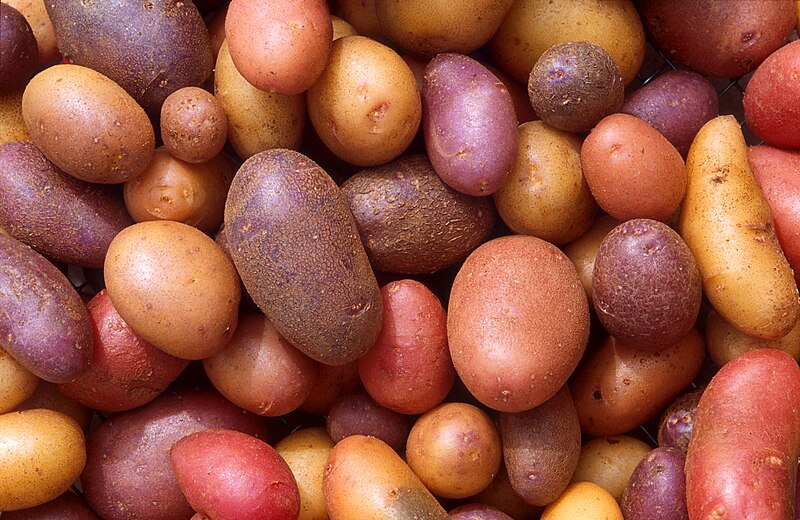
File:Patates.jpg · Wikimedia Commons · See Wikimedia Commons
A potato is a starchy vegetable that grows underground and serves as a staple food for many people around the world. It matters because it's nutritious, affordable, and can be grown in many different climates and soil conditions, making it an important crop for feeding large populations.
AI-generated from the Wikipedia summary — may contain errors.
Nutrition · Open Food Facts
Typical values per 100 g · averaged across 283 products
- Energy
- 114 kcal
- Fat
- 1.5 g
- — of which saturates
- 0.5 g
- Carbohydrates
- 21 g
- — of which sugars
- 1.5 g
- Fibre
- 2.1 g
- Protein
- 2.5 g
- Salt
- 0.48 g
via Open Food Facts · ODbL
Wikidata facts
- Instance of
- staple food
- Subclass of
- vegetable
- Has part
- starch
- Image
- Potatoe buds.jpg
Show 10 more facts
- Commons category
- Potatoes
- natural product of taxon
- potato
- topic's main category
- Category:Potatoes
- Unicode character
- 🥔
- history of topic
- potato cooking
- time of discovery or invention
- 8000-00-00
- different from
- papaya
- carbon footprint
- 0.2
- water footprint
- 287
- food energy
- 77
via Wikidata · CC0
~37 min read
Encyclopedic overview
The potato (/pəˈteɪtoʊ/) is a starchy tuberous vegetable native to the Americas that is consumed as a staple food in many parts of the world. Potatoes are underground stem tubers of the plant Solanum tuberosum, a perennial in the nightshade family Solanaceae.
Wild potato species can be found from the southern United States to southern Chile. Genetic studies show that the cultivated potato has a single origin, in the area of present-day southern Peru and extreme northwestern Bolivia. Potatoes were domesticated there about 7,000–10,000 years ago from a species in the S. brevicaule complex. Many varieties of the potato are cultivated in the Andes region of South America, where the species is indigenous.
Excerpted from Wikipedia’s “potato” article, available under the CC BY-SA 4.0 licence.