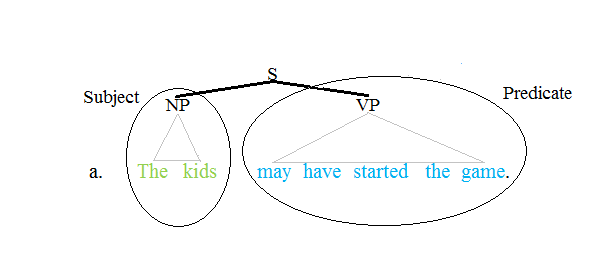
File:Predicate_tree_1.png · Wikimedia Commons · See Wikimedia Commons
A predicate is the part of a sentence that tells you what the subject is doing or what condition it's in, typically including the verb and any words that modify or complement it. It matters because understanding predicates helps you grasp the core meaning of sentences and how ideas are communicated in writing and speech.
AI-generated from the Wikipedia summary — may contain errors.
Wikidata facts
- Instance of
- sentence constituent
- Subclass of
- sentence constituent
- Part of
- sentence
- Image
- Predicate tree 2.png
Show 1 more fact
- different from
- predicative
Sources (2)
via Wikidata · CC0
~9 min read
Encyclopedic overview
The term predicate is used in two ways in linguistics and its subfields. The first defines a predicate as everything in a standard declarative sentence except the subject, and the other defines it as only the main content verb or associated predicative expression of a clause. Thus, by the first definition, the predicate of the sentence Frank likes cake is likes cake, while by the second definition, it is only the content verb likes, and Frank and cake are the arguments of this predicate. The conflict between these two definitions can lead to confusion.
Syntax
Excerpted from Wikipedia’s “predicate” article, available under the CC BY-SA 4.0 licence.
Gallery (2)
Available in 67 languages
- Español
- Français
- Deutsch
- 中文
- 日本語
- Русский
- Português
- Italiano
- العربية
- Albanian
- Armenian
- Asturian
- Azerbaijani
- Bahasa Indonesia
- Bangla
- Basque
- be_x_old
- Belarusian
Show 48 more
- Betawi
- Breton
- Bulgarian
- Catalan
- Central Kurdish
- Chuvash
- Croatian
- Czech
- Danish
- Erzya
- Esperanto
- Estonian
- Filipino
- Finnish
- Galician
- Gan Chinese
- Georgian
- Hebrew
- Hungarian
- Icelandic
- Inari Sami
- Kazakh
- Komi-Permyak
- Kyrgyz
- Latvian
- Lithuanian
- Lombard
- Macedonian
- Malagasy
- Malayalam
- Nederlands
- Norwegian
- Norwegian Nynorsk
- Polski
- Romanian
- Serbian
- simple
- Slovak
- Slovenian
- Svenska
- Tiếng Việt
- Türkçe
- Ukrainian
- Uzbek
- Wu Chinese
- zh_yue
- فارسی
- 한국어
via Wikidata sitelinks · CC0