
PROBA-3
Sign in to saveAlso known as Project for On-Board Autonomy 3
PROBA-3 is a dual-probe technological demonstration mission by the European Space Agency devoted to high-precision formation flying to achieve scientific coronagraphy. It is part of the series of PROBA satellites that are being used to validate new spacecraft technologies and concepts while also carrying scientific instruments. It lifted off aboard ISRO's PSLV-XL rocket from Satish Dhawan Space Center in Sriharikota, India. The project is managed by Damien Galano.
Key facts
- Spaceflight.name
- PROBA-3
- Spaceflight.image
- PROBA-3 artistic rendering.jpg
- Spaceflight.image_caption
- An artistic rendering of PROBA-3
- Spaceflight.mission_type
- Solar observatorytechnology demonstrator
- Spaceflight.operator
- ESA
- Spaceflight.website
- ,
- Spaceflight.mission_duration
- 2 years (nominal) (elapsed)
- Spaceflight.manufacturer
- S/C: SENER/Redwire/EADS CASA/GMV/SPACEBEL ASPIICS: CSL
- Spaceflight.launch_mass
- CSC and OSC in stack:
- Spaceflight.dimensions
- CSC: OSC:
- Spaceflight.launch_date
- 5 December 2024, 10:34 UTC
- Spaceflight.launch_rocket
- PSLV-XL C-59
- Spaceflight.launch_site
- First Launch Pad,Satish Dhawan Space Centre
- Spaceflight.launch_contractor
- NSIL ISRO
- Spaceflight.orbit_reference
- Geocentric
- Spaceflight.orbit_regime
- Highly elliptical Earth orbit
- Spaceflight.orbit_eccentricity
- 0.8111
- Spaceflight.orbit_inclination
- 59 degrees
via Wikipedia infobox
Described at
The Proba-3 program takes an important step in the integration of its two satellites - Sener
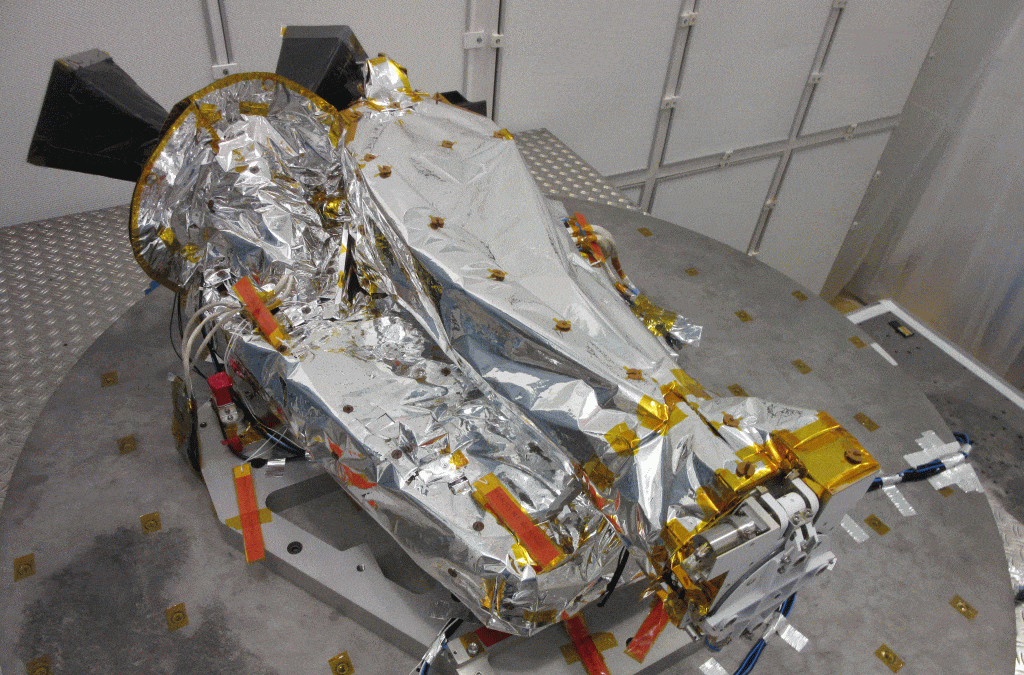
group.sener →wp-wpml current language Designa el código de país que se calcula según la dirección IP del usuario. Utilizada para determinar qué idioma debería usarse para usuarios. analytics event v2 analytics event metadata Permite consultas desde una base de datos de terceros para la implementación de contenido visual. Secure-ROLLOUT TOKEN Se usa para rastrear la interacción del usuario con el contenido integrado. Secure-YNID Se usa para rastrear la interacción del usuario con el contenido integrado. LAST RESULT ENTRY KEY Se usa para rastrear la interacción del usuario con el contenido integrado. LogsDatabaseV2:V LogsRequestsStore Se usa para rastrear la interacción del usuario con el contenido integrado. VISITOR INFO1 LIVE Intenta calcular el ancho de banda del usuario en páginas con vídeos de YouTube integrados. YSC Registra una identificación única para mantener estadísticas de qué vídeos de YouTube ha visto el usuario. ytidb::LAST RESULT ENTRY KEY Se usa para rastrear la interacción del usuario con el contenido integrado. YtIdbMeta databases Se usa para rastrear la interacción del usuario con el contenido integrado. SENER Aeroespacial, together with Airbus Defence and Space and QinetiQ, culminate new relevant milestones in the development and integration of the two satellites (Occulter and Coronagraph) that make up this mission. Simultaneously, SENER Aeroespacial has integrated the mission’s main payload, the coronagraph instrument, in the high-stability Optical Bench Assembly (OBA) developed by the company. SENER Aeroespacial is coordinating this new scientific and technological demonstration mission, which will revolutionize the conception and configuration of future scientific satellites. This is the first time that a Spanish company, SENER Aeroespacial, has led the full development of a European Space Agency mission. The Proba-3 program, spearheaded by SENER Aeroespacial, the project’s prime contractor for the European Space Agency (ESA), has accomplished several relevant milestones in the integration of the two satellites that will, for the first time, demonstrate a high-precision formation flight in space. In the future, spacecraft formation flying technology will be used to replace bulky structures (such as telescopes) with small independent platforms, which are easier to launch into space and can be combined to form large assemblies that work as a single entity, while achieving equivalent performance. In parallel, Proba-3 will perform scientific observations taking images of the Sun’s corona by means of a coronagraph instrument, placed in one of the spacecraft. Formation flying technology entails placing one of the two satellites in front of the instrument’s lens, thus blocking out the sun’s disk and creating an artificial eclipse in flight. For SENER Aeroespacial, Proba-3 marks a technical milestone, since it is the first time that a Spanish company has led the full development (i.e., is responsible for the entire flight and ground system) of a European Space Agency mission. The project has made an important step ahead with the start of the integration of the flight equipment, after the delivery of the platforms of the two satellites by Airbus Defence and Space. In this program, Airbus manufactures and integrates the platforms of both satellites. The first one, called Coronagraph Spacecraft (CSC), contains the main instrument (coronagraph), whereas the second satellite, called Occulter Spacecraft (CSO), carries an occulting disk that cover the sun’s disk as seen from the other satellite. Airbus delivered the structure of both satellites already integrated with the propulsion system, harness and the thermal control system. This platform integration was carried out at the company’s facilities in Madrid (Spain). The two satellites are now at the QinetiQ facility in Kruibeke (Belgium). For this program, QinetiQ is leading the activities to develop the avionics system, integrate all the electronic units within th
Excerpt from a page describing this subject · 33,595 chars · not written by Vinony
Wikidata facts
- Official website
- www.esa.int/proba3
- Image
- PSLV-C59, PROBA-3 - Dual spacecraft stack in cleanroom.webp
Show 3 more facts
- UTC date of spacecraft launch
- 2024-12-05
- described at URL
- www.group.sener/noticias/proba-3-program-takes-important-step-integration-two-satellites/?lang=en
- Commons category
- PROBA-3
via Wikidata · CC0
~11 min read
Encyclopedic overview
15 sectionsContents
- Mission concept
- Design
- CSC and OSC spacecraft
- Scientific payloads
- Ground segment and operations
- Background
- Timeline
- Development
- Launch campaign
- In orbit
- Results
- Coronagraph anomaly
- See also
- References
- External links
PROBA-3 is a dual-probe technological demonstration mission by the European Space Agency devoted to high-precision formation flying to achieve scientific coronagraphy. It is part of the series of PROBA satellites that are being used to validate new spacecraft technologies and concepts while also carrying scientific instruments. It lifted off aboard ISRO's PSLV-XL rocket from Satish Dhawan Space Center in Sriharikota, India. The project is managed by Damien Galano.
==Mission concept== PROBA-3 consists of two independent, three-axis-stabilized spacecraft: the Coronagraph Spacecraft (CSC) and the Occulter Spacecraft (OSC). The spacecraft fly close to each other on a highly elliptical orbit around the Earth, with an apogee at 60,500 km altitude.
Excerpted from Wikipedia’s “PROBA-3” article, available under the CC BY-SA 4.0 licence.