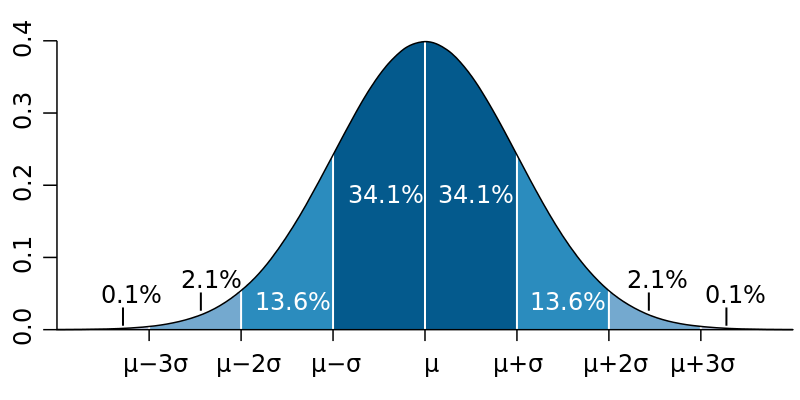
File:Standard_deviation_diagram_micro.svg · Wikimedia Commons · See Wikimedia Commons
probability theory
Sign in to saveAlso known as probability calculus
branch of mathematics concerning probability
OverviewAI-generated
Probability theory is a subject within mathematics. It has a dedicated category on the Wikimedia Commons platform. The topic is also associated with specific tags on several Stack Exchange sites, including Math Stack Exchange, MathOverflow, Computer Science Theory Stack Exchange, and Operations Research Stack Exchange.
The subject is described in various online resources, such as articles on GeeksforGeeks and Cuemath, as well as educational notes from the University of Cambridge and Pennsylvania State University. A search on PubMed yields 13,489 results for the term. Additionally, the topic is referenced by 1,974 other encyclopedia articles.
Synthesized by Vinony from 10 facts across 4 sources: Wikidata, Firecrawl, PubMed, Vinony graph. Generated from structured data (not the Wikipedia text) and checked against those facts — may still contain errors.
Research
13,489 papers- Probability theory and consistent reasoning.ReviewRisk analysis : an official publication of the Society for Risk Analysis · 2010North DWDOI: 10.1111/j.1539-6924.2010.01362.x
- Application of probability theory to neonatal cardiac evaluation.Cardiology in the young · 2023Rodríguez Velásquez JO, Correa Herrera SC, Bertolotto Cepeda AMDOI: 10.1017/S104795112200097X
- Probability Theory Plus Noise: Descriptive Estimation and Inferential Judgment.Topics in cognitive science · 2018Costello F, Watts PDOI: 10.1111/tops.12319
- Elucidating protein-ligand binding kinetics based on returning probability theory.The Journal of chemical physics · 2023Kasahara K, Masayama R, Okita K et al.DOI: 10.1063/5.0165692
- The origins of the treatment of uncertainty in clinical medicine - Part 2: the emergence of probability theory and its limitations.ReviewJournal of the Royal Society of Medicine · 2020Matthews RADOI: 10.1177/0141076820928901
- People's conditional probability judgments follow probability theory (plus noise).Cognitive psychology · 2016Costello F, Watts PDOI: 10.1016/j.cogpsych.2016.06.006
- Probability theory, not the very guide of life.Psychological review · 2009Juslin P, Nilsson H, Winman ADOI: 10.1037/a0016979
- Uniform probability in cosmology.Studies in history and philosophy of science · 2023Wenmackers SDOI: 10.1016/j.shpsa.2023.08.009
via PubMed
Described at

Probability Theorems | Theorems and Examples - GeeksforGeeks
Your All-in-One Learning Portal: GeeksforGeeks is a comprehensive educational platform that empowers learners across domains-spanning computer science and programming, school education, upskilling, commerce, software tools, competitive exams, and more., Your All-in-One Learning Portal. It contains well written, well thought and well explained computer science and programming articles, quizzes and practice/competitive programming/company interview Questions.
geeksforgeeks.org →6. Independent Events: Two events are said to be independent if the occurrence of one event does not depend upon the other. This rule is known as the Theorem of Addition for Mutually Exclusive Events. When the events are overlapping, the theorem of addition determines the probability that one or more events would occur in a single trial. This is a case of overlapping events as some students who passed in Math may have passed in English too and some students who passed in English may have passed in Math too. Thus we need to remove these common students from the sum of students who passed in Math and English. Thus, using the theorem of addition for overlapping events, we get: When we have to determine the probability of joint occurrence or occurrence in unison of two or more than two events, the theorem of multiplication is used. For instance, the probability of getting the same number on two dice tossed simultaneously, drawing different coloured balls from a box having red, blue, and green balls. If this relationship does not hold true, events E1 and E2 are statistically not independent . Therefore, the overall chances that the policy will be introduced are 42%.
Excerpt from a page describing this subject · 20,224 chars · not written by Vinony
Wikidata facts
- Subclass of
- mathematics
- Part of
- measure theory
Show 7 more facts
- is the study of
- probability
- Commons category
- Probability theory
- topic's main category
- Category:Probability theory
- on focus list of Wikimedia project
- Wikipedia:Vital articles/Level/4
- Stack Exchange tag
- or.stackexchange.com/tags/probability-theory
- topic has template
- Template:Probability fundamentals
- described at URL
- online.stat.psu.edu/stat414/lesson/2/2.6
Sources (8)
via Wikidata · CC0
~24 min read
Encyclopedic overview
Probability theory or probability calculus is the branch of mathematics concerned with probability. Although there are several different probability interpretations, probability theory treats the concept in a rigorous mathematical manner by expressing it through a set of axioms. Typically these axioms formalise probability in terms of a probability space, which assigns a measure taking values between 0 and 1, termed the probability measure, to a set of outcomes called the sample space. Any specified subset of the sample space is called an event.
Central subjects in probability theory include discrete and continuous random variables, probability distributions, and stochastic processes (which provide mathematical abstractions of non-deterministic or uncertain processes or measured quantities that may either be single occurrences or evolve over time in a random fashion). Although it is not possible to perfectly predict random events, much can be said about their behavior. Two major results in probability theory describing such behaviour are the law of large numbers and the central limit theorem.
Excerpted from Wikipedia’s “probability theory” article, available under the CC BY-SA 4.0 licence.
Gallery (3)
Available in 86 languages
- Español
- Français
- Deutsch
- 中文
- 日本語
- Русский
- Português
- Italiano
- العربية
- हिन्दी
- Afrikaans
- Albanian
- Armenian
- Asturian
- azb
- Azerbaijani
- Bahasa Indonesia
- Bangla
Show 67 more
- Bashkir
- Basque
- be_x_old
- Belarusian
- btm
- Bulgarian
- Catalan
- Central Kurdish
- Chuvash
- Croatian
- Czech
- Danish
- Esperanto
- Estonian
- Filipino
- Finnish
- Galician
- Georgian
- Greek
- Hebrew
- Hungarian
- Icelandic
- Irish
- Javanese
- Kara-Kalpak
- Kazakh
- Kyrgyz
- Latin
- Latvian
- Lithuanian
- Macedonian
- Malay
- Mongolian
- Nederlands
- Norwegian
- Norwegian Nynorsk
- Occitan
- Odia
- Ossetic
- Polski
- Punjabi
- Romanian
- Scots
- Serbian
- Serbian (Latin)
- simple
- Sinhala
- Slovak
- Slovenian
- Sundanese
- Svenska
- Tajik
- Tamil
- Tiếng Việt
- Tumbuka
- Türkçe
- Turkmen
- Ukrainian
- Urdu
- Uzbek
- Welsh
- Wu Chinese
- Yiddish
- zh_yue
- فارسی
- ไทย
- 한국어
via Wikidata sitelinks · CC0