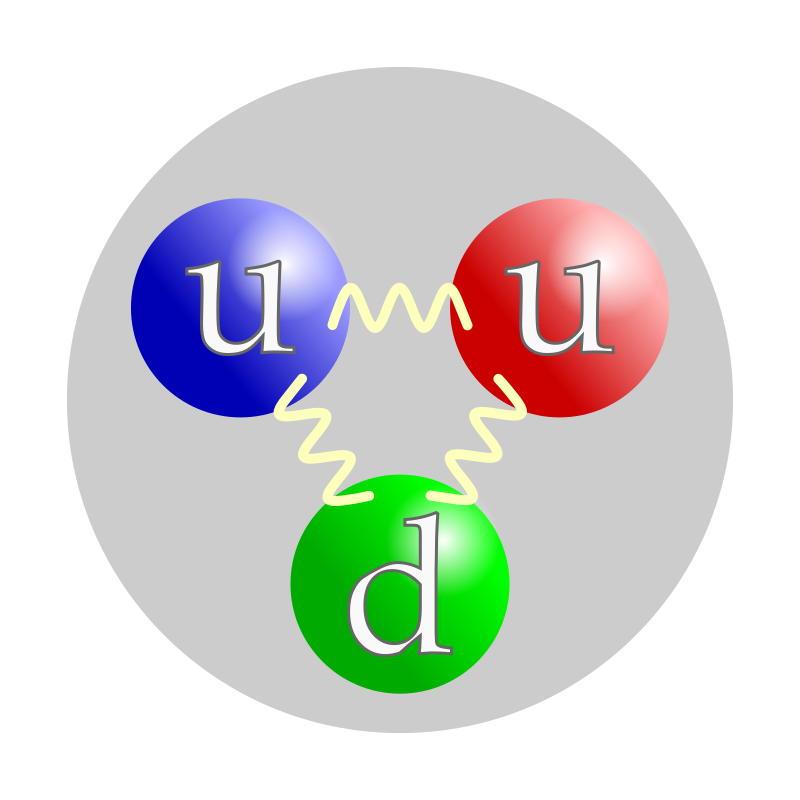
File:Quark_structure_proton.svg · Wikimedia Commons · See Wikimedia Commons
proton
Sign in to saveAlso known as p, ¹H⁺, 1H+, p⁺
A proton is a stable subatomic particle, symbol , H+, or 1H+ with a positive electric charge of +1 e (elementary charge). Its mass is slightly less than the mass of a neutron and approximately times the mass of an electron (the proton-to-electron mass ratio). Protons and neutrons, each with a mass of approximately one dalton, are jointly referred to as nucleons (particles present in atomic nuclei).
OverviewAI-generated
The proton, identified by the chemical formula H+, is a particle with a positive electric charge of 1. It was discovered in 1920. The particle has a spin quantum number of 0.5 and a parity quantum number of 1. Its isospin quantum number is 0.5, with an isospin z-component of 0.5.
The mass of the proton is 938.27208943, and its weight is 1.0078250319. It possesses a magnetic moment of 2.79284734463 and a g-factor of 5.5856946893. The particle has one hydrogen bond donor and zero hydrogen bond acceptors. Its topological polar surface area is 0, and its xlogP value is 0. Under pressure, the value is 100000000000000000000000000000000000.
Synthesized by Vinony from 26 facts across 4 sources: Wikidata, PubChem, PubMed, Vinony graph. Generated from structured data (not the Wikipedia text) and checked against those facts — may still contain errors.
Key facts
- Particle.classification
- Baryon
- Particle.name
- Proton
- Particle.image
- Quark structure proton.svg
- Particle.caption
- The valence quark content of a proton. The color assignment of individual quarks is arbitrary, but all three colors must be present. Forces between quarks are mediated by gluons.
- Particle.composition
- 2 up quarks (u), 1 down quark (d)
- Particle.statistics
- Fermionic
- Particle.group
- Hadron
- Particle.interaction
- Gravity, electromagnetic, weak, strong
- Particle.antiparticle
- Antiproton
- Particle.theorized
- William Prout (1815)
- Particle.discovered
- Observed as H+ by Eugen Goldstein (1886). Identified in other nuclei (and named) by Ernest Rutherford (1917–1920).
- Particle.symbol
- , , ,
- Particle.mean_lifetime
- > (stable)
- Particle.electric_dipole_moment
- <
- Particle.spin
- ħ
- Particle.parity
- +1
- Particle.condensed_symmetries
- I(JP) = (+)
via Wikipedia infobox
Chemical data
- Formula
- H+
- Molecular weight
- 1.0078250319 g/mol
- IUPAC name
- proton
- SMILES
- [1H+]
- InChIKey
- GPRLSGONYQIRFK-FTGQXOHASA-N
- XLogP
- 0
- Polar surface area
- 0 Ų
- H-bond donors
- 1
- H-bond acceptors
- 0
- Formal charge
- 1
via PubChem
Research
218,771 papers- Proton Transfer Mechanisms in Bimetallic Hydrogenases.Accounts of chemical research · 2021Tai H, Hirota S, Stripp STDOI: 10.1021/acs.accounts.0c00651
- Proton transfer pathway in anion channelrhodopsin-1.eLife · 2021Tsujimura M, Kojima K, Kawanishi S et al.DOI: 10.7554/eLife.72264
- Proton-detected solid-state NMR spectroscopy at aliphatic sites: application to crystalline systems.ReviewAccounts of chemical research · 2013Asami S, Reif BDOI: 10.1021/ar400063y
- The Protonic Brain: Nanoscale pH Dynamics, Proton Wires, and Acid-Base Information Coding in Neural Tissue.ReviewInternational journal of molecular sciences · 2026Grigorean VT, Tataru CI, Pantu C et al.DOI: 10.3390/ijms27020560
- Linkage between proton binding and folding in RNA: implications for RNA catalysis.ReviewBiochemical Society transactions · 2005Bevilacqua PC, Brown TS, Chadalavada D et al.DOI: 10.1042/BST0330466
- Halide-selective, proton-coupled anion transport by phenylthiosemicarbazones.Biochimica et biophysica acta. Biomembranes · 2022Howe ENW, Chang VT, Wu X et al.DOI: 10.1016/j.bbamem.2021.183828
- Proton Control of Transitions in an Amino Acid Transporter.Biophysical journal · 2019Wu Z, Alibay I, Newstead S et al.DOI: 10.1016/j.bpj.2019.07.056
- Proton transfer events in GFP.Physical chemistry chemical physics : PCCP · 2011Di Donato M, van Wilderen LJ, Van Stokkum IH et al.DOI: 10.1039/c1cp20387h
via PubMed
Wikidata facts
Show 22 more facts
- Monte Carlo Particle Number
- 2212
- discoverer or inventor
- Ernest Rutherford
- interaction
- gravity
- location of discovery
- University of Manchester
- Commons gallery
- Proton
- spin quantum number
- 0.5
- parity quantum number
- 1
- isospin z-component
- 0.5
- isospin quantum number
- 0.5
- g-factor
- 5.5856946893
- topic's main category
- Category:Proton
- antiparticle
- antiproton
- electric charge
- 1
- Commons category
- Protons
- under pressure
- 100000000000000000000000000000000000
- magnetic moment
- 2.79284734463
- different from
- hydronium
- on focus list of Wikimedia project
- Wikipedia:Vital articles/Level/4
- time of discovery or invention
- 1920-00-00
- native label
- proton
- named by
- Ernest Rutherford
- opposite of
- electron
via Wikidata · CC0
~23 min read
Encyclopedic overview
19 sectionsContents
- Description
- History
- Occurrence
- Stability
- Quarks and the mass of a proton
- Charge radius
- Pressure inside the proton
- Charge radius in solvated proton, hydronium
- Interaction of free protons with ordinary matter
- Proton in chemistry
- Atomic number
- Hydrogen ion
- Proton nuclear magnetic resonance (NMR)
- Human exposure
- Antiproton
- See also
- References
- Further reading
- External links
A proton is a stable subatomic particle, symbol , H+, or 1H+ with a positive electric charge of +1 e (elementary charge). Its mass is slightly less than the mass of a neutron and approximately times the mass of an electron (the proton-to-electron mass ratio). Protons and neutrons, each with a mass of approximately one dalton, are jointly referred to as nucleons (particles present in atomic nuclei).
One or more protons are present in the nucleus of every atom. They provide the attractive electrostatic central force which binds the atomic electrons. The number of protons in the nucleus is the defining property of an element, and is referred to as the atomic number (represented by the symbol Z). Since each element is identified by the number of protons in its nucleus, each element has its own atomic number, which determines the number of atomic electrons and consequently the identity and chemical characteristics of the element.
Excerpted from Wikipedia’s “proton” article, available under the CC BY-SA 4.0 licence.
Gallery (12)
Available in 157 languages
- Español
- Français
- Deutsch
- 中文
- 日本語
- Русский
- Português
- Italiano
- العربية
- हिन्दी
- Afrikaans
- Albanian
- Albanian
- Angika
- Aragonese
- Armenian
- Assamese
- Asturian
Show 138 more
- azb
- Azerbaijani
- Bahasa Indonesia
- Bangla
- Basque
- bat_smg
- be_x_old
- Belarusian
- Bikol
- Bosnian
- Breton
- Buginese
- Bulgarian
- Burmese
- Catalan
- cdo
- Cebuano
- Central Kurdish
- Chuvash
- Colognian
- Croatian
- Czech
- Danish
- Egyptian Arabic
- Esperanto
- Estonian
- Fiji Hindi
- Filipino
- Finnish
- fiu_vro
- Galician
- Gan Chinese
- Ganda
- gcr
- Georgian
- Greek
- Gujarati
- Haitian Creole
- Hebrew
- Hungarian
- Icelandic
- Ido
- Interlingua
- Irish
- Jamaican Creole English
- Javanese
- Kabyle
- Kalmyk
- Kannada
- Kashmiri
- Kazakh
- kbp
- Kurdish
- Kyrgyz
- Lao
- Latin
- Latvian
- Ligurian
- Limburgish
- Lingala
- Lingua Franca Nova
- Lithuanian
- Lombard
- Low German
- Luxembourgish
- Macedonian
- Maithili
- Malagasy
- Malay
- Malayalam
- map_bms
- Marathi
- Mari
- Moksha
- Mongolian
- Moroccan Arabic
- Nederlands
- Nepali
- Newari
- Northern Frisian
- Norwegian
- Norwegian Nynorsk
- Novial
- Occitan
- Odia
- olo
- Oromo
- Pashto
- Piedmontese
- Polski
- Punjabi
- Quechua
- Romanian
- Rusyn
- Sardinian
- Saterland Frisian
- Scots
- Serbian
- Serbian (Latin)
- Sicilian
- simple
- Sindhi
- Sinhala
- Slovak
- Slovenian
- Somali
- Sundanese
- Svenska
- Swahili
- Tajik
- Tamil
- Tatar
- Telugu
- Tiếng Việt
- Toki Pona
- Türkçe
- Ukrainian
- Urdu
- Uyghur
- Uzbek
- Venetian
- Waray
- Welsh
- West Flemish
- Western Frisian
- Western Panjabi
- Wolof
- Wu Chinese
- Xhosa
- Yiddish
- Yoruba
- zh_classical
- zh_min_nan
- zh_yue
- Zulu
- فارسی
- ไทย
- 한국어
via Wikidata sitelinks · CC0