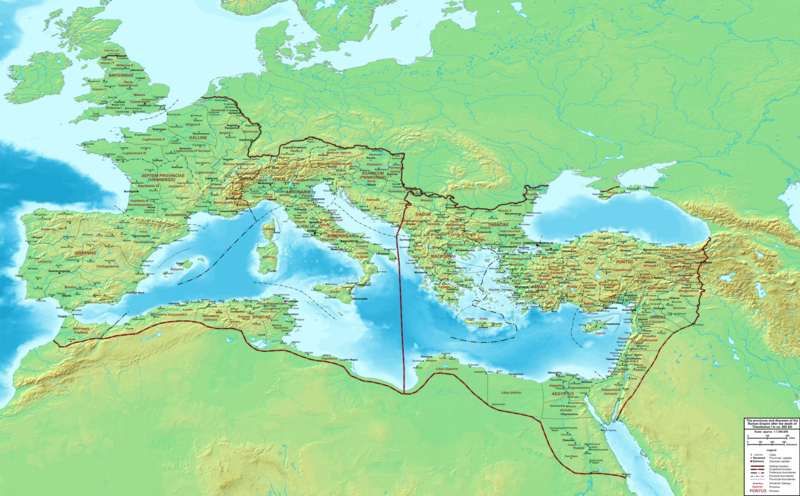
File:The_Roman_Empire_ca_400_AD.png · Wikimedia Commons · See Wikimedia Commons
province
Sign in to saveAlso known as provinces, landscape
A province is an administrative division within a country or state. The term derives from the ancient Roman , which was the major territorial and administrative unit of the Roman Empire's territorial possessions outside Italy. The term province has since been adopted by many countries. In some countries with no actual provinces, "the provinces" is a metaphorical term meaning "outside the capital city".
A province is an administrative division that divides a country or state into separate regions, each with its own local governance. The concept comes from the Roman Empire, which used provinces to organize and manage territory, and the term has since been adopted by many modern countries around the world.
AI-generated from the Wikipedia summary — may contain errors.
Wikidata facts
- Subclass of
- administrative territorial entity
- Image
- Map of country subdivisions (provinces).svg
Show 4 more facts
- topic's main category
- Category:Provinces
- Commons category
- Provinces
- P8168
- 8mm 2
- on focus list of Wikimedia project
- Wikipedia:Vital articles/Level/4
Sources (1)
via Wikidata · CC0
~26 min read
Encyclopedic overview
15 sectionsContents
- Etymology
- History and culture
- Legal aspects
- Current provinces
- Modern provinces
- Canada
- Pakistan
- Russia
- Polities translated
- Historic provinces
- Ancient, medieval and feudal
- Colonial and early modern
- See also
- References
- External links
A province is an administrative division within a country or state. The term derives from the ancient Roman , which was the major territorial and administrative unit of the Roman Empire's territorial possessions outside Italy. The term province has since been adopted by many countries. In some countries with no actual provinces, "the provinces" is a metaphorical term meaning "outside the capital city".
While some provinces were produced artificially by colonial powers, others were formed around local groups with their own ethnic identities. Many have their own powers independent of central or federal authority, especially in Canada. In other countries, like China or France, provinces are the creation of central government, with very little autonomy.
Excerpted from Wikipedia’s “province” article, available under the CC BY-SA 4.0 licence.
Gallery (4)
Available in 147 languages
- Español
- Français
- Deutsch
- 中文
- 日本語
- Русский
- Português
- Italiano
- العربية
- हिन्दी
- Achinese
- Afrikaans
- Albanian
- Albanian
- Aragonese
- Armenian
- Asturian
- Aymara
Show 128 more
- azb
- Azerbaijani
- Bahasa Indonesia
- Balinese
- Bangla
- Banjar
- Bashkir
- Basque
- be_x_old
- Belarusian
- Bhojpuri
- Bikol
- Bosnian
- Breton
- Bulgarian
- Burmese
- Catalan
- cbk_zam
- cdo
- Cebuano
- Central Kurdish
- Chechen
- Chuvash
- Corsican
- Croatian
- Czech
- Danish
- Egyptian Arabic
- Esperanto
- Estonian
- Filipino
- Finnish
- Galician
- Georgian
- Gorontalo
- Greek
- Guarani
- Gujarati
- Hakka Chinese
- Hebrew
- Hungarian
- hyw
- Iloko
- Interlingua
- Javanese
- Kannada
- Kazakh
- Khmer
- Kikuyu
- Kurdish
- Kyrgyz
- Ladino
- Latin
- Latvian
- Ligurian
- Limburgish
- Lingala
- Lingua Franca Nova
- Lithuanian
- Macedonian
- Malagasy
- Malay
- Manx
- map_bms
- Marathi
- Minangkabau
- Mingrelian
- Mirandese
- Moksha
- Mongolian
- Moroccan Arabic
- nah
- nds_nl
- Neapolitan
- Nederlands
- Nepali
- Newari
- Northern Sotho
- Norwegian
- Norwegian Nynorsk
- nrm
- Papiamento
- Pashto
- Piedmontese
- Polski
- Punjabi
- Quechua
- Romanian
- Sardinian
- Serbian
- Serbian (Latin)
- Shona
- Sicilian
- Silesian
- simple
- Sindhi
- skr
- Slovenian
- Sundanese
- Svenska
- Swahili
- Tajik
- Tamil
- Tatar
- Telugu
- Tibetan
- Tiếng Việt
- Tswana
- Türkçe
- Ukrainian
- Urdu
- Uzbek
- Venetian
- Walloon
- Waray
- West Flemish
- Western Frisian
- Western Panjabi
- Wu Chinese
- Yiddish
- Zaza
- Zeelandic
- zh_min_nan
- zh_yue
- Zulu
- فارسی
- ไทย
- 한국어
via Wikidata sitelinks · CC0