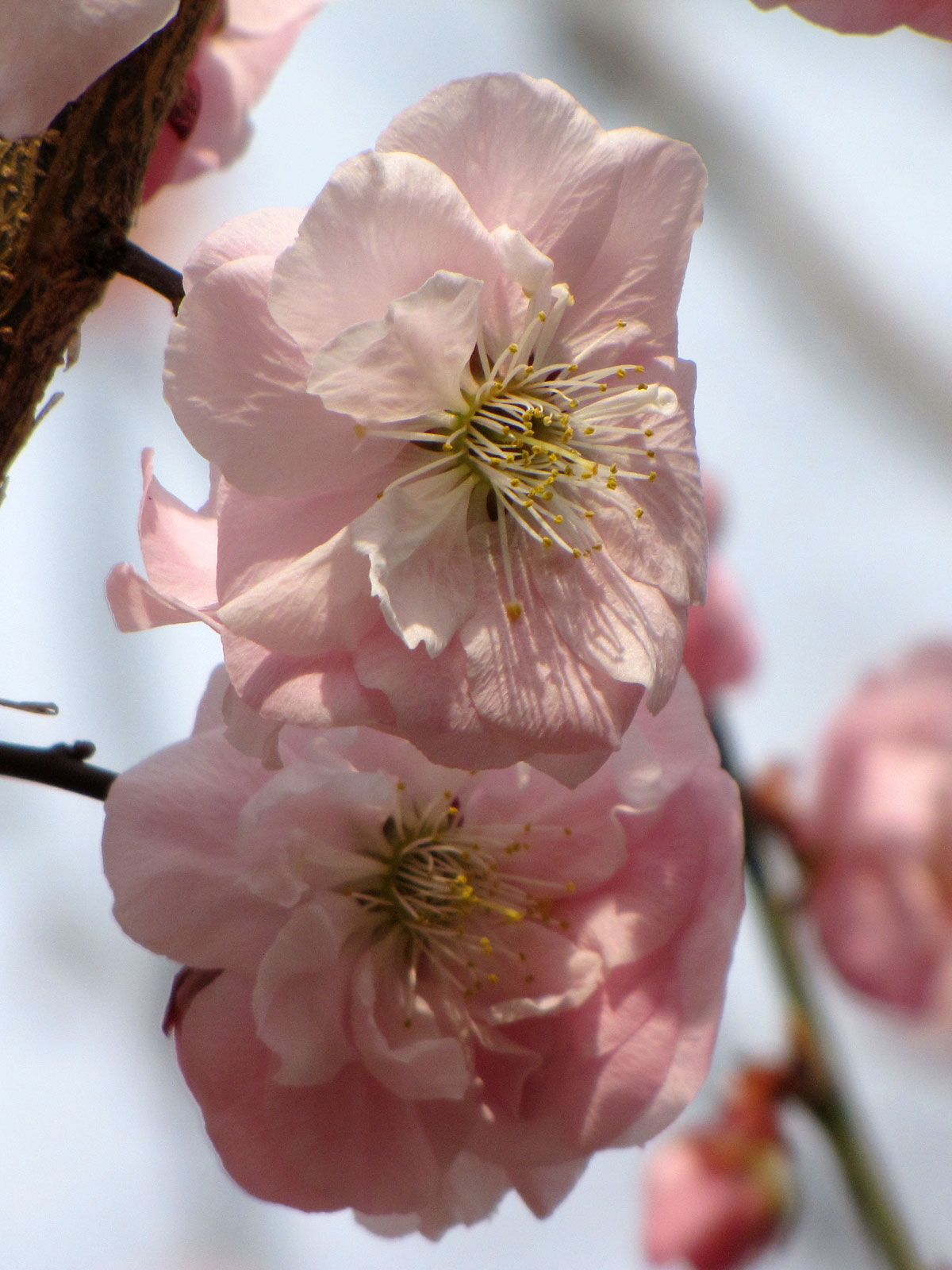
Encyclopedia of Life · EOL (see source)
Prunus mume
Sign in to saveAlso known as Ume, Japanese apricot, green plum, sour green plum
species of plant
OverviewAI-generated
Prunus mume, commonly known as the Japanese apricot, Ume, or Chinese plum, is a species of fruit tree within the family Rosaceae. It belongs to the genus Prunus and is classified under the order Rosales and class Magnoliopsida. The taxon was described by Siebold & Zucc. and is cited in the source Gujin Tushu Jicheng.
Native to South-Central China, Laos, and Vietnam, the species has been introduced to various regions including North-Central China, Southeast China, Hainan, Inner Mongolia, Japan, Korea, Manchuria, Taiwan, Tibet, and Xinjiang. Its taxon range also includes Fujian, Guangdong, and the Tibet Autonomous Region. The plant is utilized for afforestation, food, and as a medicinal plant.
The IUCN Red List assessed the species as Least Concern in 2019. It is noted as the National Flower of Taiwan. Occurrence records are held by institutions such as NCZP, LOB, CAS, CM, and USCH, with collections documented in the United States, China, and Japan.
Synthesized by Vinony from 38 facts across 7 sources: Wikidata, GBIF, Gbif Occ, IUCN Red List, Plants of the World, iDigBio, Vinony graph. Generated from structured data (not the Wikipedia text) and checked against those facts — may still contain errors.
Species
Least ConcernSPECIES
- KingdomPlantae
- PhylumTracheophyta
- ClassMagnoliopsida
- OrderRosales
- FamilyRosaceae
Der Titel dieses Artikels ist mehrdeutig. Weitere Bedeutungen werden unter UME aufgeführt Ume (Prunus mume; von jap. 梅, kana うめ), auch Japanische Aprikose, Japanische Pflaume oder Winterkirsche, ist eine Pflanzenart aus der Gattung Prunus in der Familie der Rosengewächse (Rosaceae). Sie gehört wie die Aprikose und die Sibirische Aprikose zur Sektion Armeniaca in der Untergattung Prunus. Eine andere oft als „Japanische Pflaume“ bezeichnete Art ist die Sumomo (Prunus salicina). Der asiatische Ume-Baum stammt aus China, aus der Gegend von Sichuan, Shaanxi, West-Hubei, dort méi (chinesisch 梅, Pinyin méi, Jyutping mui4 – „Ume“) bzw. méishù (梅樹 / 梅树, méishù, Jyutping mui4syu6 – „Ume-Baum“) genannt. Über kulturellen Austausch mit China wuchs der Ume-Baum jedoch schon in alten Zeiten auch in Japan und in Korea (dort maesil genannt). Er wird wegen seiner Früchte und Blüten kultiviert. In Japan gibt es mehr als 300 Kultursorten der Ume. Sie werden in drei Typen eingeteilt: Wildpflaumen-Typ (野梅系, yabai-kei), als Pfropfunterlage genutzt Purpur-blütiger Typ (紅梅系, kōbai-kei), eher als Zierbaum angebaut Bungo-Typ (豊後系, Bungo-kei), liefert die besten Früchte
via GBIF · IUCN · Kew POWO
Museum specimens
- Specimen records
- 335
- With media
- 295
- Family
- Rosaceae
- Collections
- NCZP, LOB, CAS, CM, USCH, SHTC
- Recorded in
- United States, China, Japan
Wikidata facts
- Instance of
- taxon
- Subclass of
- fruit tree
- Parent taxon
- Prunus
- Image
- Nagaoka-tenjin hakubai.jpg
- Said to be same as
- National Flower of Taiwan
- Has use
- medicinal plant
Show 10 more facts
- Commons category
- Prunus mume
- taxon rank
- species
- taxon name
- Prunus mume
- Commons gallery
- Prunus mume
- taxon common name
- mumovec
- IUCN conservation status
- Least Concern
- taxon range
- Zhoushan Archipelago
- short name
- P. mume
- taxon author citation
- Siebold & Zucc.
via Wikidata · CC0
~21 min read
Encyclopedic overview
Prunus mume, also known as a Chinese plum, is a tree species in the family Rosaceae. It is also referenced by its flowers as plum blossom. Although referred to as a plum in English, it is classified in the Armeniaca section of the genus Prunus, making it an apricot. Mei flowers, or meihua (梅花), which bloom in the late winter and early spring, notably during the spring festival (春節), symbolize endurance, as they are the first to bloom despite the cold; the flower is one of the Three Friends of Winter.
The plant is intimately associated with art, literature, and everyday life in China, from where it was then introduced to Korea, Vietnam, and Japan. In East Asian cuisine (Chinese, Japanese, Korean, and Vietnamese cuisine), the fruit, known as meizi (梅子) in Chinese, is used in juices and sauces; as a flavoring for alcohol; and may be pickled or dried. It is also used in traditional Chinese medicine. Meihua are also appreciated for their characteristic fragrance, which is unique among apricots.
Excerpted from Wikipedia’s “Prunus mume” article, available under the CC BY-SA 4.0 licence.