Pternandra · Kew POWO · Kew Plants of the World Online
Pternandra
Sign in to savePternandra is a genus of trees in the Melastomataceae family. There are 17 species in the taxa. It is native to an area from northern Australia through Southeast Asia to Hainan, Zhōngguó/China and India. The botanist William Jack who named the taxa, died at 27 years of age, the year his description was published.
Species
GENUS
- KingdomPlantae
- PhylumTracheophyta
- ClassMagnoliopsida
- OrderMyrtales
- FamilyMelastomataceae
General: Pternandra has been recorded from primary and disturbed
via GBIF · Kew POWO
Museum specimens
- Specimen records
- 657
- With media
- 613
- Family
- Melastomataceae
- Collections
- A
- Recorded in
- Malaysia, Indonesia, Brunei
Wikidata facts
- Instance of
- taxon
- Parent taxon
- Melastomataceae
Show 5 more facts
- taxon name
- Pternandra
- taxon rank
- genus
- topic's main category
- Category:Pternandra
- taxon common name
- 翼药花属
Sources (2)
via Wikidata · CC0
~3 min read
Encyclopedic overview
6 sectionsContents
- Description
- Taxonomy
- Distribution
- Species
- References
- Further reading
Pternandra is a genus of trees in the Melastomataceae family. There are 17 species in the taxa. It is native to an area from northern Australia through Southeast Asia to Hainan, Zhōngguó/China and India. The botanist William Jack who named the taxa, died at 27 years of age, the year his description was published.
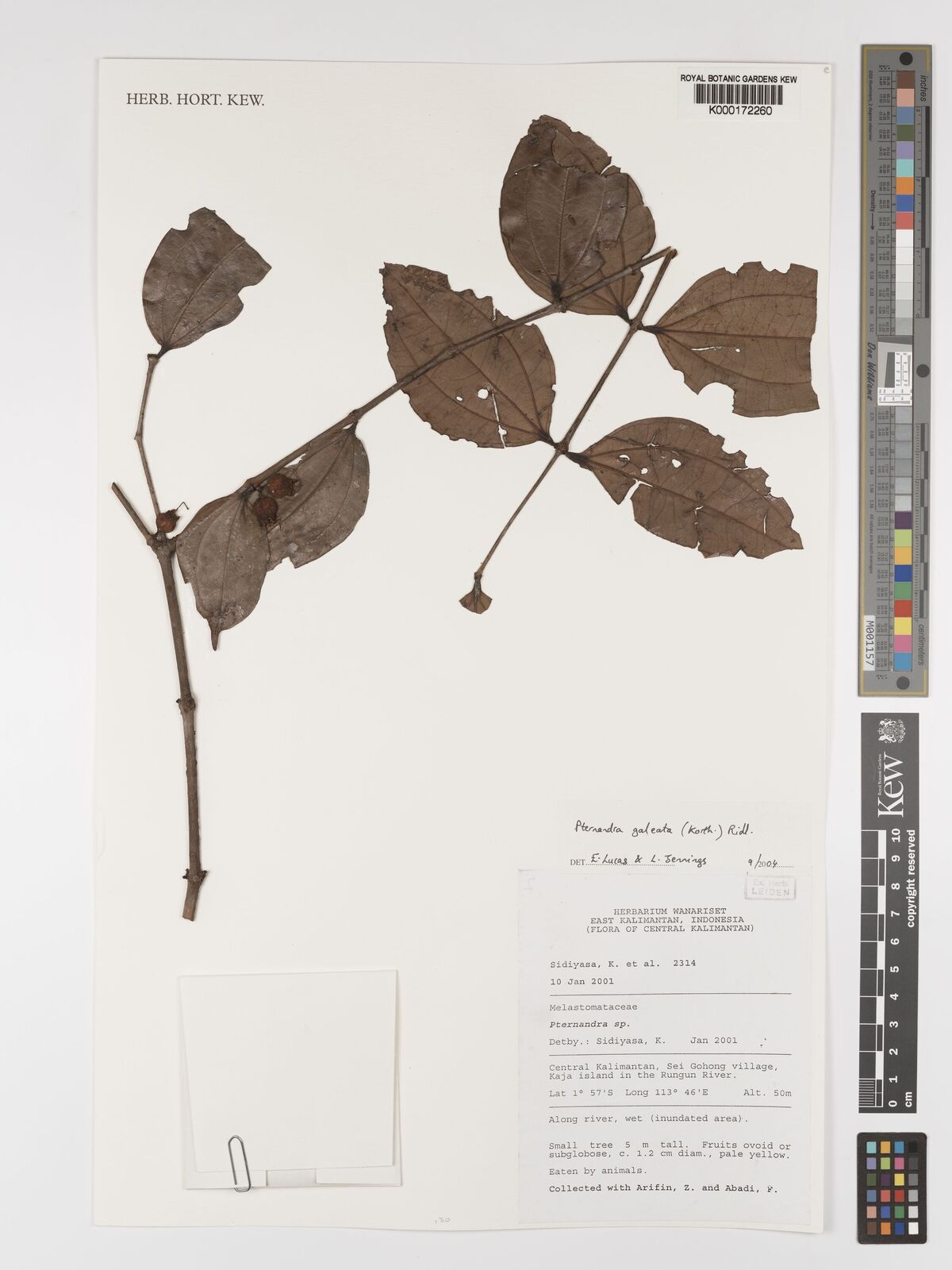
==Description== The plants of this genus grow as trees or sometimes as shrubs. The leaves have 3-5 veins and a generally short petiole. The terminal or axillary inflorescences can be umbellate, cymose, paniculate or of almost sessile clusters, the flowers are rarely solitary, and have small, paired connate bracts and bracteoles. Flowers come in groups of 4. Campanulate hypanthium has an outside pattern of plates or setose appendages. Fairly indistinct calyx lobes are either short teeth or not present, but generally persistent in the fruit. Broadly ovate to suborbicular petals can be white, yellow, blue or purple. There are 8 isomorphic stamens. The dolabriform to oblong anthers have lateral slits, with the connective mostly distinctly thickened, not prolonged and have at the most a small and calcarate dorsal appendage with no ventral appendage. Quadrilocular ovary, with glabrous summit and numerous ovules on parietal placentas. Filiform style. Fleshy indehiscent fruit. Numerous small seeds that are cuneate and minutely tuberculate.
Excerpted from Wikipedia’s “Pternandra” article, available under the CC BY-SA 4.0 licence.