File:Cetoine_global.jpg · Wikimedia Commons · See Wikimedia Commons
pupa
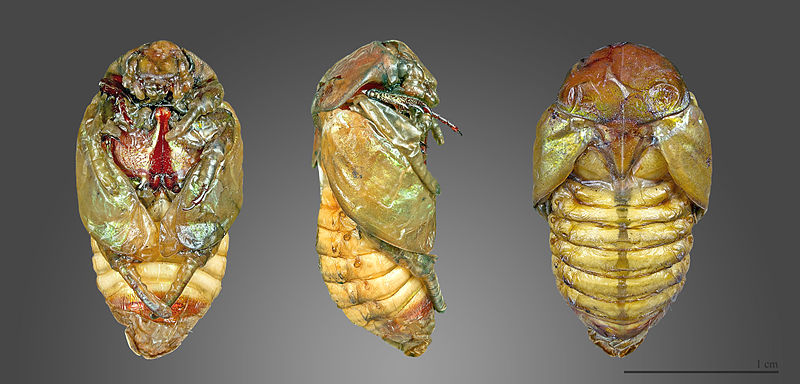
Sign in to savethumb|upright=1.6|Pupa of the rose chafer beetle, Cetonia aurata thumb|Tumbler (pupa) of a mosquito. Unlike most pupae, tumblers can swim around actively. A pupa (; : pupae) is the life stage of insects from the Holometabola clade undergoing transformation between immature and mature stages. Insects that go through a pupal stage are holometabolous: they go through four distinct stages in their life cycle, the stages thereof being egg, larva, pupa, and imago. The processes of entering and completing the pupal stage are controlled by the insect's hormones, especially juvenile hormone, prothoraci
A pupa is a stage in the life cycle of certain insects where they transform from their immature larval form into their adult form. This transformation stage is important because it allows insects like beetles and mosquitoes to completely reorganize their bodies, enabling them to develop wings, change their body structure, and transition to their adult lifestyle.
AI-generated from the Wikipedia summary — may contain errors.
Research
9,270 papers- The Pupa Stage Is the Most Sensitive to Hypoxia in Drosophila melanogaster.International journal of molecular sciences · 2024Stobdan T, Wen NJ, Lu-Bo Y et al.DOI: 10.3390/ijms25020710
- Non-CG DNA methylation marks the transition from pupa to adult in Helicoverpa armigera.Insect molecular biology · 2024Royle JW, Hurwood D, Sadowski P et al.DOI: 10.1111/imb.12917
- The larva and pupa of Anabolia appendix (Ulmer 1905) (Trichoptera: Limnephilidae) from China.Zootaxa · 2024Deng Z, Zang H, Wang M et al.DOI: 10.11646/zootaxa.5529.1.4
- Anaphylactic shock caused by silkworm pupa consumption in China.ReviewAllergy · 2008Ji KM, Zhan ZK, Chen JJ et al.DOI: 10.1111/j.1398-9995.2008.01838.x
- Description of the larva and pupa of Culex (Melanoconion) dureti Casal & Garcia and redescription of the adult male (Diptera: Culicidae).Zootaxa · 2024Bangher DN, Almirón WR, Stein MDOI: 10.11646/zootaxa.5443.2.7
- Polyphenol oxidase from edible insect Antheraea pernyi pupa: Characterization and browning mechanism.Food chemistry · 2025She Y, Song S, Liu Y et al.DOI: 10.1016/j.foodchem.2025.146641
- Where did the pupa come from? The timing of juvenile hormone signalling supports homology between stages of hemimetabolous and holometabolous insects.Philosophical transactions of the Royal Society of London. Series B, Biological sciences · 2019Jindra MDOI: 10.1098/rstb.2019.0064
- Prediction, identification, and analysis of major B-cell linear epitopes of bomb m 6 from silkworm pupa.Food chemistry · 2025Yue W, Huang S, Lin S et al.DOI: 10.1016/j.foodchem.2024.141211
via PubMed
Wikidata facts
- Followed by
- imago
- Follows
- insect larva
- Image
- Cetoine global.jpg
- Said to be same as
- chrysalis
Show 2 more facts
- Commons category
- Pupae
- on focus list of Wikimedia project
- Wikipedia:Vital articles/Level/4
via Wikidata · CC0
~12 min read
Encyclopedic overview
13 sectionsContents
- Position in life cycle
- Duration
- Emergence
- Pupal mating
- Defense
- Types
- Chrysalis
- Cocoon
- Puparium
- Gallery
- See also
- References
- External links
thumb|upright=1.6|Pupa of the rose chafer beetle, Cetonia aurata thumb|Tumbler (pupa) of a mosquito. Unlike most pupae, tumblers can swim around actively. A pupa (; : pupae) is the life stage of insects from the Holometabola clade undergoing transformation between immature and mature stages. Insects that go through a pupal stage are holometabolous: they go through four distinct stages in their life cycle, the stages thereof being egg, larva, pupa, and imago. The processes of entering and completing the pupal stage are controlled by the insect's hormones, especially juvenile hormone, prothoracicotropic hormone, and ecdysone. The act of becoming a pupa is called pupation, and the act of emerging from the pupal case is called eclosion or emergence.
The pupae of different groups of insects have different names such as chrysalis for the pupae of butterflies and tumbler for those of the mosquito family. Pupae may further be enclosed in other structures such as cocoons, nests, or shells.
Excerpted from Wikipedia’s “pupa” article, available under the CC BY-SA 4.0 licence.
Gallery (30)
Available in 74 languages
- Español
- Français
- Deutsch
- 中文
- 日本語
- Русский
- Português
- Italiano
- العربية
- हिन्दी
- Armenian
- Asturian
- Bahasa Indonesia
- Bangla
- Basque
- be_x_old
- Belarusian
- Bikol
Show 55 more
- Bulgarian
- Catalan
- Chuvash
- Croatian
- Czech
- Danish
- Esperanto
- Estonian
- Filipino
- Finnish
- Galician
- Georgian
- Greek
- Haitian Creole
- Hebrew
- Hungarian
- Icelandic
- Ido
- Irish
- Javanese
- Kabyle
- Kannada
- Kashmiri
- Kyrgyz
- Latvian
- Lithuanian
- Low German
- Malay
- Malayalam
- Nederlands
- Norwegian
- Norwegian Nynorsk
- Polski
- Quechua
- Romanian
- Serbian
- Serbian (Latin)
- simple
- Slovak
- Slovenian
- Svenska
- Swahili
- Tamil
- Tiếng Việt
- Türkçe
- Ukrainian
- Uzbek
- Welsh
- Western Frisian
- Wu Chinese
- zh_yue
- Zhuang
- فارسی
- ไทย
- 한국어
via Wikidata sitelinks · CC0