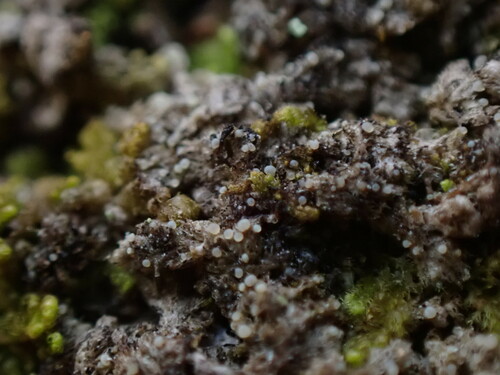
no rights reserved, uploaded by Randal · cc0
Puttea
Sign in to savePuttea is a genus of lichen-forming fungi with uncertain familial placement in the order Lecanorales. The genus comprises four species. Finnish lichenologists Soili Stenroos and Seppo Huhtinen established the genus Puttea in 2009 for the lichen species formerly known as Lecidea margaritella, which has undergone various reclassifications. Molecular phylogenetics analyses have shown that Puttea margaritella does not align closely with genera like Fellhanera or Micarea, but its precise familial placement remains uncertain. Puttea is characterized by an indistinct, lichenized thallus composed of d
Wikidata facts
- Instance of
- taxon
- Parent taxon
- Lecanorales
Show 2 more facts
- taxon name
- Puttea
- taxon rank
- genus
Sources (2)
via Wikidata · CC0
~7 min read
Encyclopedic overview
7 sectionsContents
- Systematics
- Historical taxonomy
- Phylogenetics
- Description
- Habitat and distribution
- Species
- References
Puttea is a genus of lichen-forming fungi with uncertain familial placement in the order Lecanorales. The genus comprises four species. Finnish lichenologists Soili Stenroos and Seppo Huhtinen established the genus Puttea in 2009 for the lichen species formerly known as Lecidea margaritella, which has undergone various reclassifications. Molecular phylogenetics analyses have shown that Puttea margaritella does not align closely with genera like Fellhanera or Micarea, but its precise familial placement remains uncertain. Puttea is characterized by an indistinct, lichenized thallus composed of delicate fungal filaments and small algal cells. Its minute, round, whitish apothecia (fruiting bodies) lack a distinct margin, and the asci, or spore-producing cells, are thick-walled, club-shaped, and contain eight spores, showing specific reactions with iodine-based stains. The type species of the genus, Puttea margaritella, typically inhabits boreal forests, growing on the liverwort species Ptilidium pulcherrimum and sometimes on decaying wood or bark. Initially thought to be confined to Europe, it has since been found in North America, particularly in Alaska and Québec, extending its known range. The species is parasitic, damaging its host, and is considered rare within its distribution.
==Systematics==
Excerpted from Wikipedia’s “Puttea” article, available under the CC BY-SA 4.0 licence.