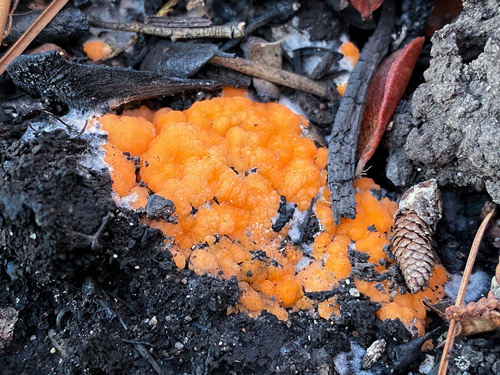
(c) Natalie McNear, all rights reserved, uploaded by Natalie McNear
Pyronema
Sign in to savePyronema is a genus of cup fungi in the family Pyronemataceae. Pyronema are found fruiting exclusively on recently burned or heat-sterilized substrates. The fruiting bodies (apothecia) are light-pink to orange and disc or cushion shaped. Always growing in dense clusters, and often fusing together resulting in an amorphous mat-like appearance. Ascospores are simple, smooth, ellipsoid, colorless, and lack lipid droplets. When grown in a laboratory setting on agar plates, P. domesticum produces sclerotia, whereas P. omphalodes does not. P. domesticum tends to produce pink to orange apothecia and
In the Vinony graph
Within Vinony's link graph, Pyronema is referenced by 6 other articles, and connects out to fungi, Pier Andrea Saccardo and International Standard Book Number.
Vinony files it under Pezizales genera and Pyronemataceae.
Its subject is documented across 10 Wikipedia language editions.
Species
GENUS
- KingdomFungi
- PhylumAscomycota
- ClassPezizomycetes
- OrderPezizales
- FamilyPyronemataceae
via GBIF
Museum specimens
- Specimen records
- 49
- With media
- 41
- Family
- Pyronemataceae
- Collections
- NY, DBG, BPI, MEL, ILLS, LSUM
- Recorded in
- United States, Australia, Peru, Oregon, Portugal, Sweden
Wikidata facts
- Instance of
- taxon
- Parent taxon
- Pyronemataceae
- Image
- Pyronema domesticum 151.jpg
Show 5 more facts
- Commons category
- Pyronema
- taxon rank
- genus
- taxon name
- Pyronema
- topic's main category
- Category:Pyronema
- taxon author citation
- Carus
Sources (2)
via Wikidata · CC0
~1 min read
Encyclopedic overview
1 sectionsContents
- References
Pyronema is a genus of cup fungi in the family Pyronemataceae. Pyronema are found fruiting exclusively on recently burned or heat-sterilized substrates. The fruiting bodies (apothecia) are light-pink to orange and disc or cushion shaped. Always growing in dense clusters, and often fusing together resulting in an amorphous mat-like appearance. Ascospores are simple, smooth, ellipsoid, colorless, and lack lipid droplets. When grown in a laboratory setting on agar plates, P. domesticum produces sclerotia, whereas P. omphalodes does not. P. domesticum tends to produce pink to orange apothecia and slightly larger spores, whereas P. omphalodes apothecia are orange to yellow-orange with slightly smaller spores. Pyronema are known to dominate the soil fungal community after fire, and P. domesticum has been shown to metabolize charcoal. P. omphalodes is synonymous with P. confluens and P. marianum.
Pyronema was first circumscribed as Peziza omphalodes by Pierre Bulliard in 1790, and in 1870 Leopold Fuckel built off the description from Bulliard, merging several synonymous species into P. omphalodes. In 1889, Pier Andrea Saccardo circumscribed the species P. domesticum, directly building from the work of James Sowerby.
Excerpted from Wikipedia’s “Pyronema” article, available under the CC BY-SA 4.0 licence.