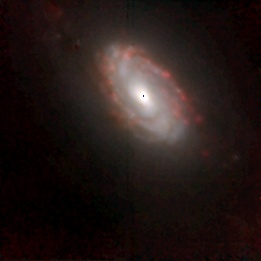
File:NGC23-hst-110-160-190.jpg · Wikimedia Commons · See Wikimedia Commons
Q34747
Sign in to saveAlso known as New General Catalogue 23
spiral galaxy in the constellation Pegasus
Key facts
- Constellation
- Pegasus
- Right ascension
- 00 09 53.411
- Declination
- +25 ° 55 ′ 25.46 ″
- Heliocentric radial velocity
- 4,568 km/s
- Distance
- 173.5 Mly (53.21 Mpc )
- Group or cluster
- NGC 23 Group (LGG 2)
- Apparent magnitude v
- 11.9 mag
- Type
- SBb
- Apparent size v
- 2.1′ × 1.3′
via Wikipedia infobox
Wikidata facts
- Distance from Earth
- 64.2
- Image
- NGC23-hst-110-160-190.jpg
Show 9 more facts
- Commons category
- NGC 23
- catalog code
- [DC78] UGC 89
- time of discovery or invention
- 1784-09-10
- redshift
- 0.015227
- apparent magnitude
- 11.393
- galaxy morphological type
- SBb
- right ascension
- 2.4725458
- declination
- 25.9237389
- radial velocity
- 4822
Sources (1)
via Wikidata · CC0
~2 min read
Article
NGC 23 is a spiral galaxy located in the northern constellation of Pegasus, around 173.5 megalight-years distant from the Milky Way. It was discovered by William Herschel on 10 September 1784. In the Webb Society Deep-Sky Observer's Handbook, the visual appearance of NGC 23 is described as follows:
Bright, extended ellipse; a bright nuclear structure is noticeably elongated; two weak spiral enhancements emerge from opposite sides of the nucleus, one curving towards a bright star attached on the south end. The galaxy is likely interacting with NGC 9.