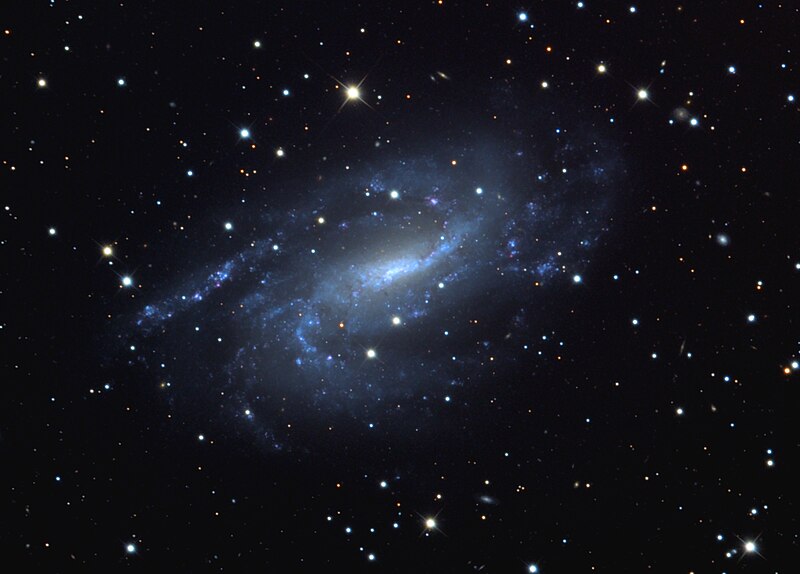
File:NGC925.jpg · Wikimedia Commons · See Wikimedia Commons
Key facts
- Constellation
- Triangulum
- Right ascension
- 02 27 16.913
- Declination
- +33 ° 34 ′ 43.97 ″
- Redshift
- 553 ± 3 km/ s
- Heliocentric radial velocity
- 564 km/s
- Distance
- 30.3 ± 2.3 million light years (9.29 ± 0.69 Mpc )
- Group or cluster
- NGC 1023 Group
- Type
- SB(s)d
- Apparent size v
- 10′.5 × 5′.9
via Wikipedia infobox
Wikidata facts
- Instance of
- astrophysical X-ray source
- Constellation
- Triangulum
- Distance from Earth
- 9.2
- Image
- NGC925.jpg
Show 11 more facts
- redshift
- 0.001845
- time of discovery or invention
- 1784-09-13
- radial velocity
- 568
- Commons category
- NGC 925
- catalog code
- LEDA 9332
- discoverer or inventor
- William Herschel
- galaxy morphological type
- SAB(s)d
- apparent magnitude
- 7.873
- right ascension
- 36.8204708
- declination
- 33.5788806
- epoch
- J2000.0
Sources (2)
via Wikidata · CC0
~1 min read
Encyclopedic overview
NGC 925 is a barred spiral galaxy located about 30 million light-years away in the constellation Triangulum. German-British astronomer William Herschel discovered this galaxy on 13 September 1784.
The morphological classification of this galaxy is SB(s)d, indicating that it has a bar structure and loosely wound spiral arms with no ring. The spiral arm to the south is stronger than the northern arm, with the latter appearing flocculent and less coherent. The bar is offset from the center of the galaxy and is the site of star formation all along its length. Both of these morphological traits—a dominant spiral arm and the offset bar—are typically characteristics of a Magellanic spiral galaxy. The galaxy is inclined at an angle of 55° to the line of sight along a position angle of 102°.
Excerpted from Wikipedia’s “NGC 925” article, available under the CC BY-SA 4.0 licence.