File:QD_S.jpg · Wikimedia Commons · See Wikimedia Commons
quantum dot
Sign in to saveAlso known as quantum spot, artificial atom, QD, artificial molecule, quantum dots
nano-scale semiconductor particle subject to quantum effects
Research
43,680 papers- Quantum Dot-Based Simultaneous Multicolor Imaging.Molecular imaging and biology · 2020
- Quantum Dot Nanomaterials: Preparation, Characterization, Advanced Bio-Imaging and Therapeutic Applications.Journal of fluorescence · 2024
- Quantum Dot-Antibody Conjugates for Immunofluorescence Studies of Biomolecules and Subcellular Structures.Journal of fluorescence · 2022
- Recent Advances in Silicon Quantum Dot-Based Fluorescent Biosensors.Biosensors · 2023
- Graphene Oxide Quantum Dot-Based Functional Nanomaterials for Effective Antimicrobial Applications.Chemical record (New York, N.Y.) · 2020
via PubMed
Wikidata facts
- Subclass of
- nanomaterial
- Image
- Colloidal nanoparticle of lead sulfide (selenide) with complete passivation.png
Show 2 more facts
- Commons category
- Quantum dots
- Stack Exchange tag
- quantumcomputing.stackexchange.com/tags/quantum-dots
Sources (2)
via Wikidata · CC0
~40 min read
Encyclopedic overview
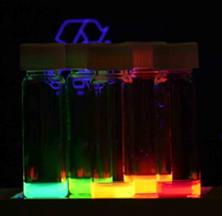
Colloidal quantum dots irradiated with a UV light. Differently sized quantum dots emit different colors of light due to quantum confinement.
Quantum dots (QDs) or semiconductor nanocrystals are semiconductor particles a few nanometres in size with optical and electronic properties that differ from those of larger particles via quantum mechanical effects. They are a central topic in nanotechnology and materials science. When a quantum dot is illuminated by UV light, an electron in the quantum dot can be excited to a state of higher energy. In the case of a semiconducting quantum dot, this process corresponds to the transition of an electron from the valence band to the conduction band. The excited electron can drop back into the valence band releasing its energy as light. This light emission (photoluminescence) is illustrated in the figure on the right. The color of that light depends on the energy difference between the discrete energy levels of the quantum dot in the conduction band and the valence band.
Excerpted from Wikipedia’s “quantum dot” article, available under the CC BY-SA 4.0 licence.
Gallery (12)
Available in 47 languages
- Español
- Français
- Deutsch
- 中文
- 日本語
- Русский
- Português
- Italiano
- العربية
- Armenian
- Assamese
- Azerbaijani
- Bahasa Indonesia
- Bangla
- Belarusian
- Bulgarian
- Catalan
- Crimean Tatar
Show 28 more
via Wikidata sitelinks · CC0