File:Quark_structure_proton.svg · Wikimedia Commons · See Wikimedia Commons
quark
Sign in to saveA quark () is a type of elementary particle and a fundamental constituent of matter. Quarks combine to form composite particles called hadrons, the most stable of which are protons and neutrons, the components of atomic nuclei. All commonly observable matter is composed of up quarks, down quarks and electrons. Owing to a phenomenon known as color confinement, quarks are never found in isolation; they can be found only within hadrons, which include baryons (such as protons and neutrons) and mesons, or in quark–gluon plasmas. For this reason, much of what is known about quarks has been drawn fro
A quark is one of the tiniest building blocks of matter that combines with other quarks to form protons and neutrons, which make up the nuclei of atoms. Quarks are important because understanding them helps us explain what all ordinary matter around us is fundamentally made of, though they can never be observed by themselves—they only exist bound together inside larger particles.
AI-generated from the Wikipedia summary — may contain errors.
Key facts
- Particle.alt
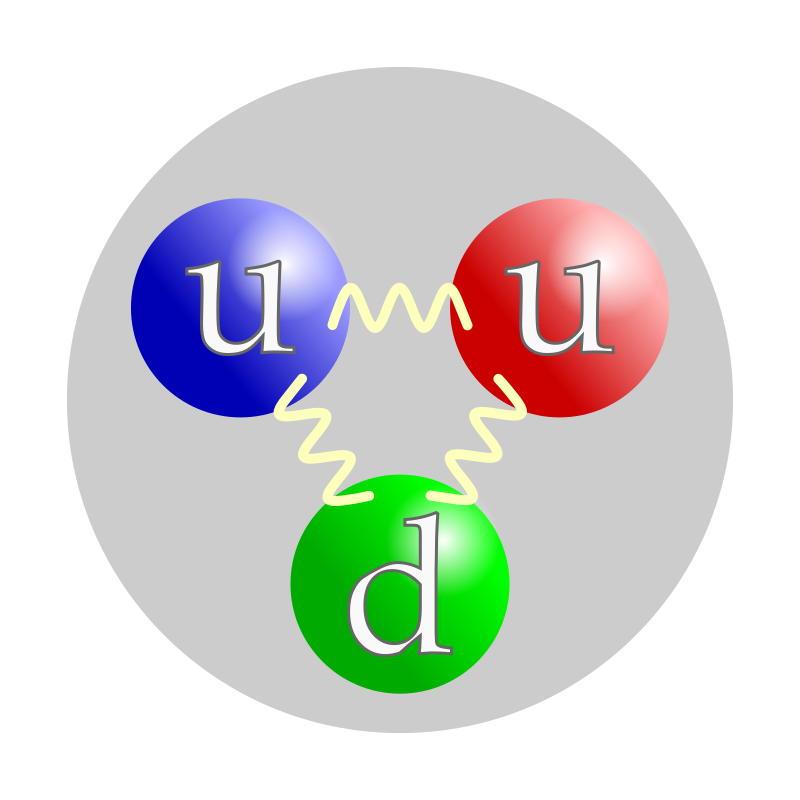
- Three colored balls (symbolizing quarks) connected pairwise by springs (symbolizing gluons), all inside a gray circle (symbolizing a proton). The colors of the balls are red, green, and blue, to parallel each quark's color charge. The red and blue balls are labeled "u" (for "up" quark) and the green one is labeled "d" (for "down" quark).
- Particle.caption
- A proton is composed of two up quarks, one down quark, and the gluons that mediate the forces "binding" them together. The color assignment of individual quarks is arbitrary, but all three colors must be present; red, blue and green are used as an analogy to the primary colors that together produce a white color.
- Particle.num_types
- 6 (up, down, strange, charm, bottom, and top)
- Particle.composition
- elementary particle
- Particle.statistics
- fermionic
- Particle.generation
- 1st, 2nd, 3rd
- Particle.interaction
- strong, weak, electromagnetic, gravitation
- Particle.antiparticle
- antiquark ()
- Particle.discovered
- SLAC ()
- Particle.electric_charge
- + e, − e
- Particle.color_charge
- yes
- Particle.spin
- ħ
- Particle.name
- Quark
- Particle.image
- Quark structure proton.svg
- Particle.image_size
- 225px
via Wikipedia infobox
Wikidata facts
- Subclass of
- charged particle
- Part of
- hadron
- Followed by
- diquark
- Image
- Quark.svg
Show 10 more facts
- interaction
- electromagnetic interaction
- Commons category
- Quarks
- topic's main category
- Category:Quarks
- antiparticle
- antiquark
- Commons gallery
- Quark
- spin quantum number
- 0.5
- has superpartner
- squark
- has characteristic
- electric charge
- Stack Exchange tag
- physics.stackexchange.com/tags/quarks
- on focus list of Wikimedia project
- Wikipedia:Vital articles/Level/4
Sources (9)
via Wikidata · CC0
~31 min read
Encyclopedic overview
19 sectionsContents
- Classification
- History
- Etymology
- Properties
- Electric charge
- Spin
- Weak interaction
- Strong interaction and color charge
- Mass
- Size
- Table of properties
- Interacting quarks
- Sea quarks
- Other phases of quark matter
- See also
- Explanatory notes
- References
- Further reading
- External links
A quark () is a type of elementary particle and a fundamental constituent of matter. Quarks combine to form composite particles called hadrons, the most stable of which are protons and neutrons, the components of atomic nuclei. All commonly observable matter is composed of up quarks, down quarks and electrons. Owing to a phenomenon known as color confinement, quarks are never found in isolation; they can be found only within hadrons, which include baryons (such as protons and neutrons) and mesons, or in quark–gluon plasmas. For this reason, much of what is known about quarks has been drawn from observations of hadrons.
Quarks have various intrinsic properties, including electric charge, mass, color charge, and spin. They are the only elementary particles in the Standard Model of particle physics to experience all four fundamental interactions, also known as fundamental forces (electromagnetism, gravitation, strong interaction, and weak interaction), as well as the only known particles whose electric charges are not integer multiples of the elementary charge.
Excerpted from Wikipedia’s “quark” article, available under the CC BY-SA 4.0 licence.
Gallery (31)
Available in 106 languages
- Español
- Français
- Deutsch
- 中文
- 日本語
- Русский
- Português
- Italiano
- العربية
- हिन्दी
- Afrikaans
- Albanian
- Albanian
- Angika
- Armenian
- Asturian
- azb
- Azerbaijani
Show 87 more
- Bahasa Indonesia
- Bangla
- Basque
- be_x_old
- Belarusian
- Bosnian
- Bulgarian
- Burmese
- Catalan
- Central Kurdish
- Chuvash
- Croatian
- Czech
- Danish
- Esperanto
- Estonian
- Filipino
- Finnish
- Galician
- Georgian
- Greek
- Haitian Creole
- Hebrew
- Hungarian
- Icelandic
- Ido
- Interlingua
- Irish
- Kazakh
- Kurdish
- Kyrgyz
- Lao
- Latin
- Latvian
- Limburgish
- Lingua Franca Nova
- Lithuanian
- lld
- Low German
- Luxembourgish
- Macedonian
- Malay
- Malayalam
- Maltese
- Marathi
- Mongolian
- Moroccan Arabic
- Nederlands
- Nepali
- Norwegian
- Norwegian Nynorsk
- Occitan
- Oromo
- Pashto
- Polski
- Punjabi
- Romanian
- Scots
- Serbian
- Serbian (Latin)
- Sicilian
- simple
- Slovak
- Slovenian
- Sundanese
- Svenska
- Tajik
- Tamil
- Tatar
- Telugu
- Tiếng Việt
- Toki Pona
- Türkçe
- Ukrainian
- Urdu
- Uzbek
- Venetian
- Waray
- Welsh
- Western Panjabi
- Wu Chinese
- zh_classical
- zh_yue
- Zulu
- فارسی
- ไทย
- 한국어
via Wikidata sitelinks · CC0