File:Simple_qubits.svg · Wikimedia Commons · See Wikimedia Commons
qubit
Sign in to saveAlso known as quantum bit, qbit
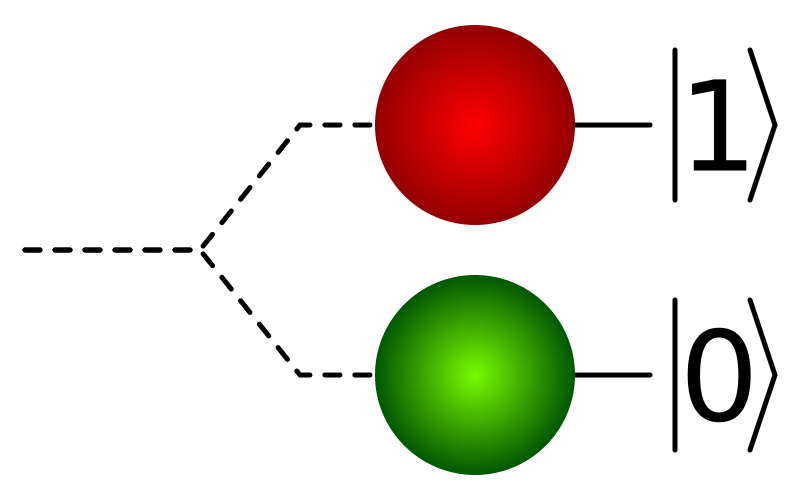
thumb|upright=0.6|The general definition of a qubit as the quantum state of a two-Energy level|level quantum system In quantum computing, a qubit () or quantum bit is a basic unit of quantum information; a binary qudit the quantum version of the classic binary bit physically realized with a two-state device. A qubit is a two-state (or two-level) quantum-mechanical system, one of the simplest quantum systems displaying the peculiarity of quantum mechanics. Examples include the spin of the electron in which the two levels can be taken as spin up and spin down; or the polarization of a single pho
Wikidata facts
- Instance of
- unit of information
- Subclass of
- quantity
- Named after
- bit
- Image
- Bloch sphere.svg
- Has use
- quantum computer
Show 3 more facts
- Commons category
- Qubit
- measured physical quantity
- quantum information
- maintained by WikiProject
- WikiProject Mathematics
via Wikidata · CC0
~23 min read
Encyclopedic overview
18 sectionsContents
- Etymology
- Comparison with classical bits
- Standard representation
- Qubit states
- Bloch sphere representation
- Mixed state
- Operations on qubits
- Quantum entanglement
- Controlled gate to construct the Bell state
- Applications
- Quantum register
- Qudits and qutrits
- Physical implementation
- Qubit storage
- See also
- Notes
- References
- Further reading
thumb|upright=0.6|The general definition of a qubit as the quantum state of a two-Energy level|level quantum system In quantum computing, a qubit () or quantum bit is a basic unit of quantum information; a binary qudit the quantum version of the classic binary bit physically realized with a two-state device. A qubit is a two-state (or two-level) quantum-mechanical system, one of the simplest quantum systems displaying the peculiarity of quantum mechanics. Examples include the spin of the electron in which the two levels can be taken as spin up and spin down; or the polarization of a single photon in which the two spin states (left-handed and the right-handed circular polarization) can also be measured as horizontal and vertical linear polarization. In a classical system, a bit would have to be in one state or the other. However, quantum mechanics allows the qubit to be in a coherent superposition of multiple states simultaneously, a property that is fundamental to quantum mechanics and quantum computing.
==Etymology== The coining of the term qubit is attributed to Benjamin Schumacher. In the acknowledgments of his 1995 paper, Schumacher states that the term qubit was created in jest during a conversation with William Wootters.
Excerpted from Wikipedia’s “qubit” article, available under the CC BY-SA 4.0 licence.