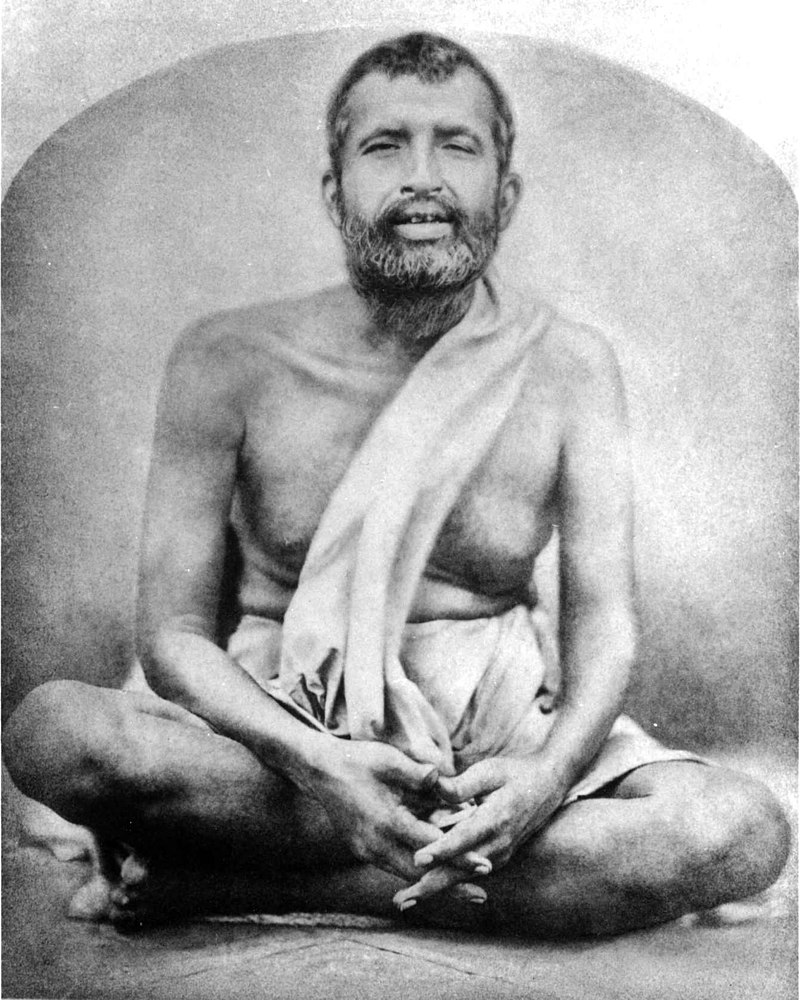
File:Ramakrishna.jpg · Wikimedia Commons · See Wikimedia Commons
Ramakrishna
Sign in to saveAlso known as Ramakrishna Paramahamsa, Gadadhar Chattopadhyay, Sri Ramakrishna Paramahamsa
Ramakrishna (18 February 1836 – 16 August 1886), also called Ramakrishna Paramahamsa (; ; ), born Ramakrishna Chattopadhyay (his childhood nickname was Gadadhar), was an Indian Hindu mystic. He was a devotee of the goddess Kali, but adhered to various religious practices from the Hindu traditions of Vaishnavism, Tantric Shaktism, and Advaita Vedanta, as well as Christianity and Sufi Islam. His parable-based teachings advocated the essential unity of religions and proclaimed that world religions are "so many paths to reach one and the same goal". He is regarded by his followers as an avatar (di
OverviewAI-generated
Ramakrishna was a male philosopher and Hindu who lived from 1836 to 1886. He was born in Kamarpukur and died in Kolkata from laryngeal cancer. He was a citizen of the British Raj and spoke Bangla. He also wrote in Telugu. His notable works include *al-Ḥaqāʼiq al-rūḥīyah al-kubrá*, *Memoirs*, *Teachings of Sri Ramakrishna*, *Thus spake Sri Ramakrishna*, and *Ein Werkzeug Gottes sein*.
He was married to Sarada Devi and had a student named Swami Vivekananda. Ramakrishna suffered from epilepsy. He is described in the Armenian Soviet Encyclopedia and the New International Encyclopedia.
Synthesized by Vinony from 24 facts across 2 sources: Wikidata, Open Library. Generated from structured data (not the Wikipedia text) and checked against those facts — may still contain errors.
Person · Open Library
- Born
- 1836
- Died
- 1886
- Works
- 47
Top works
- al-Ḥaqāʼiq al-rūḥīyah al-kubrá
- Memoirs
- Teachings of Sri Ramakrishna
- Thus spake Sri Ramakrishna
- Ein Werkzeug Gottes sein
via Open Library + Wikidata
Key facts
- Hindu leader.name
- Ramakrishna Paramahamsa
- Hindu leader.image
- Ramakrishna.jpg
- Hindu leader.caption
- Ramakrishna at Dakshineswar, 1883–84
- Hindu leader.birth_place
- Kamarpukur, Bengal Presidency, Company India(now West Bengal, India)
- Hindu leader.birth_name
- Ramakrishna Chattopadhyay
- Hindu leader.death_place
- Cossipore, Bengal Presidency, British India(now West Bengal, India)
- Hindu leader.death_cause
- Throat cancer
- Hindu leader.nationality
- Indian
- Hindu leader.spouse
- Sarada Devi
- Hindu leader.guru
- Totapuri, Bhairavi Brahmani, and others
- Hindu leader.school
- Vedanta
- Hindu leader.lineage
- Daśanāmi Sampradaya
- Hindu leader.founder
- Ramakrishna Order
- Hindu leader.disciples
- Swami Vivekananda and others
- Hindu leader.religion
- Hinduism
- Hindu leader.philosophy
- Advaita VedantaShaktism
- Hindu leader.honors
- Paramahamsa
- Hindu leader.parents
- Khudiram Chattopadhyay (Father)Chandramani Devi (Mother)
via Wikipedia infobox
Wikidata facts
- Instance of
- human
- Gender
- male
- Place of birth
- Kamarpukur
- Place of death
- Kolkata
- Spouse
- Sarada Devi
- Occupation
- philosopher
- Languages spoken
- Bangla
- Religion
- Hinduism
- Field of work
- philosophy
- Image
- Ramakrishna.jpg
Show 11 more facts
- Commons category
- Ramakrishna
- date of birth
- 1836-02-18
- date of death
- 1886-08-16
- topic's main category
- Category:Ramakrishna
- described by source
- New International Encyclopedia
- student
- Swami Vivekananda
- cause of death
- laryngeal cancer
- manner of death
- natural causes
- on focus list of Wikimedia project
- Wikipedia:Vital articles/Level/4
- medical condition
- epilepsy
- writing language
- Telugu
via Wikidata · CC0
~76 min read
Encyclopedic overview
44 sectionsContents
- Early life
- Birth and childhood
- First "superconsciousness experience"
- Education
- Priesthood and marriage
- Lead up to priesthood
- Officiation as priest
- Vision of the Goddess Kali
- Marriage
- God-realisation via various traditions
- Rama Bhakti
- Tantra
- Vaishnava Bhakti
- Tota Puri and Vedanta
- Initial meeting
- Initiation into sannyasa
- Experience of samadhi
- Maya and the Divine Mother
- Tota Puri humbled
- Perception in samadhi
- Islam and Christianity
- Islam
- Christianity
- Popularisation and final years
- Keshab Chandra Sen and the "New Dispensation"
- Swami Vivekananda
- Other devotees and disciples
- Last days
- Reception and teachings
- Transformation into neo-Vedantin
- Analysis of samadhi
- Psychoanalysis
- Romain Rolland and the "Oceanic feeling"
- ''The Analyst and the Mystic''
- ''Kali's Child''
- Teachings
- Influence and legacy
- See also
- References
- Explanatory notes
- Footnotes
- Sources cited
- General and cited bibliography
- External links
Ramakrishna (18 February 1836 – 16 August 1886), also called Ramakrishna Paramahamsa (; ; ), born Ramakrishna Chattopadhyay (his childhood nickname was Gadadhar), was an Indian Hindu mystic. He was a devotee of the goddess Kali, but adhered to various religious practices from the Hindu traditions of Vaishnavism, Tantric Shaktism, and Advaita Vedanta, as well as Christianity and Sufi Islam. His parable-based teachings advocated the essential unity of religions and proclaimed that world religions are "so many paths to reach one and the same goal". He is regarded by his followers as an avatar (divine incarnation).
Ramakrishna was born in Kamarpukur, Bengal Presidency, India. He described going through religious experiences in childhood. Around the age twenty, he became a temple priest at the Dakshineshwar Kali Temple in Calcutta. While at the temple, his devotional temperament and intense religious practices led him to experience various spiritual visions. He was assured of the authenticity and sanctity of his visions by several religious teachers.
Excerpted from Wikipedia’s “Ramakrishna” article, available under the CC BY-SA 4.0 licence.
Gallery (34)
Available in 83 languages
- Español
- Français
- Deutsch
- 中文
- 日本語
- Русский
- Português
- Italiano
- العربية
- हिन्दी
- Armenian
- Assamese
- Asturian
- Azerbaijani
- Bahasa Indonesia
- Bangla
- Basque
- be_x_old
Show 64 more
- Belarusian
- Bulgarian
- Catalan
- Croatian
- Czech
- Egyptian Arabic
- Esperanto
- Estonian
- Fiji Hindi
- Filipino
- Finnish
- Galician
- Georgian
- Goan Konkani
- Greek
- Gujarati
- Hebrew
- Hungarian
- Interlingua
- Irish
- Kannada
- Kazakh
- Latin
- Latvian
- Lingala
- Lithuanian
- Maithili
- Malagasy
- Malay
- Malayalam
- Marathi
- Nederlands
- Nepali
- Newari
- Norwegian
- Odia
- Pali
- Polski
- Punjabi
- Romanian
- Sanskrit
- Scots
- Serbian
- Serbian (Latin)
- Sinhala
- Slovak
- Slovenian
- Svenska
- Tamil
- Tatar
- Telugu
- Tiếng Việt
- Tulu
- Türkçe
- Ukrainian
- Urdu
- Uzbek
- Waray
- Western Panjabi
- Wu Chinese
- zh_yue
- فارسی
- ไทย
- 한국어
via Wikidata sitelinks · CC0