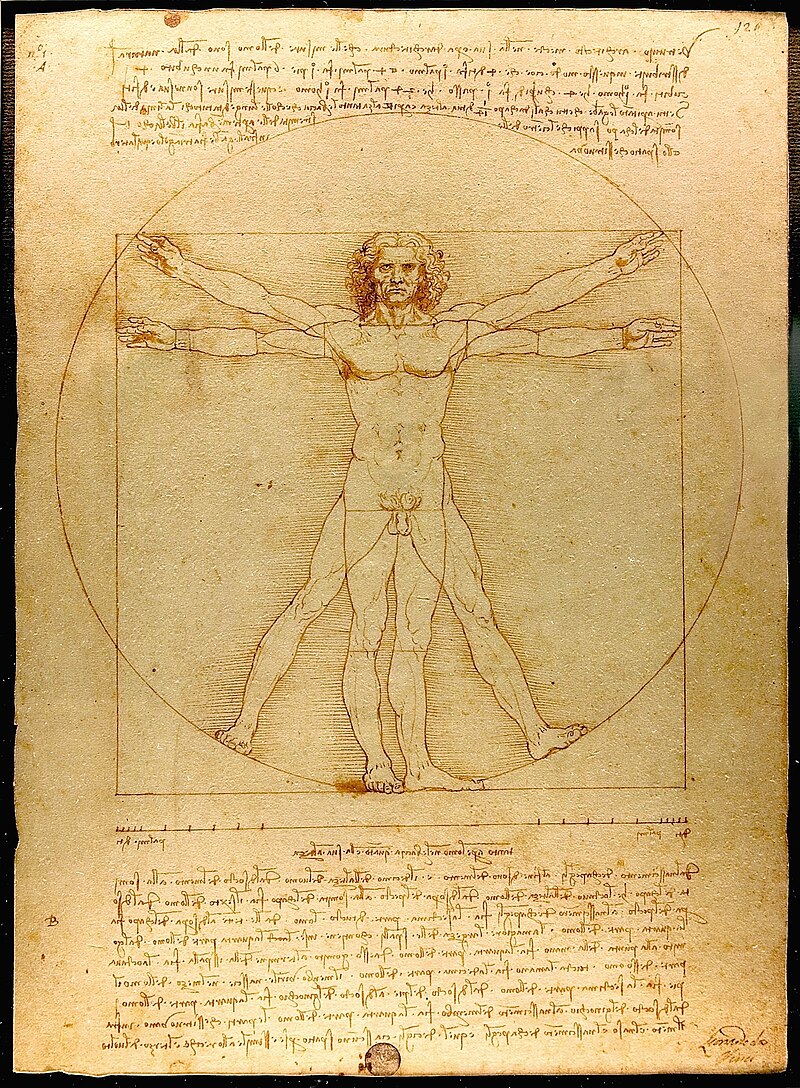
File:Da_Vinci_Vitruve_Luc_Viatour.jpg · Wikimedia Commons · See Wikimedia Commons
Renaissance
Sign in to saveThe Renaissance ( , ) is a European period of history and cultural movement, very roughly defined as covering the 14th through 17th centuries, though sometimes more narrowly defined for instance as only covering the 15th through 16th centuries. It marked the transition from the Middle Ages to modernity and was characterized by the European rediscovery and revival of the literary, philosophical, and artistic achievements of classical antiquity. Associated with great social change in most fields and disciplines, including art, architecture, politics, literature, exploration and science, the Rena
The Renaissance was a European cultural movement spanning roughly the 14th to 17th centuries that marked the transition from the Middle Ages to the modern world, characterized by a revival of classical Greek and Roman ideas in literature, philosophy, and art. It brought significant changes across society in fields like art, architecture, politics, science, and exploration, making it a pivotal period in European history.
AI-generated from the Wikipedia summary — may contain errors.
Wikidata facts
- Image
- Last Judgement by Michelangelo.jpg
Show 6 more facts
- Commons category
- Renaissance
- Commons gallery
- Renaissance
- end time
- 1650-00-00
- start time
- 1400-00-00
- subject named as
- Renaissance
via Wikidata · CC0
~71 min read
Article
41 sectionsContents
- Period
- Italian Renaissance
- Overview
- Origins
- Latin and Greek phases of Renaissance humanism
- Social and political structures in Italy
- Black Death
- Cultural conditions in Florence
- Characteristics
- Humanism
- Humanism and libraries
- Art
- Navigation and geography
- Science
- Music
- Religion
- Self-awareness
- Spread
- England
- France
- Germany
- Hungary
- Low Countries
- Northern Europe
- Poland
- Portugal
- Spain
- Further countries
- Historiography
- Conception
- Debates about progress
- Other Renaissances
- See also
- References
- Explanatory notes
- Citations
- General sources
- Further reading
- Historiography
- Primary sources
- External links
The Renaissance ( , ) is a European period of history and cultural movement, very roughly defined as covering the 14th through 17th centuries, though sometimes more narrowly defined for instance as only covering the 15th through 16th centuries. It marked the transition from the Middle Ages to modernity and was characterized by the European rediscovery and revival of the literary, philosophical, and artistic achievements of classical antiquity. Associated with great social change in most fields and disciplines, including art, architecture, politics, literature, exploration and science, the Renaissance was first centered in the Republic of Florence, then spread to the rest of Italy and later throughout Europe. The term ('rebirth') first appeared in Lives of the Artists () by Giorgio Vasari, while the corresponding French word was adopted into English as the term for this period during the 1830s.
The Renaissance's intellectual basis was founded in its version of humanism, derived from the concept of Roman and the rediscovery of classical Greek philosophy, such as that of Protagoras, who said that "man is the measure of all things". Although the invention of metal movable type sped the dissemination of ideas from the later 15th century, the changes of the Renaissance were not uniform across Europe: the first traces appear in Italy as early as the late 13th century, in particular with the writings of Dante and the paintings of Giotto.
Gallery (52)
Available in 169 languages
- Español
- Français
- Deutsch
- 中文
- 日本語
- Русский
- Português
- Italiano
- العربية
- हिन्दी
- Abkhazian
- Afrikaans
- Albanian
- Albanian
- Amharic
- Aragonese
- Armenian
- Assamese
Show 150 more
- Asturian
- azb
- Azerbaijani
- Bahasa Indonesia
- Balinese
- Bangla
- Bashkir
- Basque
- bat_smg
- Bavarian
- be_x_old
- Belarusian
- Bikol
- blk
- Bosnian
- Breton
- Bulgarian
- Buriat
- Burmese
- Catalan
- cdo
- Cebuano
- Central Kurdish
- Chechen
- Chuvash
- Cornish
- Crimean Tatar
- Croatian
- Czech
- Danish
- Egyptian Arabic
- Esperanto
- Estonian
- Extremaduran
- Faroese
- Fiji Hindi
- Filipino
- Finnish
- fiu_vro
- Friulian
- Galician
- gcr
- Georgian
- Greek
- Guarani
- Haitian Creole
- Hausa
- Hebrew
- Hungarian
- hyw
- Icelandic
- Ido
- Iloko
- Interlingua
- Interlingue
- Irish
- Jamaican Creole English
- Javanese
- Kabyle
- Kannada
- Kara-Kalpak
- Kashmiri
- Kazakh
- kbp
- Kurdish
- Kyrgyz
- Lao
- Latin
- Latvian
- Lezghian
- Ligurian
- Limburgish
- Lingua Franca Nova
- Lithuanian
- lld
- Lombard
- Low German
- Luxembourgish
- Macedonian
- Malay
- Malayalam
- Maltese
- Marathi
- Mazanderani
- Mingrelian
- Mirandese
- Mongolian
- Moroccan Arabic
- nds_nl
- Nederlands
- Nepali
- Newari
- Northern Frisian
- Norwegian
- Norwegian Nynorsk
- nrm
- Occitan
- Oromo
- Papiamento
- Pashto
- Picard
- Piedmontese
- Polski
- Punjabi
- Romanian
- Romansh
- Rusyn
- Sardinian
- Saterland Frisian
- Scottish Gaelic
- Serbian
- Serbian (Latin)
- Sicilian
- simple
- Sindhi
- Sinhala
- Slovak
- Slovenian
- Sundanese
- Svenska
- Swahili
- szy
- Tajik
- Talysh
- Tamil
- Telugu
- Tibetan
- Tiếng Việt
- Tumbuka
- Türkçe
- Turkmen
- Ukrainian
- Urdu
- Uyghur
- Uzbek
- Venetian
- Waray
- Welsh
- West Flemish
- Western Frisian
- Western Panjabi
- Wu Chinese
- Yakut
- Yiddish
- zh_classical
- zh_min_nan
- zh_yue
- فارسی
- ไทย
- 한국어
via Wikidata sitelinks · CC0