File:Riemann_zeta_function_absolute_value.png · Wikimedia Commons · See Wikimedia Commons
Riemann hypothesis
Sign in to saveAlso known as RH
conjecture in mathematics linked to the repartition of prime numbers
The Riemann hypothesis is a famous conjecture in mathematics that describes a pattern in how prime numbers are distributed across all numbers. If proven true, it would answer a centuries-old question about the underlying order of primes and would have major implications for cryptography, computer science, and our fundamental understanding of numbers.
AI-generated from the Wikipedia summary — may contain errors.
In the Vinony graph
Within Vinony's link graph, Riemann hypothesis is referenced by 696 other articles, and connects out to complex number, Riemann–Siegel theta function and natural number.
It is catalogued under topics including 1859 introductions, Analytic number theory and Bernhard Riemann.
Its subject is documented across 56 Wikipedia language editions.
Wikidata facts
- Instance of
- mathematical problem
- Part of
- list of theorems
- Named after
- Bernhard Riemann
- Image
- VignetteRiemannHypothesis.svg
Show 4 more facts
- Stack Exchange tag
- mathoverflow.net/tags/riemann-hypothesis
- Commons category
- Riemann hypothesis
- on focus list of Wikimedia project
- Wikipedia:Vital articles/Level/4
- maintained by WikiProject
- WikiProject Mathematics
via Wikidata · CC0
~40 min read
Encyclopedic overview
Unsolved problem in mathematics
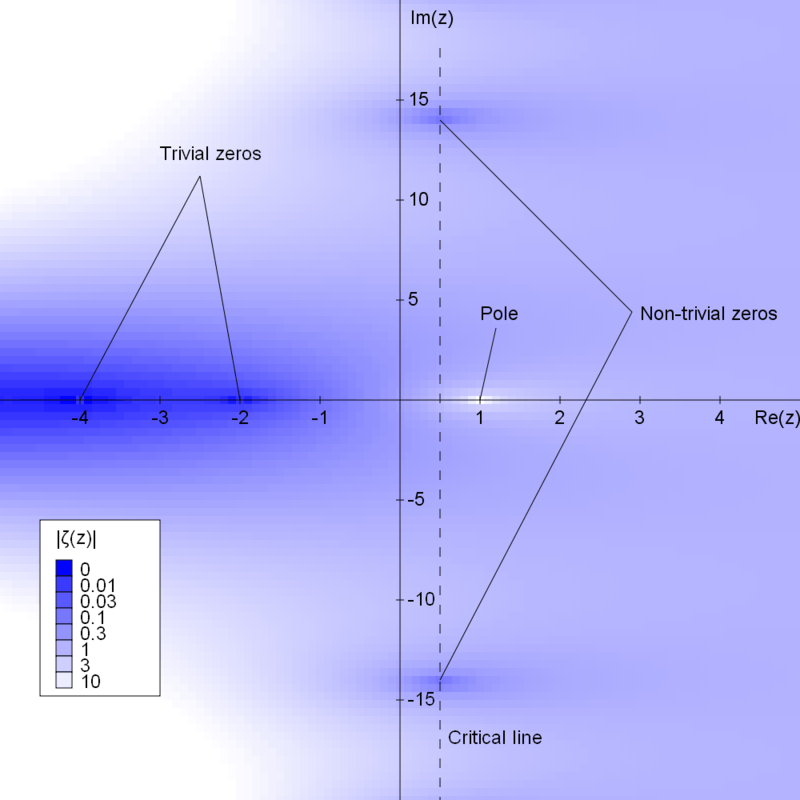
Do all non-trivial zeros of the Riemann zeta function have a real part equal to one half?
Excerpted from Wikipedia’s “Riemann hypothesis” article, available under the CC BY-SA 4.0 licence.