
File:PG_1063Burns_Naysmith.jpg · Wikimedia Commons · See Wikimedia Commons
Robert Burns
Sign in to saveAlso known as Robbie Burns, Rabbie Burns, Scotland's favorite son, Ploughman Poet, Bard of Ayrshire, The Bard, National poet of Scotland, Robden of Solway Firth
Scottish poet and lyricist (1759–1796)
Robert Burns was a Scottish poet and songwriter from the late 1700s who wrote in the Scots language and dialect, creating verses that ranged from love songs to social commentary. His work became foundational to Scottish cultural identity and remains widely celebrated for capturing the voice and spirit of ordinary Scottish life.
AI-generated from the Wikipedia summary — may contain errors.
Wikidata facts
- Instance of
- human
- Given name
- Robert
- Family name
- Burns
- Gender
- male
- Citizenship
- Kingdom of Great Britain
- Place of birth
- Alloway
- Place of death
- Dumfries
- Occupation
- farmer
- Languages spoken
- English language
- Field of work
- poetry
- Genre
- cantata
- Movement
- Romanticism
- Official website
- www.robertburns.org
- Image
- Robert Burns 1.jpg
- Residence
- Edinburgh
Show 15 more facts
- Commons category
- Robert Burns
- date of birth
- 1759-01-25
- date of death
- 1796-01-01
- topic's main category
- Category:Robert Burns
- Commons gallery
- Robert Burns
- name in native language
- Robert Burns
- ethnic group
- Scottish people
- cause of death
- congenital heart disease
- writing language
- Scottish English
- nickname
- Bard of Ayrshire
- archives at
- Harry Ransom Center
- Commons Creator page
- Robert Burns (poet)
- P8168
- David Glass
- P12749
- Deutschneudorf
- manner of death
- natural causes
Sources (6)
via Wikidata · CC0
Works in European collections
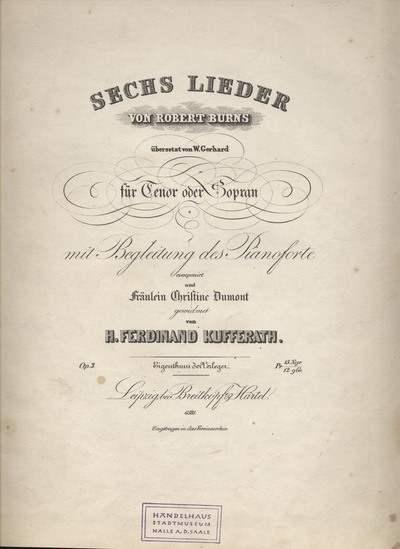
3 objects attributed to Robert Burns, held across European museums, libraries & archives · via Europeana


~40 min read
Encyclopedic overview
Robert Burns (25 January 1759 – 21 July 1796), also known familiarly as Rabbie Burns, was a Scottish poet and lyricist. He is widely regarded as the national poet of Scotland and is celebrated worldwide. He is the best known of the poets who have written in the Scots language, although much of his writing is in a "light Scots dialect" of English, accessible to an audience beyond Scotland. He also wrote in standard English, and in these writings his political or civil commentary is often at its bluntest.
He is regarded as a pioneer of the Romantic movement, and after his death he became a great source of inspiration to the founders of both liberalism and socialism, and a cultural icon in Scotland and among the Scottish diaspora around the world. Celebration of his life and work became almost a national charismatic cult during the 19th and 20th centuries, and his influence has long been strong on Scottish literature. In 2009 he was chosen as the greatest Scot by the Scottish public in a vote run by Scottish television channel STV.
Excerpted from Wikipedia’s “Robert Burns” article, available under the CC BY-SA 4.0 licence.
Gallery (13)
Available in 89 languages
- Español
- Français
- Deutsch
- 中文
- 日本語
- Русский
- Português
- Italiano
- العربية
- हिन्दी
- Afrikaans
- Albanian
- Albanian
- Aragonese
- Armenian
- Arpitan
- azb
- Azerbaijani
Show 70 more
- Bahasa Indonesia
- Bangla
- Basque
- be_x_old
- Belarusian
- Breton
- Bulgarian
- Catalan
- Central Kurdish
- Croatian
- Czech
- Danish
- Egyptian Arabic
- Esperanto
- Estonian
- Fiji Hindi
- Finnish
- Galician
- Georgian
- Greek
- Hebrew
- Hungarian
- Icelandic
- Interlingua
- Irish
- Javanese
- Kannada
- Kazakh
- Kyrgyz
- Latin
- Latvian
- Lithuanian
- Lombard
- Low German
- Macedonian
- Malay
- Malayalam
- Marathi
- Minangkabau
- Mingrelian
- Nederlands
- Northern Frisian
- Norwegian
- Norwegian Nynorsk
- nrm
- Polski
- Romanian
- Scots
- Scottish Gaelic
- Serbian
- Serbian (Latin)
- simple
- Slovak
- Svenska
- Tajik
- Tamil
- Tiếng Việt
- Türkçe
- Ukrainian
- Urdu
- Uzbek
- Welsh
- West Flemish
- Western Frisian
- Western Panjabi
- Wu Chinese
- zh_yue
- فارسی
- ไทย
- 한국어
via Wikidata sitelinks · CC0