Roget's Thesaurus
Sign in to saveAlso known as Thesaurus of English Words and Phrases
English thesaurus, a book listing categories of words grouped by semantics (multiple editions)
Described at
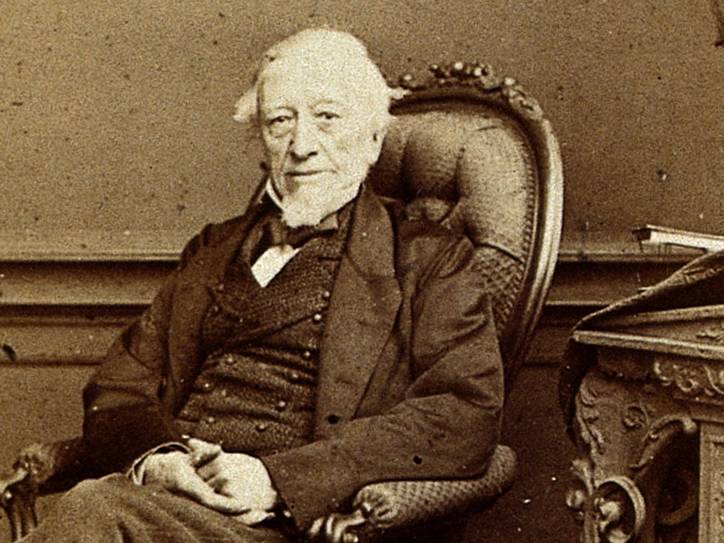
The Remarkable Roget's Thesaurus | Merriam-Webster
More than just a collection of related words—Peter Mark Roget intended his Thesaurus to be a classification of all knowledge
merriam-webster.com →Though nearly everyone is familiar with the Roget’s Thesaurus , few people know anything about Peter Mark Roget, the eminent 19th century physician, physiology expert, mathematician, inventor, writer, editor and chess whiz—and what motivated him to write his immortal book. Roget was obsessed with symmetry. The 1852 Thesaurus divvied 1,000 concepts into six Linnaean classifications. However, it was not until his retirement from science in 1848, at the age of 69, that Roget took on the challenge of finishing the Thesaurus . The still spry Roget worked nonstop for nearly four years to prepare the book for publication. He would continue to tinker with his masterpiece until his death at the age of ninety in 1869, having watched over the publication of some 28 editions. Borrowing the principles of zoological classification, Roget arranged all knowledge—not just words. Just as his hero, the 18th century naturalist Carl Linnaeus divided animals into six classes, Roget divvied up his 1000 concepts as follows: The first edition actually contains 1002 concepts, but Roget was a stickler for symmetry. Upon discovering that he had a couple too many, he numbered “Absence of Intellect” 450a and “Indiscrimination” 465a. The 1000 headings of the 1852 edition were arranged not alphabetically but according to where a given idea fit within Roget’s classification system. In that edition, the first entry is “Existence” (which falls under the first class, Abstract Relations). The purpose is to help readers find le mot juste for a given idea—say “being” or “reality” for existence. Since first rolling off the presses of London’s Longman, Brown, Green and Longmans in June 1852, Roget’s Thesaurus of English Words And Phrases has emerged as one of the most recognizable books in the English language. Roget’s has sold more than 40 million copies, and has become a proprietary eponym like Coke, Kleenex, or Google. Joshua Kendall is the author of The Man Who Made Lists: Love Death Madness and the Creation of Roget’s Thesaurus (Putnam, 2008). His latest book is First Dads: Parenting and Politics from George Washington to Barack Obama (2016). Spot the Misspelled Word July 2026 Those little red underlines can't help you now... Take the quiz
Excerpt from a page describing this subject · 10,618 chars · not written by Vinony
Wikidata facts
- Author
- Peter Mark Roget
Show 7 more facts
- language of work or name
- English language
- title
- Thesaurus of English Words
- inception
- 1805-00-00
- short name
- Roget’s Thesaurus
- copyright status
- public domain
- Commons category
- Roget's Thesaurus
- described at URL
- www.merriam-webster.com/words-at-play/rogets-thesaurus
Sources (2)
via Wikidata · CC0
Available in 13 languages
via Wikidata sitelinks · CC0