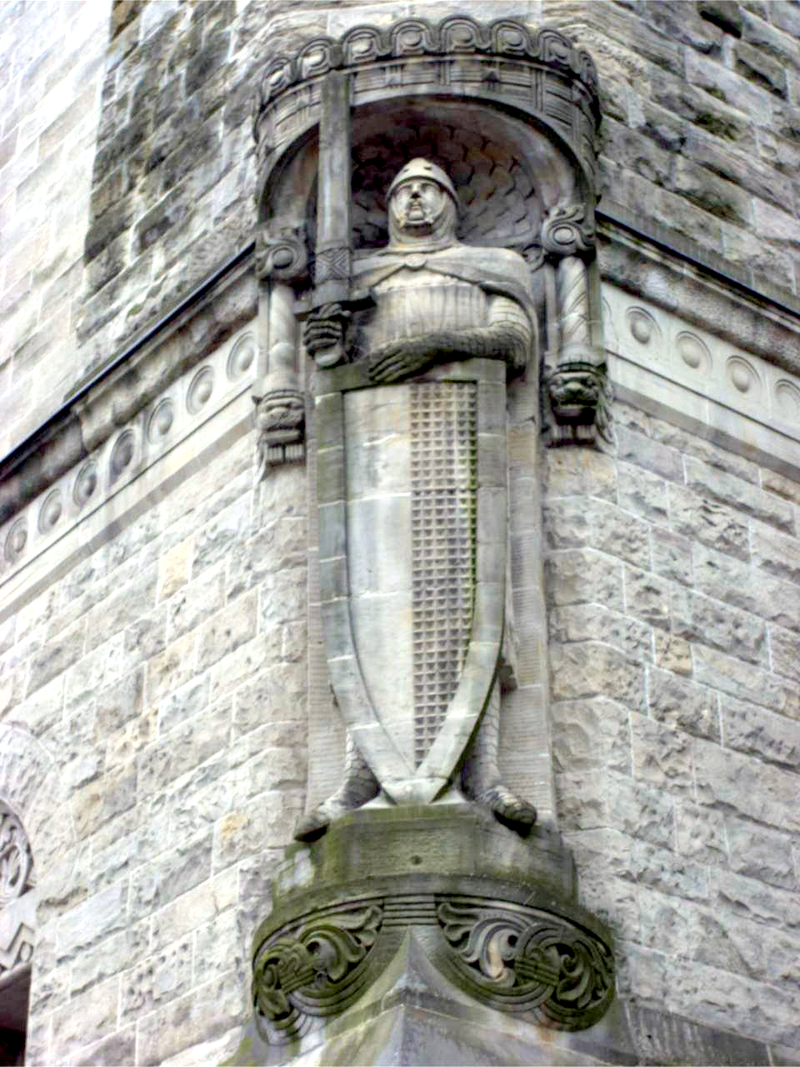
File:Gare_Metz_décor_16.png · Wikimedia Commons · See Wikimedia Commons
Roland
Sign in to saveAlso known as Roland the Valiant
Roland (; ; or Rotholandus; or Rolando; died 15 August 778) was a Frankish military leader under Charlemagne who became an epic hero and one of the principal figures in the literary cycle known as the Matter of France. The historical Roland was military governor of the Breton March, responsible for defending Francia's frontier against the Bretons. His only historical attestation is in Einhard's Vita Karoli Magni, which notes he was part of the Frankish rearguard killed in retribution by the Basques in Iberia at the Battle of Roncevaux Pass.
OverviewAI-generated
Roland was a male knight and count from Francia, born in 737 and died on August 15, 778, at the Roncevaux Pass. He is depicted as the owner of the sword Durendal and the horse Veillantif. The figure appears in the works *The Song of Roland* and *Orlando Furioso*. His significant person is identified as Oliver.
The name Roland is also associated with Roland Dorgelès, an author born in 1886 and died in 1973. Dorgelès wrote 105 works, including *Le Cabaret de la Belle Femme*, *Souvenirs sur les croix de bois*, *Sur la route mandarine*, *Bouquet de bohème*, and *Le dernier moussem*. Additionally, a musical artist named Roland from Germany performs schlager music.
Synthesized by Vinony from 35 facts across 7 sources: Wikidata, Open Library, Last.fm, Crossref, Wikiquote, MusicBrainz, Vinony graph. Generated from structured data (not the Wikipedia text) and checked against those facts — may still contain errors.
Key facts
- Military person.name
- Roland
- Military person.image
- Gare Metz décor 16.png
- Military person.caption
- A statue of Roland at Metz railway station, France
- Military person.native_name
- Hrōþiland
- Military person.native_name_lang
- frk
- Military person.death_date
- 15 August 778
- Military person.placeofburial
- Blaye
- Military person.allegiance
- Frankish
via Wikipedia infobox
Wikidata facts
- Instance of
- human
- Given name
- Roland
- Gender
- male
- Citizenship
- Francia
- Place of death
- Roncevaux Pass
- Occupation
- knight
- Noble title
- count
- Image
- HB 2016-0607 photo03 Bremer Roland.jpg
Show 9 more facts
- Commons category
- Roland
- topic's main category
- Category:Roland
- date of death
- 0778-08-15
- mount
- Veillantif
- present in work
- The Song of Roland
- owner of
- Veillantif
- on focus list of Wikimedia project
- Wikipedia:Vital articles/Level/4
- significant person
- Oliver
- date of birth
- 0737-00-00
via Wikidata · CC0
~10 min read
Encyclopedic overview
6 sectionsContents
- History
- Medieval icon
- Legacy
- References
- Sources
- External links
Roland (; ; or Rotholandus; or Rolando; died 15 August 778) was a Frankish military leader under Charlemagne who became an epic hero and one of the principal figures in the literary cycle known as the Matter of France. The historical Roland was military governor of the Breton March, responsible for defending Francia's frontier against the Bretons. His only historical attestation is in Einhard's Vita Karoli Magni, which notes he was part of the Frankish rearguard killed in retribution by the Basques in Iberia at the Battle of Roncevaux Pass.
The story of Roland's death at Roncevaux Pass was embellished in later medieval and Renaissance literature. The first and most famous of these epic treatments was the Old French Chanson de Roland of the 11th century.
Excerpted from Wikipedia’s “Roland” article, available under the CC BY-SA 4.0 licence.