
File:Rosetta_Stone.JPG · Wikimedia Commons · See Wikimedia Commons
Rosetta Stone
Sign in to saveancient Egyptian stele with inscriptions in three writing systems
OverviewAI-generated
The Rosetta Stone is an ancient artifact with an inception date of 196 BCE. It was discovered on July 15, 1799. The object has a height of 112.3, a width of 75.7, and a thickness of 28.4. Its horizontal depth is recorded as 284.
The stone is held in the collection of the British Museum, where it carries the inventory number EA24 and catalog code 33. A 3D model of the artifact is available from the museum. Digital resources include a 360-degree view and a description on Sketchfab. The work is also available at a URL on el.wikisource.org. The subject is referenced by 671 other encyclopedia articles.
Synthesized by Vinony from 18 facts across 3 sources: Wikidata, Firecrawl, Vinony graph. Generated from structured data (not the Wikipedia text) and checked against those facts — may still contain errors.
Described at
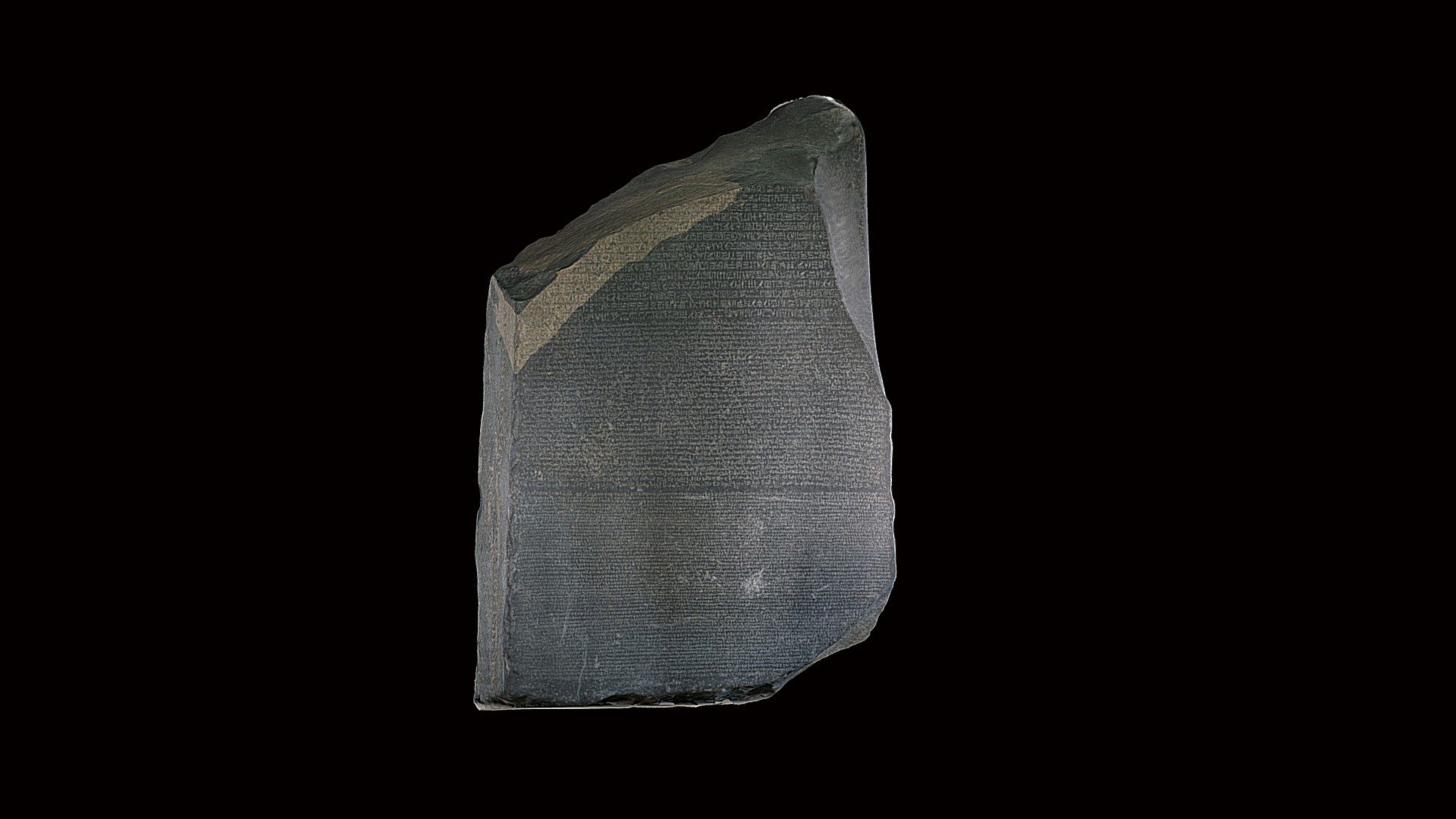
The Rosetta Stone - Download Free 3D model by The British Museum (@britishmuseum) [1e03509]
Part of grey and pink granodiorite stela bearing priestly decree concerning Ptolemy V in three blocks of text: Hieroglyphic (14 lines), Demotic (32 lines) and Greek (54 lines). The inscription is a decree passed by a council of priests, one of a series that affirm the royal cult of the 13 year-old Ptolemy V on the first anniversary of his coronation. © The Trustees of the British Museum. Shared under a Creative Commons Attribution-NonCommercial-ShareAlike 4.0 International (CC BY-NC-SA 4.0) licence. - The Rosetta Stone - Download Free 3D model by The British Museum (@britishmuseum)
sketchfab.com →Link to a page describing this subject · 17,514 chars · not written by Vinony
Wikidata facts
- Instance of
- stele
- Named after
- Rosetta
- Country
- Egypt
- Owned by
- British Museum
- Main subject
- Rosetta Stone decree
- Material used
- granodiorite
- Collection
- British Museum
- Location
- British Museum
- Image
- Rosetta Stone - front face - corrected image.jpg
- Height
- 112.3
- Width
- 75.7
Show 18 more facts
- Commons category
- Rosetta Stone
- work available at URL
- el.wikisource.org/wiki/Στήλη_της_Ροζέττας
- described at URL
- www.britishmuseum.org/collection/object/Y_EA24
- inventory number
- EA24
- writing system
- Greek alphabet
- discoverer or inventor
- Pierre-François Bouchard
- time of discovery or invention
- 1799-07-15
- inception
- 0196-00-00
- Commons gallery
- Rosetta Stone
- thickness
- 28.4
- time period
- Hellenistic period
- catalog code
- 33
- ground level 360 degree view URL
- goo.gl/maps/uMvT8f5CunYx2vto7
- horizontal depth
- 284
- location of discovery
- Fort Julien
- language of work or name
- Egyptian
- native label
- حجر لقاه عساكر
- commissioned by
- Ptolemy V Epiphanes
Sources (6)
via Wikidata · CC0
~40 min read
Encyclopedic overview
The Rosetta Stone is a stele of granodiorite inscribed with three versions of a decree issued in 196 BC during the Ptolemaic dynasty of Egypt, on behalf of King Ptolemy V Epiphanes. The top and middle texts are in Ancient Egyptian using hieroglyphic and Demotic scripts, respectively, while the bottom is in Ancient Greek. The decree has only minor differences across the three versions, making the Rosetta Stone key to deciphering the Egyptian scripts.
The stone was carved during the Hellenistic period and is believed to have originally been displayed within a temple, possibly at Sais. It was probably moved in late antiquity or during the Mamluk period, and was eventually used as building material in the construction of Fort Julien near the town of Rashid (Rosetta) in the Nile Delta. It was found there in July 1799 by French army officer Pierre-François Bouchard during France's invasion of Egypt. It was the first Ancient Egyptian bilingual text recovered in modern times, and it aroused widespread public interest with its potential to decipher this previously untranslated hieroglyphic script. Lithographic copies and plaster casts soon began circulating among European museums and scholars. When the British defeated the French, they took the stone to London under the terms of the Capitulation of Alexandria in 1801. Since 1802, it has been on public display at the British Museum almost continuously and it is the most visited object there.
Excerpted from Wikipedia’s “Rosetta Stone” article, available under the CC BY-SA 4.0 licence.
Gallery (12)
Available in 98 languages
- Español
- Français
- Deutsch
- 中文
- 日本語
- Русский
- Português
- Italiano
- العربية
- हिन्दी
- Afrikaans
- Armenian
- Asturian
- Azerbaijani
- Bahasa Indonesia
- Balinese
- Bangla
- Basque
Show 79 more
- Belarusian
- Bosnian
- Breton
- Bulgarian
- Burmese
- Catalan
- Central Kurdish
- Croatian
- Czech
- Danish
- dga
- Egyptian Arabic
- Esperanto
- Estonian
- Finnish
- Galician
- Georgian
- gpe
- Greek
- Hausa
- Hebrew
- Hungarian
- hyw
- Icelandic
- Ido
- Interlingua
- Irish
- Javanese
- Kannada
- Kurdish
- Latin
- Latvian
- Lithuanian
- Luxembourgish
- Macedonian
- Madurese
- Malagasy
- Malay
- Malayalam
- Maltese
- Mongolian
- Nederlands
- Norwegian
- Norwegian Nynorsk
- nrm
- Occitan
- Polski
- Punjabi
- Romanian
- Romansh
- Scots
- Serbian
- Serbian (Latin)
- Sicilian
- simple
- Sinhala
- Slovak
- Slovenian
- Somali
- Sundanese
- Svenska
- Swahili
- Tamil
- Tibetan
- Tiếng Việt
- Tswana
- Türkçe
- Tyap
- Ukrainian
- Urdu
- Uzbek
- Waray
- Welsh
- Western Frisian
- Wu Chinese
- zh_yue
- فارسی
- ไทย
- 한국어
via Wikidata sitelinks · CC0