Encyclopedia of Life · EOL (see source)
Rucervus
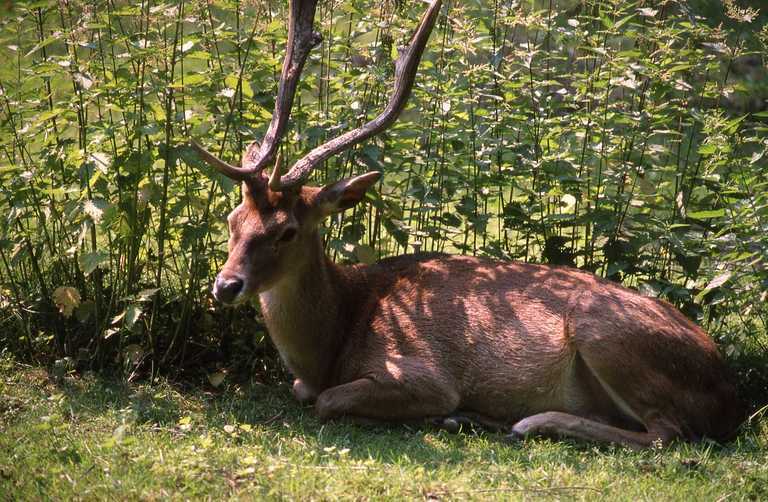
Sign in to saveRucervus is a genus of deer from India, Nepal, Indochina, and the Chinese island of Hainan. The only extant representatives, the barasingha or swamp deer (R. duvaucelii) and Eld's deer (R. eldii), are threatened by habitat loss and hunting; another species, Schomburgk’s deer (R. schomburgki), went extinct in 1938. Deer species found within the genus Rucervus are characterized by a specific antler structure, where the basal ramification is often supplemented with an additional small prong, and the middle tine is never present. The crown tines are inserted on the posterior side of the beam and m
Species
GENUS
- KingdomAnimalia
- PhylumChordata
- ClassMammalia
- OrderArtiodactyla
- FamilyCervidae
Die Barasinghas oder Zackenhirsche (Rucervus) sind eine in Indien lebende Gattung der Säugetiere aus der Familie der Hirsche (Cervidae). Sie werden manchmal auch als „Sumpfhirsche“ bezeichnet – dieser Name sollte allerdings dem südamerikanischen Sumpfhirsch (Blastocerus) vorbehalten sein, der mit den Barasinghas nicht näher verwandt ist. Die Bezeichnung Barasingha, ein Wort aus dem Hindi, bedeutet „zwölf Hörner“ und verweist auf das stark vereckte Geweih, das häufig zwölf, aber auch bis zu 14 Enden aufweist.
via GBIF
Museum specimens
- Specimen records
- 4
- Family
- Cervidae
- Collections
- NHMUK, MNHN
- Recorded in
- Myanmar, India
Wikidata facts
Show 4 more facts
- taxon rank
- genus
- taxon name
- Rucervus
- Commons category
- Rucervus
- topic's main category
- Category:Rucervus
Sources (1)
via Wikidata · CC0
~4 min read
Encyclopedic overview
6 sectionsContents
- Species
- Recent species
- Fossil species
- Paleontological record
- References
- External links
Rucervus is a genus of deer from India, Nepal, Indochina, and the Chinese island of Hainan. The only extant representatives, the barasingha or swamp deer (R. duvaucelii) and Eld's deer (R. eldii), are threatened by habitat loss and hunting; another species, Schomburgk’s deer (R. schomburgki), went extinct in 1938. Deer species found within the genus Rucervus are characterized by a specific antler structure, where the basal ramification is often supplemented with an additional small prong, and the middle tine is never present. The crown tines are inserted on the posterior side of the beam and may be bifurcated or fused into a small palmation.
==Species== ===Recent species===
Excerpted from Wikipedia’s “Rucervus” article, available under the CC BY-SA 4.0 licence.
Available in 25 languages
- Español
- Français
- Deutsch
- 中文
- 日本語
- Português
- Italiano
- Azerbaijani
- Bahasa Indonesia
- Catalan
- Cebuano
- Egyptian Arabic
- Hebrew
- Hungarian
- Kotava
- Malay
- Nederlands
- Northern Frisian
via Wikidata sitelinks · CC0