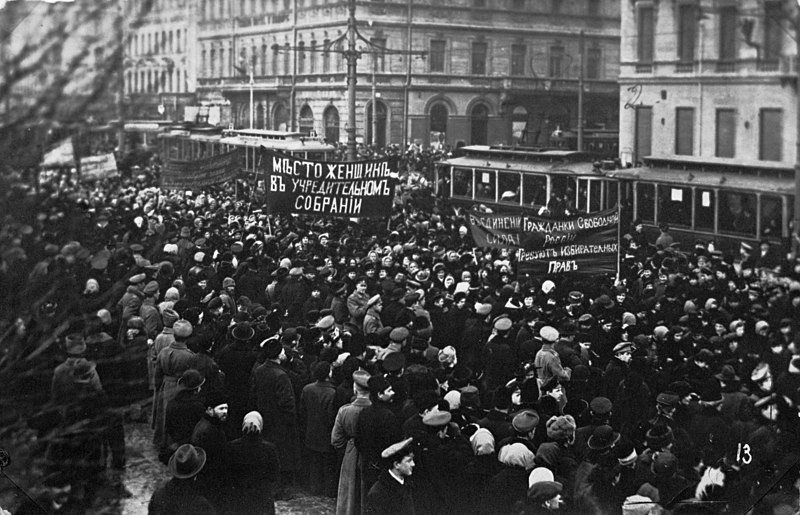
File:Митинг_на_Невском_проспекте_(1917).jpg · Wikimedia Commons · See Wikimedia Commons
Russian Revolution
Sign in to save1917-1922 political change in Russia
OverviewAI-generated
The Russian Revolution of 1917 is a subject described in the Treccani Encyclopedia. It is categorized under the Commons category "Russian Revolution of 1917" and has a corresponding gallery with that name. The event is associated with the point in time 1917.
Information about the revolution appears in several Treccani sources, including the "Enciclopedia dei ragazzi," the "Storia della civiltà europea a cura di Umberto Eco," and an article in the Treccani magazine atlas on geopolitics. The title of one source is "Rivoluzioni russe - Enciclopedia - Treccani." The subject is referenced by 7,153 other encyclopedia articles.
Synthesized by Vinony from 9 facts across 3 sources: Wikidata, Firecrawl, Vinony graph. Generated from structured data (not the Wikipedia text) and checked against those facts — may still contain errors.
Wikidata facts
- Instance of
- revolution
- Part of
- revolutions of 1917–1923
- Has part
- February Revolution
- Country
- Russian Empire
- Follows
- Russian Revolution of 1905
- Location
- Russian Empire
- Image
- Revolución-marzo-rusia--russianbolshevik00rossuoft.png
- Participant
- Socialist Revolutionary Party
Show 8 more facts
- Commons category
- Russian Revolution of 1917
- topic's main category
- Category:Russian Revolution
- Commons gallery
- Russian Revolution of 1917
- point in time
- 1917-00-00
- on focus list of Wikimedia project
- Wikipedia:Vital articles/Level/4
- topic has template
- Template:Russian Revolution
via Wikidata · CC0
~40 min read
Encyclopedic overview
The Russian Revolution was a period of political and social change in Russia, starting in 1917. This period saw Russia abolish its monarchy and adopt a socialist form of government following two successive revolutions and a civil war. It can be seen as the precursor for other revolutions that occurred in the aftermath of World War I, such as the German Revolution of 1918–1919. The Russian Revolution was a key event of the 20th century.
The Russian Revolution was inaugurated with the February Revolution in 1917, in the midst of World War I. With the German Empire inflicting defeats on the front, and increasing logistical problems causing shortages of bread and grain, the Russian Army was losing morale, with large scale mutiny looming. Officials were convinced that if Tsar Nicholas II abdicated, the unrest would subside. Nicholas stepped down on 15 March [O.S. 2 March], ushering in a provisional government led by the Duma (parliament). During the unrest, Soviet councils were formed by locals in Petrograd (now Saint Petersburg) that initially did not oppose the new government; however, the Soviets insisted on their influence in the government and control over militias. By March, Russia had two rival governments. The Provisional Government held state power in military and international affairs, whereas the network of Soviets held domestic power. Critically, the Soviets held the allegiance of the working class, and urban middle class. There were mutinies, protests and strikes. Socialist and other leftist political organizations competed for influence within the Provisional Government and Soviets. Factions included the Mensheviks, Socialist Revolutionaries, Anarchists, and the Bolsheviks, a far-left party led by Vladimir Lenin.
Excerpted from Wikipedia’s “Russian Revolution” article, available under the CC BY-SA 4.0 licence.
Gallery (12)
Available in 114 languages
- Español
- Français
- Deutsch
- 中文
- 日本語
- Русский
- Português
- Italiano
- العربية
- हिन्दी
- Afrikaans
- Albanian
- Albanian
- Angika
- Aragonese
- Armenian
- Assamese
- Asturian
Show 95 more
- Azerbaijani
- Bahasa Indonesia
- Bangla
- Bashkir
- Basque
- bat_smg
- be_x_old
- Belarusian
- Bosnian
- Breton
- Bulgarian
- Catalan
- Central Kurdish
- Cornish
- Croatian
- Czech
- Danish
- Egyptian Arabic
- Esperanto
- Estonian
- Extremaduran
- Faroese
- Fiji Hindi
- Filipino
- Finnish
- Friulian
- Galician
- Georgian
- Greek
- Guarani
- Haitian Creole
- Hebrew
- Hungarian
- Icelandic
- Ido
- Iloko
- Irish
- Javanese
- Kannada
- kbp
- Lao
- Latin
- Latvian
- Lithuanian
- Lombard
- Low German
- Macedonian
- Malay
- Malayalam
- Maltese
- Marathi
- Minangkabau
- Mingrelian
- Mirandese
- Moroccan Arabic
- Nederlands
- Norwegian
- Norwegian Nynorsk
- Occitan
- Papiamento
- Pashto
- Piedmontese
- Polski
- Punjabi
- Romanian
- Sardinian
- Serbian
- Serbian (Latin)
- Sicilian
- simple
- Sindhi
- Sinhala
- Slovak
- Slovenian
- Svenska
- Swahili
- Tamil
- Tatar
- Tiếng Việt
- Türkçe
- Ukrainian
- Urdu
- Uzbek
- Veps
- Waray
- Welsh
- Western Frisian
- Western Panjabi
- Wu Chinese
- Yiddish
- zh_min_nan
- zh_yue
- فارسی
- ไทย
- 한국어
via Wikidata sitelinks · CC0