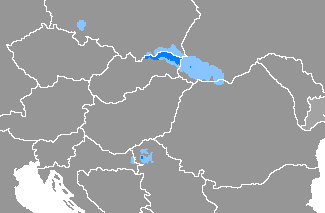
File:Idioma_rusino.PNG · Wikimedia Commons · See Wikimedia Commons
Rusyn
Sign in to saveAlso known as Rusin language, Rusnak language, Carpatho-Ruthene language, Carpatho-Ruthenian language, Rusyn language, Rusin, Rusnak, Carpatho-Ruthene
East Slavic language spoken by Carpathian Rusyns, Lemkos, Boykos, and Hutsuls
Rusyn is an East Slavic language spoken by several ethnic groups—including Carpathian Rusyns, Lemkos, Boykos, and Hutsuls—primarily in the Carpathian Mountain region. It matters because it represents a distinct linguistic and cultural identity for these communities, though it remains relatively unknown outside its native areas.
AI-generated from the Wikipedia summary — may contain errors.
Wikidata facts
- Instance of
- modern language
- Subclass of
- East Slavic
- Country
- Romania
- Follows
- Ruthenian
Show 13 more facts
- Commons category
- Rusyn language
- writing system
- Cyrillic script
- on focus list of Wikimedia project
- WikiProject Ukraine
- name
- Ruthenisch
- Wikimedia language code
- rue
- native label
- русиньскый язык
- number of speakers, writers, or signers
- 610000
- different from
- Pannonian Rusyn
- topic's main category
- Category:Rusyn language
- female form of label
- la langue rusyn
- linguistic typology
- fusional language
- indigenous to
- Zakarpattia Oblast
via Wikidata · CC0
~33 min read
Encyclopedic overview
Rusyn (/ˈruːsɪn/ ROO-sin; Carpathian Rusyn: русиньскый язык, romanized: rusîn'skyj jazyk; Pannonian Rusyn: руски язик, romanized: ruski jazik) is an East Slavic language spoken by Rusyns in parts of Central and Eastern Europe, and written in the Cyrillic script. The majority of speakers live in Carpathian Ruthenia, which includes Transcarpathia and parts of eastern Slovakia and south-eastern Poland. There is also a sizeable Pannonian Rusyn linguistic island in Vojvodina, Serbia, and a Rusyn diaspora worldwide. Under the European Charter for Regional or Minority Languages, it is recognized as a protected minority language by Bosnia and Herzegovina, Croatia, Czech Republic, Hungary, Romania, Poland (as Lemko), Serbia, and Slovakia.
The categorization of Rusyn as a language or dialect is a source of controversy. Czech, Slovak, and Hungarian, as well as American and some Polish and Serbian linguists treat it as a distinct language (with its own ISO 639-3 code), whereas other scholars (in Ukraine, Poland, Serbia, and Romania) treat it as a dialect of Ukrainian.
Excerpted from Wikipedia’s “Rusyn” article, available under the CC BY-SA 4.0 licence.
Gallery (5)
Available in 90 languages
- Español
- Français
- Deutsch
- 中文
- 日本語
- Русский
- Português
- Italiano
- العربية
- Afrikaans
- Asturian
- azb
- Azerbaijani
- Bahasa Indonesia
- Basque
- bat_smg
- be_x_old
- Belarusian
Show 71 more
- Bosnian
- Bulgarian
- Catalan
- Chuvash
- Corsican
- Crimean Tatar
- Croatian
- Czech
- Danish
- Egyptian Arabic
- Esperanto
- Estonian
- Finnish
- fiu_vro
- Gagauz
- Galician
- Georgian
- Greek
- Hakka Chinese
- Hausa
- Hebrew
- Hungarian
- Kabyle
- Kashubian
- Komi
- Kotava
- Latin
- Latvian
- Ligurian
- Limburgish
- Lithuanian
- Lombard
- Lower Sorbian
- Luxembourgish
- Macedonian
- Malagasy
- Mirandese
- Nederlands
- Northern Frisian
- Norwegian
- Norwegian Nynorsk
- Occitan
- Ossetic
- Piedmontese
- Polski
- Romanian
- rsk
- Rusyn
- Santali
- Sardinian
- Scots
- Serbian
- Silesian
- simple
- Slovak
- Slovenian
- Svenska
- Tatar
- Tiếng Việt
- Türkçe
- Udmurt
- Ukrainian
- Upper Sorbian
- Volapük
- Western Frisian
- wikifunctions
- Wu Chinese
- zh_yue
- فارسی
- ไทย
- 한국어
via Wikidata sitelinks · CC0