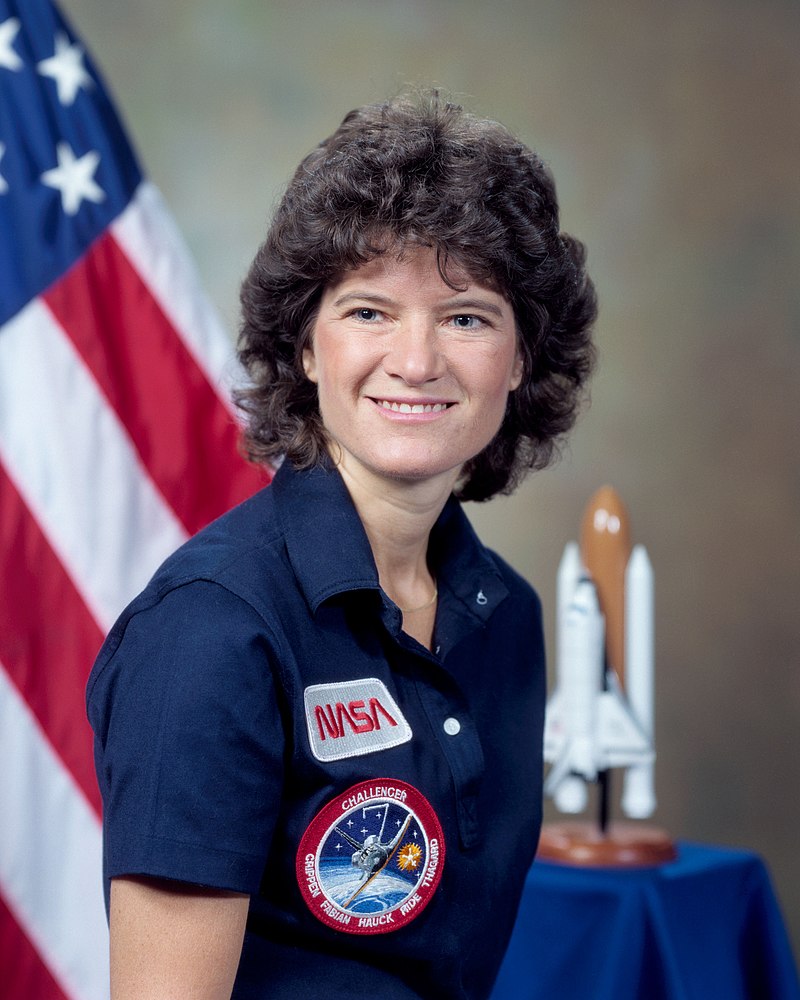
File:Sally_Ride_(1984).jpg · Wikimedia Commons · See Wikimedia Commons
Sally Ride
Sign in to saveAlso known as Dr Sally Kristen Ride, Sally Ride- Hawley, Sally K. Ride
American astronaut and physicist (1951–2012)
Sally Ride was an American astronaut and physicist who became the first American woman in space when she flew on the Space Shuttle Challenger in 1983. Her groundbreaking achievement helped open the space program to women and demonstrated that qualified female astronauts could perform at the highest levels of spaceflight.
AI-generated from the Wikipedia summary — may contain errors.
Person · Open Library
- Works
- 20
Top works
- Prentice Hall Literature--Timeless Voices, Timeless Themes--Gold Level
- Prentice Hall Literature
- Prentice Hall Literature--Timeless Voices, Timeless Themes--Gold
- Prentice Hall Literature -- Gold
- Complete Book of Bone Health
via Open Library + Wikidata
Wikidata facts
- Instance of
- human
- Part of
- Rogers Commission
- Given name
- Sally
- Gender
- female
- Citizenship
- United States
- Place of birth
- Los Angeles
- Place of death
- La Jolla
- Spouse
- Steven Hawley
- Occupation
- children's writer
- Educated at
- Stanford University
- Employer
- NASA
- Languages spoken
- English language
- Academic degree
- doctorate
- Image
- Sally Ride (1984).jpg
Show 12 more facts
- place of burial
- Woodlawn Memorial Cemetery
- Commons category
- Sally Ride
- cause of death
- pancreatic cancer
- date of birth
- 1951-05-26
- date of death
- 2012-07-23
- unmarried partner
- Tam O'Shaughnessy
- manner of death
- natural causes
- described at URL
- www.jsc.nasa.gov/Bios/htmlbios/ride-sk.html
- time in space
- 20626
- name in native language
- Sally Elizabeth Ride Gómez
- member of the crew of
- STS-41-G
- P450
- STS-41-G
Sources (7)
via Wikidata · CC0
~35 min read
Encyclopedic overview
Sally Kristen Ride (May 26, 1951–July 23, 2012) was an American astronaut and physicist. Born in Southern California, she joined NASA in 1978, and in 1983, became the first American woman and the third woman to fly in space, after cosmonauts Valentina Tereshkova in 1963 and Svetlana Savitskaya in 1982. She was the youngest American astronaut to have flown in space, having done so at the age of 32.
Ride was a graduate of Stanford University, where she earned a Bachelor of Science degree in physics and a Bachelor of Arts degree in English literature in 1973, a Master of Science degree in 1975, and a Doctor of Philosophy in 1978 (both in physics) for research on the interaction of X-rays with the interstellar medium. She was selected as a mission specialist astronaut with NASA Astronaut Group 8, the first class of NASA astronauts to include women. After completing her training in 1979, she served as the ground-based capsule communicator (CapCom) for the second and third Space Shuttle flights, and helped develop the Space Shuttle's robotic arm. In June 1983, she flew in space on the Space Shuttle Challenger on the STS-7 mission. The mission deployed two communications satellites and the first Shuttle pallet satellite (SPAS-1). Ride operated the robotic arm to deploy and retrieve SPAS-1. Her second space flight was the STS-41-G mission in 1984, also on board Challenger. She spent a total of more than 343 hours in space. She left NASA in 1987.
Excerpted from Wikipedia’s “Sally Ride” article, available under the CC BY-SA 4.0 licence.
Gallery (7)
Available in 75 languages
- Español
- Français
- Deutsch
- 中文
- 日本語
- Русский
- Português
- Italiano
- العربية
- हिन्दी
- Albanian
- Aragonese
- Armenian
- Asturian
- azb
- Bahasa Indonesia
- Bangla
- Basque
Show 56 more
- Belarusian
- Breton
- Bulgarian
- Catalan
- Croatian
- Czech
- Danish
- Egyptian Arabic
- Esperanto
- Estonian
- Filipino
- Finnish
- Galician
- Georgian
- Greek
- Hausa
- Hebrew
- Hungarian
- Icelandic
- Irish
- Javanese
- Kannada
- Kazakh
- Latin
- Latvian
- Lingua Franca Nova
- Low German
- Madurese
- Malagasy
- Malay
- Malayalam
- Marathi
- Mingrelian
- Nederlands
- Norwegian
- Norwegian Nynorsk
- Odia
- Pampanga
- Pashto
- Polski
- ppl
- Serbian
- simple
- Slovak
- Slovenian
- Svenska
- Tamil
- Telugu
- Tiếng Việt
- Türkçe
- Ukrainian
- Uzbek
- Welsh
- Wu Chinese
- فارسی
- 한국어
via Wikidata sitelinks · CC0