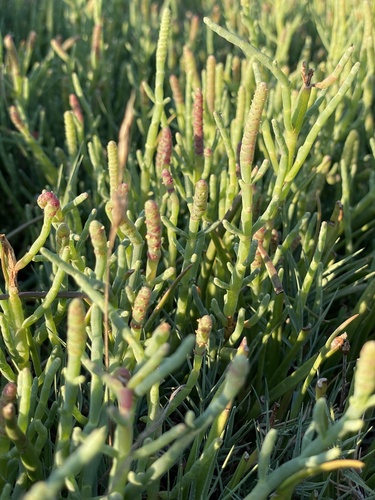
(c) Angelica Save, some rights reserved (CC BY-NC), uploaded by Angelica Save · cc-by-nc
Sarcocornia
Sign in to saveSarcocornia is a formerly recognized genus of flowering plants in the amaranth family, Amaranthaceae. Species are known commonly as samphires, glassworts, or saltworts. Molecular phylogenetic studies have shown that when separated from Salicornia, the genus is paraphyletic, since Salicornia is embedded within it, and Sarcocornia has now been merged into a more broadly circumscribed Salicornia. When separated from Salicornia, the genus has a cosmopolitan distribution, and is most diverse in the Cape Floristic Region of South Africa.
Species
Pacific Glasswort
GENUS
- KingdomPlantae
- PhylumTracheophyta
- ClassMagnoliopsida
- OrderCaryophyllales
- FamilyAmaranthaceae
via GBIF · Kew POWO
Museum specimens
- Specimen records
- 26
- With media
- 5
- Family
- Amaranthaceae
- Collections
- MO, OSU, PSM, BRY, MICH, MEL
- Recorded in
- Paraguay, United States, Chile, Argentina, France, Brasil
Wikidata facts
- Instance of
- taxon
- Image
- Arthrocnemum-perenne01.jpg
Show 7 more facts
- Commons category
- Sarcocornia
- taxon name
- Sarcocornia
- taxon rank
- genus
- topic's main category
- Category:Sarcocornia
- taxonomic type
- Sarcocornia perennis
- taxon common name
- členjača
Sources (1)
via Wikidata · CC0
~6 min read
Encyclopedic overview
5 sectionsContents
- Description
- Taxonomy
- Selected former species
- References
- External links
Sarcocornia is a formerly recognized genus of flowering plants in the amaranth family, Amaranthaceae. Species are known commonly as samphires, glassworts, or saltworts. Molecular phylogenetic studies have shown that when separated from Salicornia, the genus is paraphyletic, since Salicornia is embedded within it, and Sarcocornia has now been merged into a more broadly circumscribed Salicornia. When separated from Salicornia, the genus has a cosmopolitan distribution, and is most diverse in the Cape Floristic Region of South Africa.
== Description == Species formerly placed in Sarcocornia are perennial herbs, subshrubs or shrubs. They are taking an erect or prostrate, creeping form. The new stems are fleshy and divided into joint-like segments. Older stems are woody and not segmented. The oppositely arranged leaves are borne on fleshy, knobby petioles, their base decurrent and connate (thus forming the segments), the blades forming small, triangular tips with narrow scarious margin. thumb|Inflorescences of Salicornia pacifica, formerly Sarcocornia pacifica The terminal or lateral inflorescences are spike-like, made up of joint-like segments with tiny paired cymes emerging from the joints. Each cyme consists of three (rarely five) flowers completely embedded between the bract and immersed in the fleshy tissue of the axis. The flowers of a cyme are arranged in a transverse row, the central flower separating the lateral flowers, with tissue of the axis between them. The hermaphrodite or unisexual flowers are more or less radially symmetric, with a perianth of three or four fleshy tepals connate nearly to the apex, one or two stamens, and an ovary with two or three stigmas.
Excerpted from Wikipedia’s “Sarcocornia” article, available under the CC BY-SA 4.0 licence.