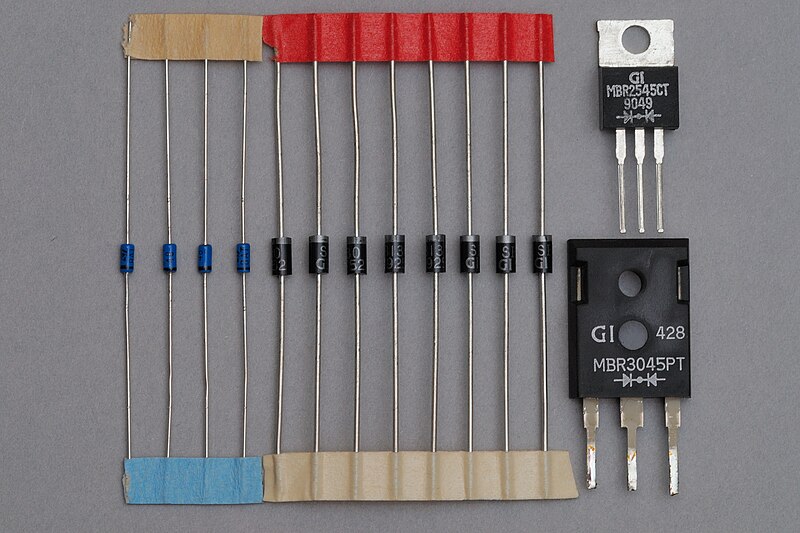
File:Schottky.jpg · Wikimedia Commons · See Wikimedia Commons
Schottky diode
Sign in to saveAlso known as Schottky barrier diode, hot-carrier diode
diode with a low forward voltage drop, formed by a semiconductor–metal junction
Key facts
- Component type
- Passive
- Inventor
- Walter H. Schottky
- Pin names
- anode and cathode
via Wikipedia infobox
Wikidata facts
- Subclass of
- semiconductor diode
- Part of
- Schottky transistor
- Has part
- metal–semiconductor junction
- Named after
- Walter H. Schottky
- Image
- Schottky.jpg
Show 4 more facts
- Commons category
- Schottky diodes
- uses
- Schottky barrier
- inception
- 1938-00-00
- different from
- Shockley diode
via Wikidata · CC0
~15 min read
Encyclopedic overview
The Schottky diode (named after the German physicist Walter H. Schottky), also known as Schottky barrier diode or hot-carrier diode, is a semiconductor diode formed by the junction of a semiconductor with a metal. It has a low forward voltage drop and a very fast switching action. The cat's-whisker detectors used in the early days of wireless and metal rectifiers used in early power applications can be considered primitive Schottky diodes.
When sufficient forward voltage is applied, a current flows in the forward direction. A silicon p–n diode has a typical forward voltage of 600–700 mV, while the Schottky's forward voltage is 150–450 mV. This lower forward voltage requirement allows higher switching speeds and better system efficiency.
Excerpted from Wikipedia’s “Schottky diode” article, available under the CC BY-SA 4.0 licence.